
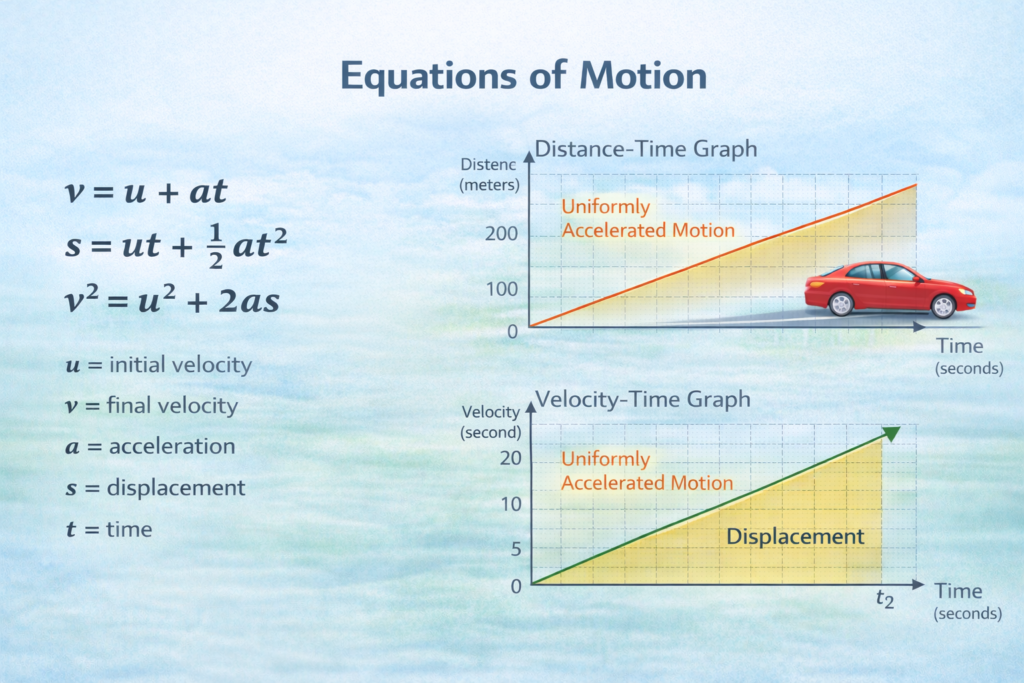
Equations of motion provide mathematical relationships between displacement, velocity, acceleration, and time. This guide introduces important formulas, graphical meaning, and real-life applications to help students solve physics problems effectively.
What are Equations of Motion?
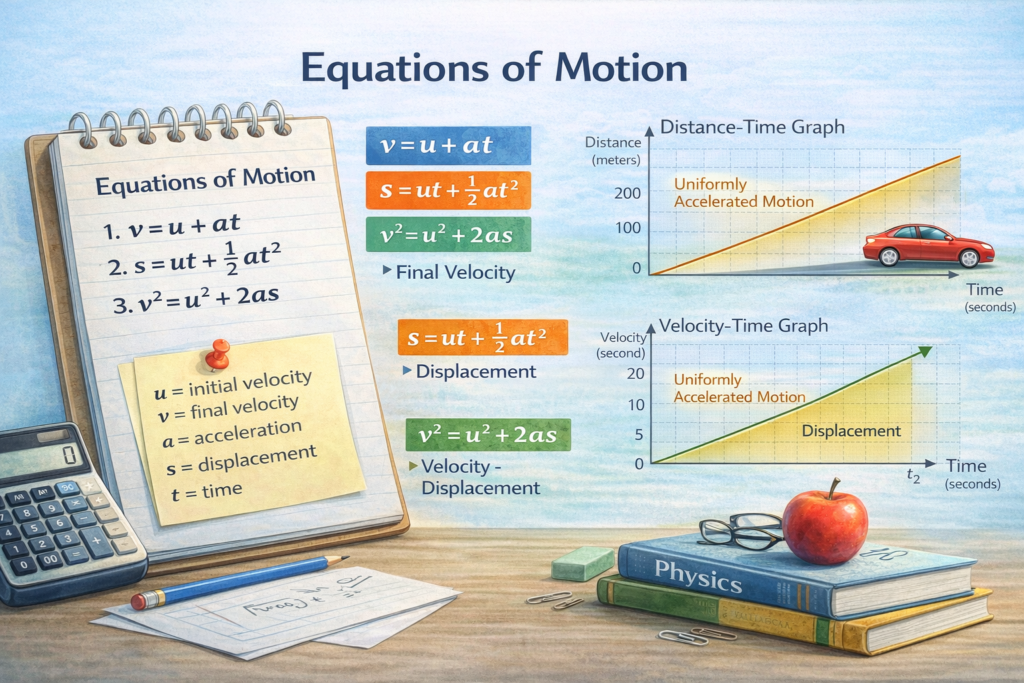
Equations of motion are mathematical formulas used to describe the relationship between displacement, velocity, acceleration, and time when an object moves with uniform acceleration. These equations help students predict how an object behaves during motion without drawing graphs every time.
In physics, equations of motion are mainly used when acceleration remains constant. By understanding equations of motion, students can solve numerical problems related to speed changes, distance travelled, and time taken during movement.
👉 Back to: Complete Guide to Motion in Physics.
The Three Equations of Motion
There are three important Motion Formulas used in basic physics. Each equation connects different motion variables.
First Equation
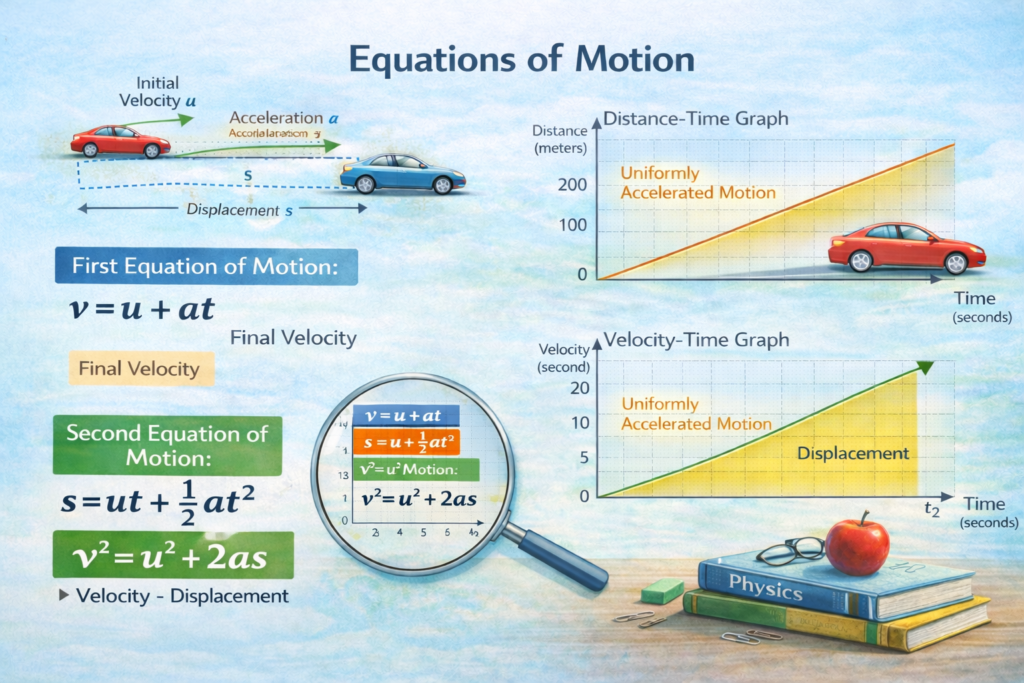
v = u + at
Where:
- v = final velocity
- u = initial velocity
- a = acceleration
- t = time
This equation shows how velocity changes when acceleration acts over time.
Second Equation
s = ut + ½at²
Where:
- s = displacement
- u = initial velocity
- a = acceleration
- t = time
This formula helps calculate how far an object travels during motion.
Third Equation
v² = u² + 2as
This equation connects velocity, acceleration, and displacement without involving time directly.
Learning these three equations of motion makes solving physics problems much easier.
Importance of Motion Formulas
These are essential because they allow students to analyse movement mathematically. Instead of only describing motion with words, these formulas provide precise answers.
They are widely used in:
- Engineering calculations
- Vehicle motion analysis
- Space science and rocket launches
- Sports physics
Understanding equations of motion helps learners move from basic concepts to advanced mechanics.
Conditions for Using Motion Formulas
Students must remember that these equations work only under specific conditions:
- Acceleration must remain constant.
- Motion should be along a straight line.
- Units must be consistent.
Ignoring these conditions often leads to incorrect answers.
Graphical Meaning of Motion Formulas
Equations of motion are closely connected to motion graphs:
- The first equation relates to velocity-time graphs.
- The second equation relates to displacement from area under the graph.
- The third equation connects velocity and displacement directly.
Understanding graphs alongside equations makes physics easier and more visual.
Real-Life Examples of Equations of Motion
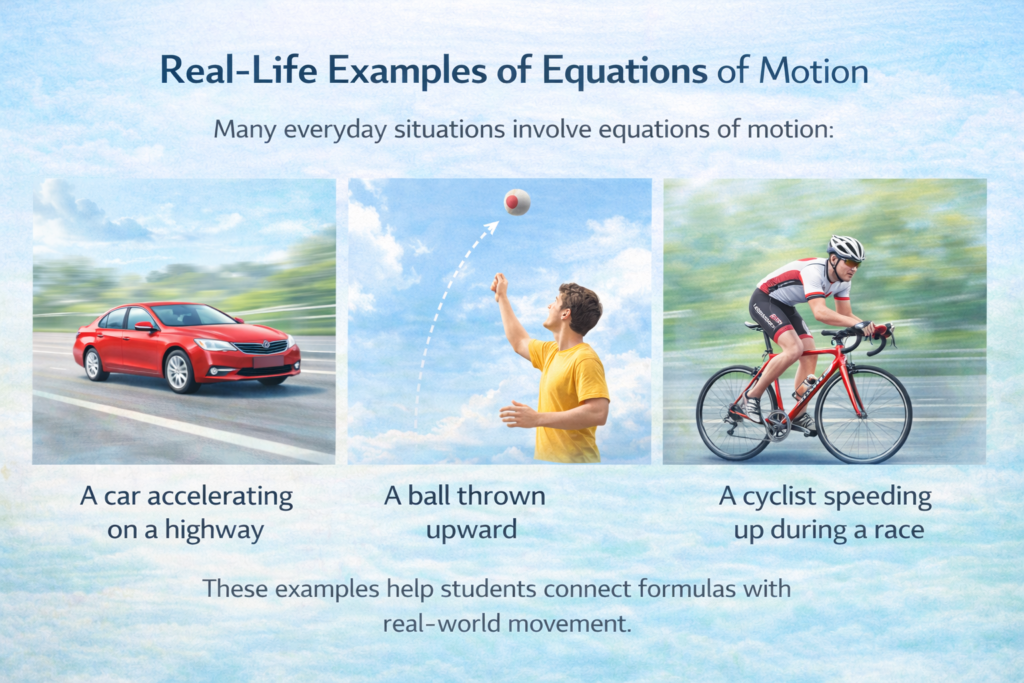
Many everyday situations involve equations of motion:
- A car accelerating on a highway
- A ball thrown upward
- A cyclist speeding up during a race
These examples help students connect formulas with real-world movement.
Common Mistakes Students Make
While learning equations of motion, beginners often:
- Forget to convert units into SI units
- Use equations when acceleration is not constant
- Confuse initial velocity with final velocity
Avoiding these mistakes improves accuracy in problem-solving.
Conclusion
Equations of motion provide a powerful mathematical way to understand how objects move under constant acceleration. By learning these formulas and their applications, students can analyse motion more effectively and solve physics problems with confidence.
Motion Formulas also help students connect theoretical physics with practical experiments. By analysing motion using these formulas, learners can predict how objects will behave before performing real experiments. This improves scientific thinking and makes solving numerical problems faster and more accurate in classroom situations.
FAQs
1. What are Motion Formulas?
They are formulas that describe the relationship between displacement, velocity, acceleration, and time.
2. How many Motion Formulas are there?
There are three main equations used for uniformly accelerated motion.
3. When can we use equations of motion?
They are used when acceleration is constant.
4. Why are equations of motion important?
They help calculate motion variables accurately and simplify physics problems.
🌐 Connect With Us
👉 Informosio Official – General updates, current affairs, and informative content
👉 Continue your physics journey with our expert guides — visit our official website to explore more motion topics and student-friendly lessons.