
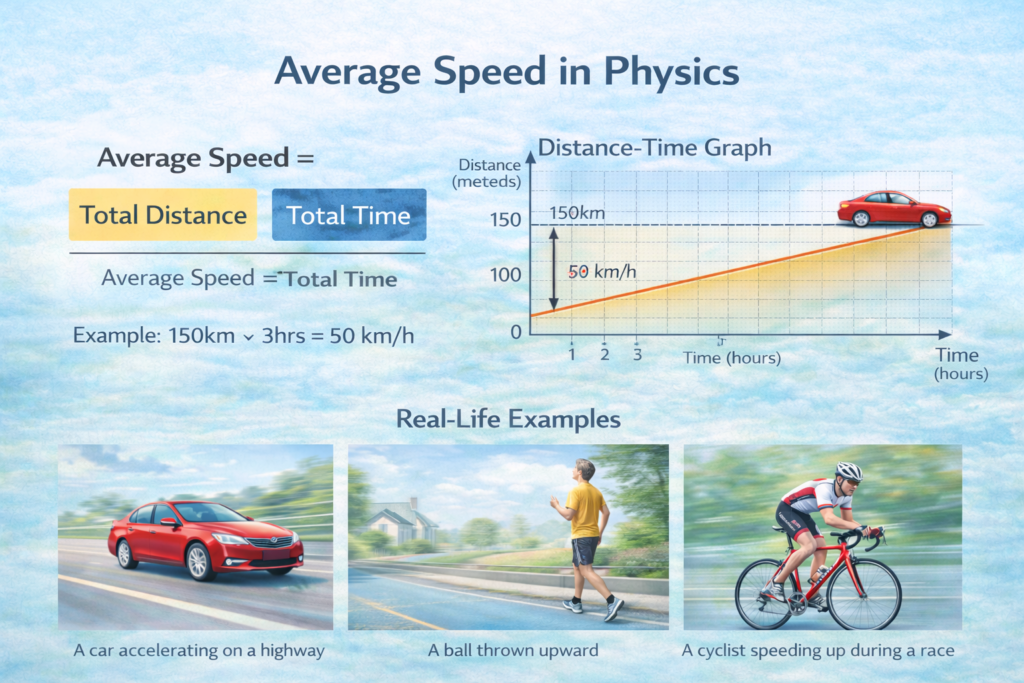
Average speed in physics describes overall motion by comparing total distance with total time. In this lesson, students will learn formulas, graphs, and real-life examples that make motion calculations simple and clear.
What is Average Speed in Physics?
Average speed in physics describes the total distance travelled by an object divided by the total time taken during motion. Unlike instantaneous speed, which measures speed at a specific moment, average speed gives an overall idea of how fast an object moves over an entire journey.
For example, if a car travels 100 kilometers in 2 hours, its average speed is 50 km/h. Even if the car speeds up or slows down during the journey, the average speed represents the overall rate of motion. Understanding average speed in physics helps students analyse real-life movement more clearly.
👉 Back to: Complete Guide to Motion in Physics.
Formula for Average Speed
The formula used to calculate average speed is simple:
Average Speed = Total Distance ÷ Total Time
This formula helps students determine how fast an object moves on average, even when its speed changes throughout the journey.
For instance, if a cyclist covers 30 meters in 5 seconds, the average speed equals 6 m/s. Practicing this formula improves problem-solving skills and builds confidence in motion calculations.
Difference Between Speed and Average Speed
Many beginners confuse speed with average speed, but they represent different ideas:
- Speed describes how fast an object moves at a specific moment.
- Average speed describes overall motion during a time interval.
A car moving through traffic may accelerate and decelerate many times. Even though its instantaneous speed changes, the average speed summarises the entire journey.
Understanding this difference helps students interpret motion more accurately.
Average Speed and Distance
Average speed depends directly on the total distance travelled. This means students must calculate the complete path covered rather than just the straight-line change in position.
For example, a runner completing a circular track covers a certain distance even if they return to the starting point. The total distance remains important for calculating average speed.
SI Unit of Average Speed
The SI unit of average speed is meter per second (m/s). However, in daily life, people often use kilometers per hour (km/h) when discussing vehicle movement.
Using proper units ensures consistency in physics calculations and helps students avoid common mistakes during exams.
Real-Life Examples of Average Speed
Average speed appears in many everyday situations:
- A train travelling between cities
- A person walking to school
- A car completing a road trip
These examples help students relate physics concepts to real-world experiences. By observing daily activities, learners understand how average speed describes overall movement.
Graphical Representation of Average Speed
Average speed can also be understood using distance-time graphs. In such graphs:
- The slope of the line represents speed.
- A steeper slope indicates faster movement.
- A flatter slope indicates slower motion.
Graphs help students visualise motion patterns and compare different journeys easily.
Importance of Average Speed in Physics
Learning average speed in physics helps students:
- Compare different types of motion
- Analyse journeys with changing speeds
- Solve numerical problems quickly
Scientists and engineers use average speed to analyse transportation systems, design vehicles, and study motion patterns.
Common Mistakes Students Make
While learning average speed, beginners often:
- Use displacement instead of total distance
- Forget to convert units
- Ignore total time during calculations
Avoiding these mistakes improves accuracy and strengthens understanding.
Conclusion
Average speed in physics provides a simple way to understand overall motion during a journey. By learning formulas, units, graphs, and real-life examples, students develop a strong foundation for studying motion concepts. Mastering average speed makes it easier to analyse real-world movement and solve physics problems confidently.
FAQs About Average Speed in Physics
1. What is average speed in physics?
Average speed is the total distance travelled divided by the total time taken.
2. What is the SI unit of average speed?
The SI unit is meter per second (m/s).
3. Why is average speed important?
It helps describe overall motion when speed changes during a journey.
4. Is average speed always constant?
No, it only represents the overall rate, not moment-to-moment changes.
🌐 Connect With Us
👉 Informosio Official – General updates, current affairs, and informative content
👉 Continue your physics journey with our expert guides — visit our official website to explore more motion topics and student-friendly lessons.