
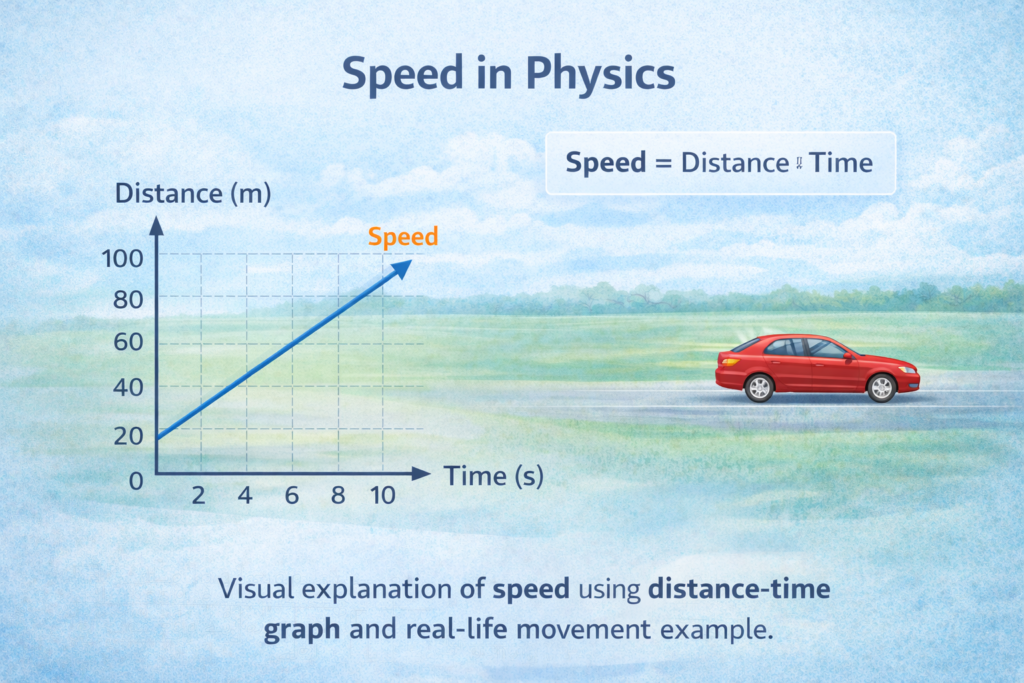
Speed in physics describes how fast an object moves over time. This guide covers formulas, graphical representation, and everyday examples to help students understand motion in a clear and practical way.
What is Speed in Physics?
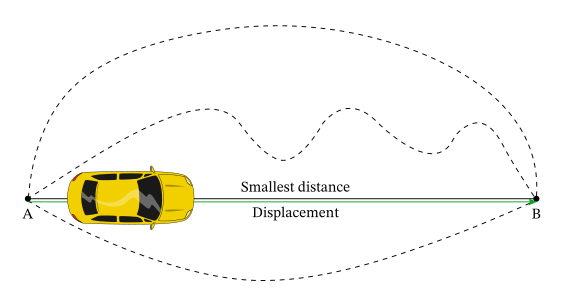
Speed in physics describes how fast an object moves over a certain distance within a given time. It is a scalar quantity, meaning it has magnitude but no direction. Understanding speed helps students analyse everyday movement, from walking and running to vehicles travelling on highways.
For example, if a car travels 60 kilometers in one hour, its speed is 60 km/h. This simple idea allows learners to compare different types of motion and understand how quickly objects change their position. Learning speed in physics builds a strong foundation for advanced concepts such as velocity and acceleration.
👉 Back to: Complete Guide to Motion in Physics.
Formula for Speed
The basic formula used to calculate speed is:
Speed = Distance ÷ Time
This formula shows that speed depends on how far an object travels and how long it takes to cover that distance. Students often use this relationship to solve numerical problems and compare different scenarios.
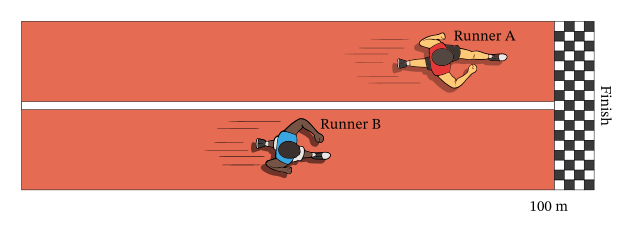
For instance, if a runner covers 100 meters in 10 seconds, the speed equals 10 meters per second. Practicing these calculations improves understanding and prepares learners for more advanced physics topics.
Types of Speed
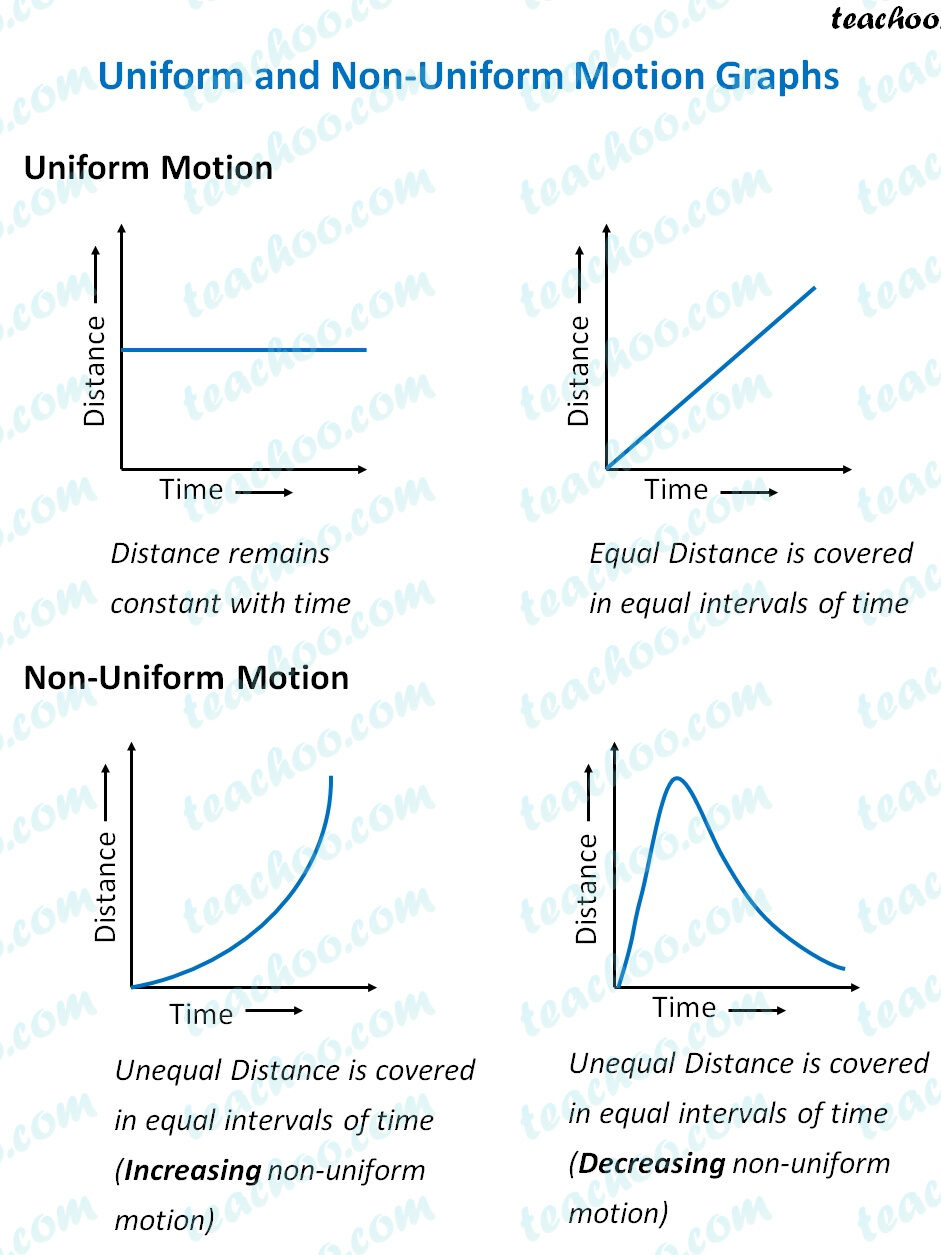
Speed can appear in different forms depending on how movement occurs:
Uniform Speed
Uniform speed happens when an object covers equal distances in equal time intervals. A car travelling at a constant rate on a straight road is a common example.
Non-Uniform Speed
Non-uniform speed occurs when an object changes its rate of movement over time. For example, a bus slowing down near a traffic signal demonstrates non-uniform speed.
Recognising these types helps students understand real-life movement more clearly.
SI Unit of Speed
The SI unit of speed is meter per second (m/s). However, in daily life, people often use kilometers per hour (km/h) to describe vehicle movement. Using standard units ensures that measurements remain consistent across experiments and calculations.
Understanding units also helps students convert between different measurement systems, which is an important skill in physics.
Speed vs Velocity
Many beginners think speed and velocity are the same, but they are different concepts. Speed measures only how fast an object moves, while velocity includes both speed and direction. For example, two cars moving at the same speed in opposite directions have equal speed but different velocities.
Learning the difference between speed and velocity helps students interpret graphs, understand displacement, and solve motion problems more accurately.
Graphical Representation of Speed
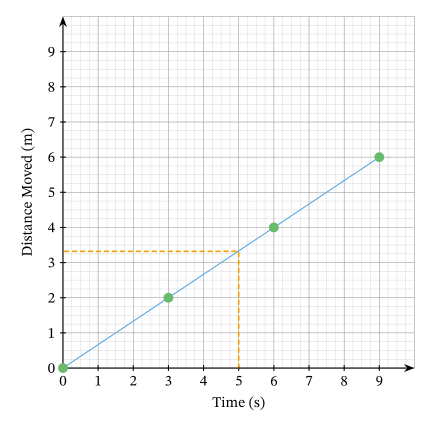
Speed can be represented visually using graphs such as distance-time graphs. In these graphs:
- A straight line indicates constant speed.
- A steeper line represents faster movement.
- A curved line shows changing speed.
Graphs make it easier for students to understand motion patterns without performing long calculations.
Real-Life Examples of Speed
Speed appears everywhere in daily life:
- A cyclist moving through a park
- A train travelling between cities
- A football player running across a field
These examples help students connect theoretical ideas with real experiences, making learning more engaging and practical.
Common Mistakes Students Make
While learning speed, beginners often:
- Confuse speed with velocity
- Forget to include units in answers
- Use incorrect formulas during calculations
Avoiding these mistakes improves problem-solving skills and builds confidence in physics.
Conclusion
Speed in physics helps describe how fast objects move over time. By understanding formulas, units, and graphical representation, students develop a strong foundation for studying velocity and acceleration. Mastering speed makes it easier to analyse motion and interpret real-world situations.
FAQs About Speed in Physics
1. What is speed in physics?
Speed is the rate at which an object covers distance over time.
2. Is speed a scalar or vector quantity?
Speed is a scalar quantity because it has magnitude only.
3. What is the SI unit of speed?
The SI unit of speed is meter per second (m/s).
4. Why is speed important in motion?
It helps compare how fast different objects move and supports further study of velocity and acceleration.
🌐 Connect With Us
👉 Informosio Official – General updates, current affairs, and informative content
👉 Continue your physics journey with our expert guides — visit our official website to explore more motion topics and student-friendly lessons.