
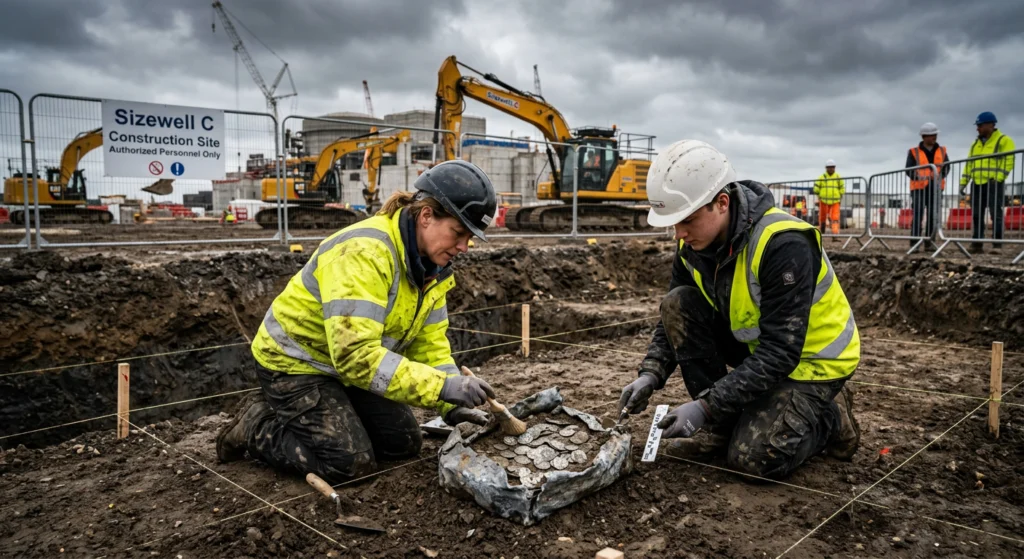
Sometimes, history hides in the most unexpected places. What started as a routine excavation for a major nuclear power project in England suddenly turned into a jaw-dropping archaeological discovery. Workers digging land for the massive Sizewell C nuclear station in Suffolk uncovered what initially looked like an ordinary lump wrapped in lead.
But no one expected what was hidden inside.
Archaeologists later revealed that the mysterious package contained a remarkable silver treasure believed to be nearly 1,000 years old. The discovery stunned researchers and instantly sparked global curiosity about who buried it and why it remained untouched for centuries. The finding happened during preparatory archaeological work before construction began at the Sizewell C nuclear project in Suffolk, England. Experts later identified hundreds of preserved medieval silver coins inside the lead-wrapped bundle.
At Informosio we uncover fascinating historical discoveries, hidden mysteries, and world-changing events in simple, engaging language so you can understand what ancient finds reveal about forgotten civilizations, untold stories, and the secrets history still hides.
Why This Discovery Is Making Headlines Worldwide
Large infrastructure projects often uncover forgotten pieces of history, but discoveries of this scale are extremely rare.
Before heavy construction could begin at the nuclear site, archaeologists were asked to inspect the area to ensure no historically important remains would be damaged. During the excavation process, workers noticed an unusual lead-covered object hidden underground.
At first glance, it appeared to be little more than old scrap material. However, once experts carefully opened it, they found a tightly packed collection of medieval silver coins preserved in remarkable condition. Archaeologists later described the find as one of the most fascinating discoveries made during the Sizewell C excavation. The hoard reportedly included hundreds of silver coins dating back to the 11th century.
The Mystery of the “Lead Pasty”
One of the most fascinating parts of the story is how the treasure was hidden.
Researchers nicknamed the object the “lead pasty” because it looked similar to a wrapped food parcel. Instead of food, however, it protected something far more valuable.
The lead covering helped shield the coins from moisture and damage for centuries. Experts believe someone intentionally buried the package to protect wealth during uncertain political times.
Historians suspect the treasure may have been hidden around the period of royal transitions in medieval England, when power struggles and instability created fear among ordinary people and wealthy landowners alike. Some experts believe the hidden silver treasure may have represented personal savings that someone never returned to reclaim.
What Was Found Inside the Silver Treasure?
The package reportedly contained more than 300 silver coins dating from around 1036 to 1044.
These coins belonged to the reigns of Anglo-Saxon kings including Harold I, Harthacnut, and Edward the Confessor. Because of their age and preservation, historians say the find offers a rare glimpse into life and economics in medieval England. Historians believe this silver treasure may have belonged to someone wealthy or politically connected.
Coins from this period are valuable not only because of the silver itself but because they help experts understand trade, political control, and currency systems from nearly a millennium ago.
Interestingly, many of the coins appeared to remain in exceptional condition despite being buried underground for centuries. Archaeologists believe the wrapping method played an important role in protecting the historic collection.
Why Would Someone Hide So Much Wealth?
This is perhaps the biggest mystery surrounding the silver treasure.
No one knows exactly who buried the coins or whether the owner ever planned to retrieve them. However, researchers have several theories.
One possibility is fear.
The period during which the treasure was hidden was politically unstable. Leadership changes and royal succession often triggered uncertainty, conflict, and anxiety. Wealthy individuals sometimes buried valuables underground to protect them from theft, invasion, or sudden political shifts.
Many believe the silver treasure was buried during fear of raids, political conflict, or sudden power changes. Another theory suggests the owner may have died unexpectedly or fled the region before recovering the hidden wealth.
If true, the forgotten treasure remained buried silently for almost a thousand years until modern excavation crews accidentally found it.
What Makes This Discovery So Important?
Ancient treasure discoveries are exciting, but this case is particularly valuable for historians. Beyond its financial value, the silver treasure offers clues about trade and daily life nearly 1,000 years ago.
The coins provide real evidence of economic activity during medieval England. Since many were preserved together, researchers can study how money circulated, what rulers controlled regions, and how wealth was stored.
The silver treasure also highlights an often-overlooked benefit of major construction projects. Archaeological inspections before development frequently reveal hidden pieces of history that would otherwise remain lost forever.
Experts say discoveries like this remind us that beneath modern cities and infrastructure, centuries of untold stories still exist.
In this case, a project meant to power the future unexpectedly uncovered a forgotten chapter of the past.
Could More Hidden Treasures Still Exist?
The surprising answer is yes.
Archaeologists believe countless historical artifacts remain buried beneath ordinary land around the world. Many are uncovered during railway projects, road construction, mining operations, or urban expansion.
England, in particular, has a long history of treasure discoveries because of its rich medieval and Roman past.
The Suffolk region where the silver treasure was discovered has already produced multiple archaeological findings over the years, making historians believe there could still be many hidden stories beneath the soil.
That possibility is exactly what makes discoveries like this so fascinating.
A Nuclear Project That Accidentally Rewrote History
Most people associate nuclear projects with technology, energy, and engineering.
Few would imagine that one excavation could reveal a forgotten fortune buried for almost 1,000 years.
Yet this discovery proves that modern progress and ancient history often cross paths in unexpected ways. What looked like an ordinary object beneath a construction site became one of the most talked-about archaeological discoveries linked to a major infrastructure project.
For historians, the find is priceless.
For the world, it is a reminder that history never truly disappears. Sometimes, it simply waits beneath the ground for the right moment to be found again.
The discovery of this mysterious silver treasure is more than just an exciting headline. It is a powerful glimpse into human history, fear, survival, and forgotten wealth that remained hidden for nearly a millennium before finally seeing daylight again.
Curious about more shocking archaeological discoveries and forgotten treasures? Explore our History & Culture section.
Conclusion
The discovery of this ancient silver treasure proves that history can appear in the most unexpected places. What began as excavation work for a modern nuclear project quickly turned into a remarkable archaeological moment that captured worldwide attention.
For nearly 1,000 years, these silver coins remained hidden beneath the soil, untouched and forgotten. Whether buried for protection during political unrest or lost due to an untold personal story, the mystery continues to fascinate historians and readers alike.
As experts continue studying the coins, this extraordinary find reminds us of something important: even in an age of technology and massive development, the past still has secrets waiting to be uncovered. Sometimes, all it takes is one unexpected discovery to rewrite a forgotten chapter of history. As researchers continue examining the silver treasure, more surprising details could still emerge.
FAQs About the Silver Treasure
Where was the silver treasure found?
The treasure was discovered at the Sizewell C nuclear project site in Suffolk, England during archaeological excavation work.
How old is the treasure?
Experts estimate the coins are around 1,000 years old and date back to the 11th century.
Why was the treasure buried?
Researchers believe it may have been hidden during political instability to protect wealth.
How many coins were discovered?
Reports suggest the package contained over 300 silver coins.
Why is this discovery important?
The treasure helps historians understand medieval trade, wealth, and political history.
🌐Connect with us
Informosio Official – General updates, current affairs, and informative content