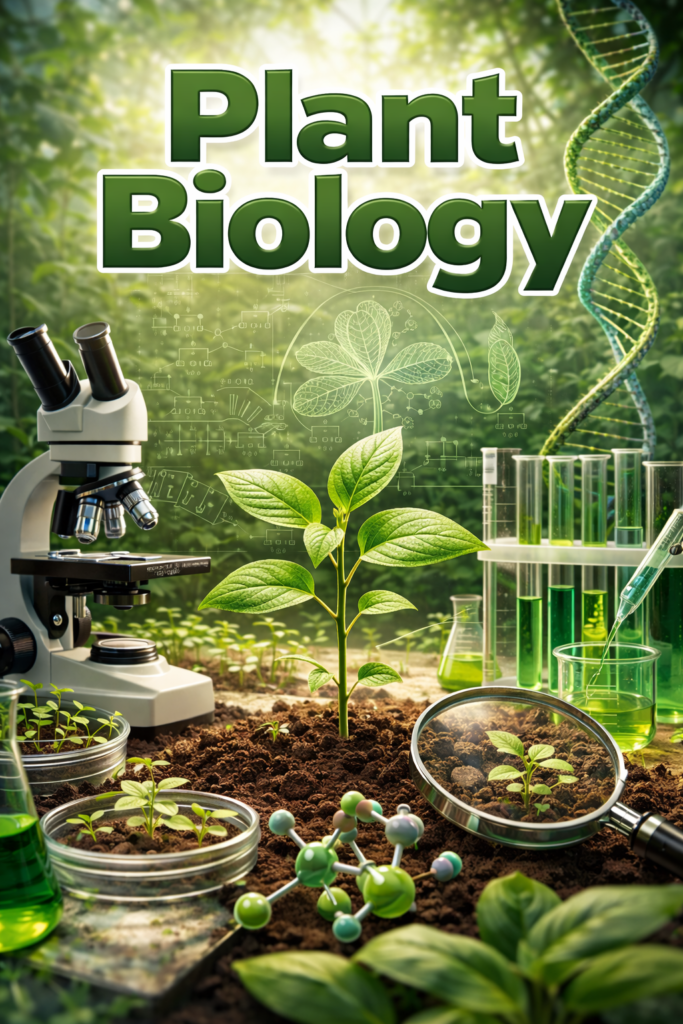
Plant Biology is a core branch of biology that focuses on the scientific study of plants and their life processes. Plants are essential for life on Earth because they produce food, release oxygen, maintain ecological balance, and support all living organisms directly or indirectly.
For students of Class 9, 10, 11, 12, NEET, CUET, and other competitive examinations, Plant Biology forms a major part of the syllabus. Concepts like photosynthesis, respiration, transport, and plant hormones are frequently tested and require clear understanding rather than rote memorization.
This article explains Plant Biology in a step-by-step, concept-based, and exam-oriented manner, just like a good classroom teacher. All major topics are explained in simple English, with definitions, processes, importance, diagram explanations, examples, common mistakes, practice questions, and revision summaries.
What Is Plant Biology?
Definition of Plant Biology
Plant Biology is the branch of biology that studies plants, including their structure, growth, metabolism, reproduction, transport systems, and responses to the environment. It focuses on understanding both the external and internal organization of plants, along with the physiological processes such as photosynthesis, respiration, transpiration, and nutrient transport that are essential for plant survival. Plant Biology also explains how plants grow, develop, and adapt to their surroundings through hormonal regulation and environmental interactions. This field plays a vital role in agriculture, ecology, and environmental science, as plants form the foundation of life on Earth by providing food, oxygen, and ecological balance.
It includes:
- External and internal plant structure
- Life processes such as photosynthesis and respiration
- Growth regulation by hormones
- Transport of water, minerals, and food
Scope and Importance of Plant Biology
Plant Biology helps us to:
- Improve crop production
- Understand plant diseases
- Develop sustainable agriculture
- Protect the environment
- Study climate change and ecosystems
1. Morphology of Plants
Definition
Morphology of Plants is the branch of plant biology that deals with the study of the external form and structure of plants, including their visible organs such as roots, stems, leaves, flowers, fruits, and seeds. Morphology of plants is the study of the external form and structure of plants and their visible organs.
It focuses on how different parts of a plant look and how they are adapted to perform specific functions.
Main Parts Studied in Plant Morphology
Root
Definition:
Root is the part of a plant that usually grows underground and helps in anchoring the plant and absorbing water and minerals from the soil. The root is the underground part of the plant that develops from the radicle of the seed.
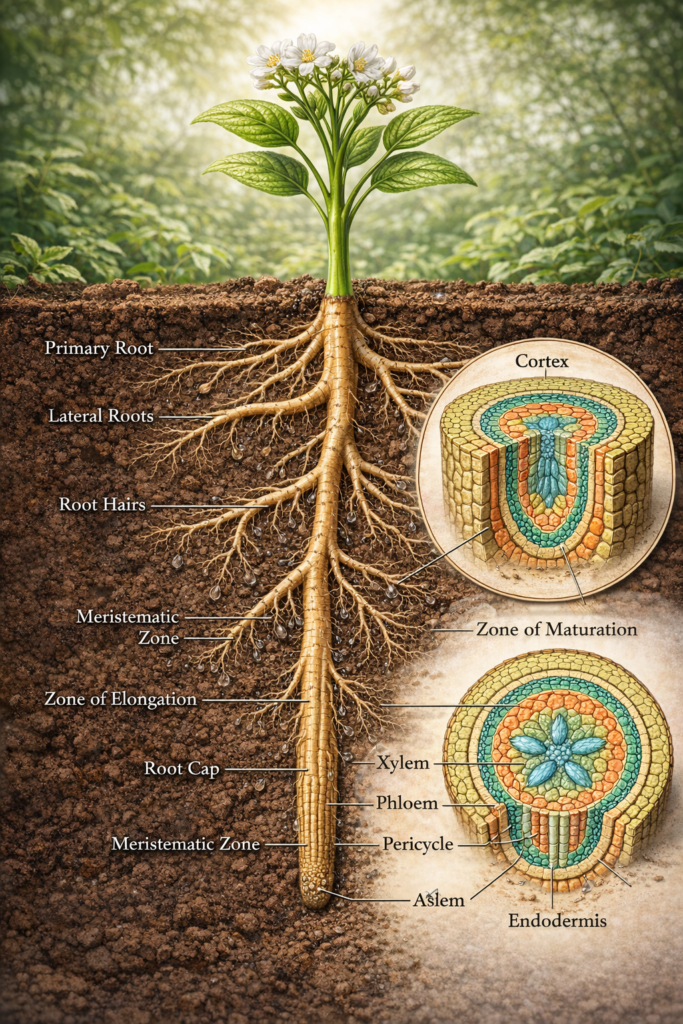
Functions of Root
- Absorption of water and minerals
- Anchorage to the soil
- Storage of food in some plants
- Prevention of soil erosion
Types of Roots
- Tap root system
- Fibrous root system
- Adventitious roots
Stem
Definition:
Stem is the main aerial part of the plant that supports leaves, flowers, and fruits and helps in the transport of water, minerals, and food. The stem is the aerial part of the plant that grows upward from the plumule.
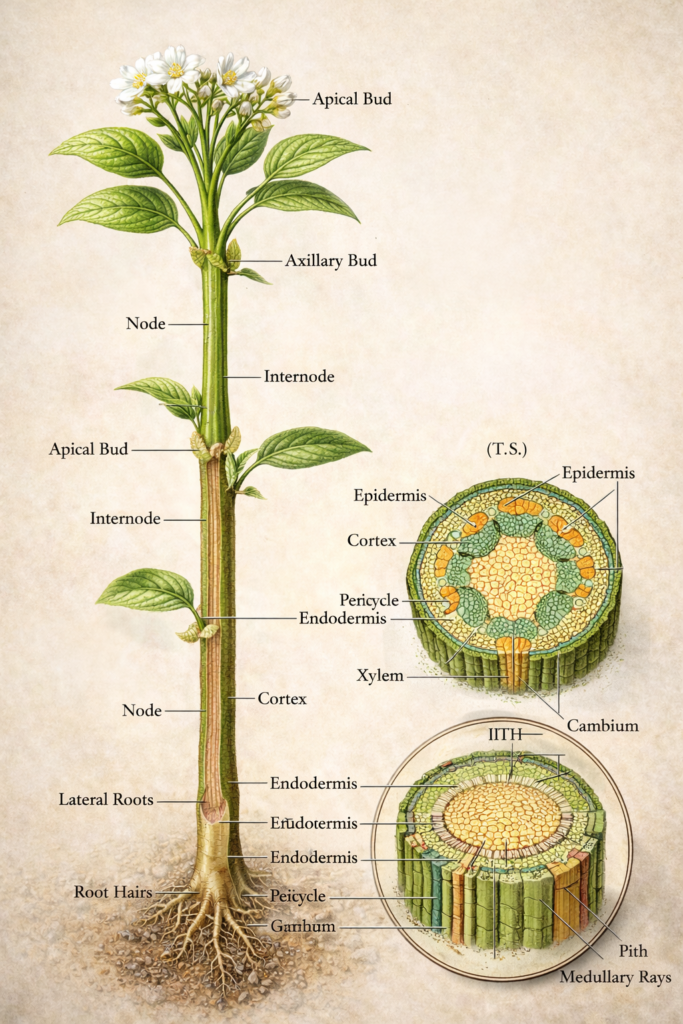
Functions of Stem
- Supports leaves, flowers, and fruits
- Transports water and food
- Stores food in modified stems
- Performs photosynthesis in green stems
Leaf
Definition:
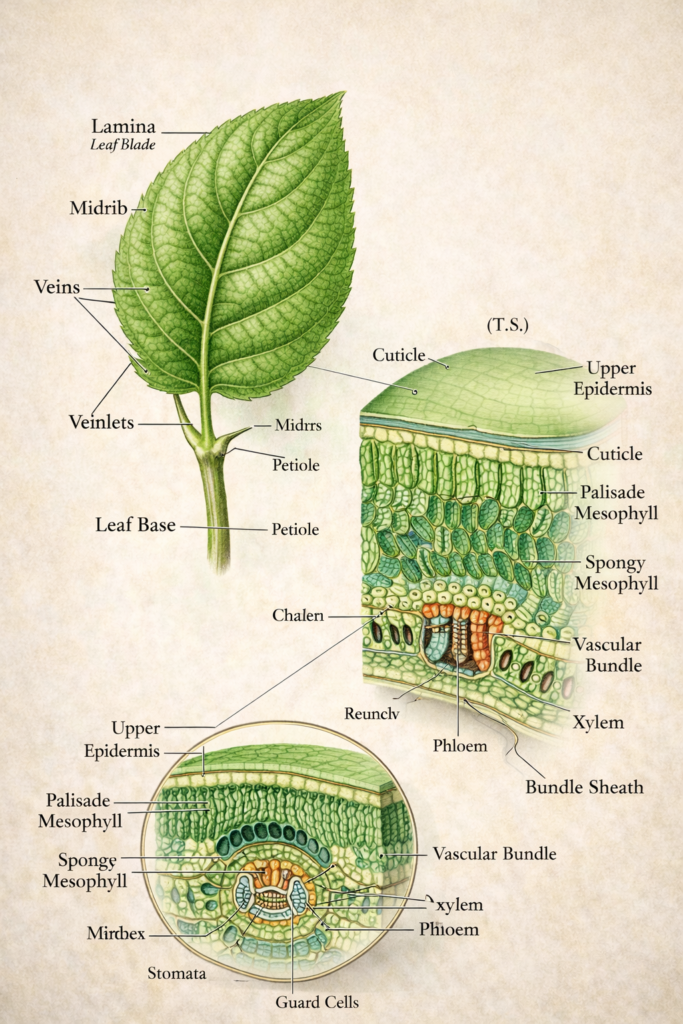
Leaf is a flat, usually green part of the plant that grows from the stem and performs vital functions such as photosynthesis, transpiration, and gaseous exchange. A leaf is a flat, green organ attached to the stem, mainly responsible for photosynthesis.
Functions of Leaf
- Photosynthesis
- Transpiration
- Gaseous exchange
Parts of a Leaf
- Leaf base
- Petiole
- Lamina
Flower
Definition:
Flower is a specialized reproductive structure of flowering plants that is responsible for sexual reproduction and seed formation. A flower is the reproductive organ of flowering plants.
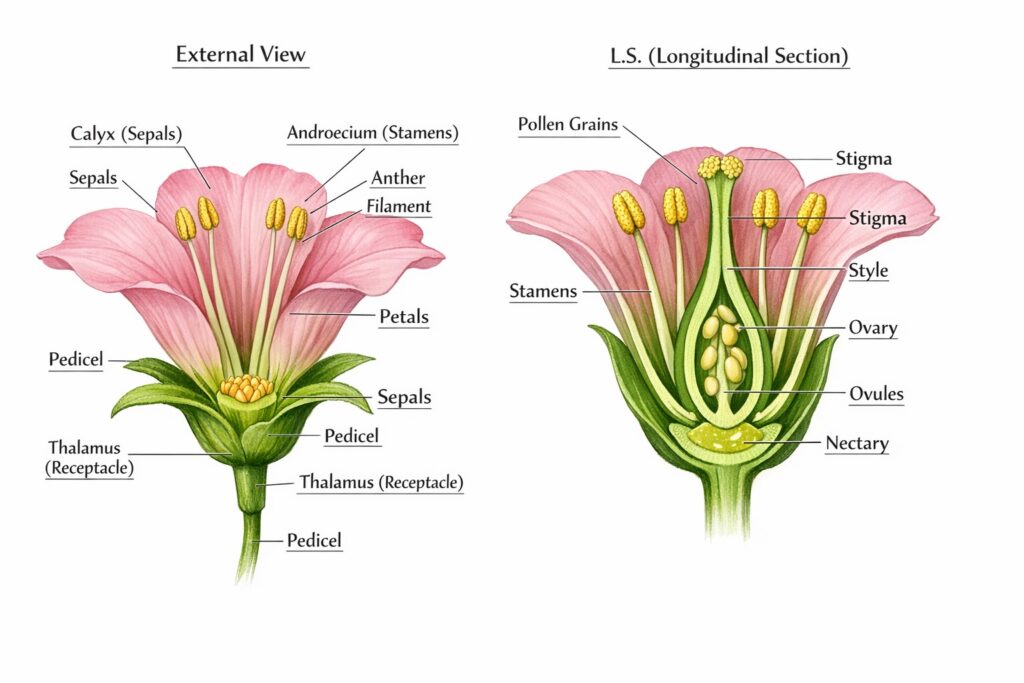
Parts of Flower
- Calyx
- Corolla
- Androecium
- Gynoecium
Fruit and Seed
Fruit:
Fruit is the part of a plant that develops after fertilization and helps in protecting and dispersing seeds. Develops from the ovary after fertilization and protects seeds.
Seed:
Seed is a mature, fertilized ovule that gives rise to a new plant under suitable conditions. Contains the embryo and stored food for germination.
2. Anatomy of Flowering Plants
Definition
Anatomy of Flowering Plants is the branch of plant biology that deals with the internal organization of tissues and cells in flowering plants. Anatomy of flowering plants is the study of the internal structure of plant organs as seen under a microscope.
Plant Tissues
Meristematic Tissue
- Actively dividing cells
- Responsible for growth
Permanent Tissue
- Derived from meristematic tissue
- Performs specialized functions
Anatomy of Root
Internal structure includes:
- Epidermis
- Cortex
- Endodermis
- Pericycle
- Xylem and phloem
Anatomy of Stem
Important features:
- Vascular bundles
- Xylem for water transport
- Phloem for food transport
Anatomy of Leaf
Leaf shows:
- Upper epidermis
- Mesophyll (palisade and spongy tissue)
- Lower epidermis
Diagram Explanation
Anatomy diagrams usually show:
- Arrangement of tissues
- Position of vascular bundles
- Path of transport
3. Photosynthesis
Definition
Photosynthesis in Plants is the process through which green plants synthesize their own food by converting sunlight, carbon dioxide, and water into glucose and oxygen, providing energy for growth and survival. Photosynthesis is the process by which green plants prepare their own food using sunlight, carbon dioxide, and water in the presence of chlorophyll.
Chemical Equation of Photosynthesis
6CO₂ + 6H₂O → C₆H₁₂O₆ + 6O₂
Steps of Photosynthesis
Step 1: Absorption of Light
Chlorophyll absorbs sunlight.
Step 2: Light Reaction
- Occurs in thylakoids
- Produces ATP and NADPH
Step 3: Dark Reaction
- Occurs in stroma
- Produces glucose
Importance of Photosynthesis
- Produces food for all living organisms
- Releases oxygen
- Maintains carbon dioxide balance
- Supports life on Earth
Diagram Explanation
Photosynthesis diagrams show:
- Chloroplast structure
- Light absorption
- Carbon dioxide entry
- Oxygen release
4. Respiration in Plants
Definition
Respiration in Plants is the biological process by which plants break down stored food to release energy required for growth, maintenance, and other vital activities. Respiration in plants is the process of breaking down food to release energy for growth and maintenance.
Types of Respiration
Aerobic Respiration
- Requires oxygen
- Produces more energy
Anaerobic Respiration
- Occurs without oxygen
- Produces less energy
Stages of Respiration
- Glycolysis
- Krebs cycle
- Electron transport chain
Importance of Respiration
- Provides energy for growth
- Helps in repair and reproduction
- Essential for survival
5. Transpiration
Definition
Transpiration is the process by which plants lose water from their leaves, stems, and flowers, helping in cooling and water transport. Transpiration is the loss of water in the form of water vapour from the aerial parts of the plant.
Types of Transpiration
- Stomatal transpiration
- Cuticular transpiration
- Lenticular transpiration
Functions of Transpiration
- Cooling effect on plant
- Helps in ascent of sap
- Maintains turgidity
Factors Affecting Transpiration
- Light
- Temperature
- Humidity
- Wind
6. Plant Hormones
Definition
Plant Hormones are naturally occurring chemical messengers in plants that control and coordinate growth, development, and responses to environmental stimuli. Plant hormones are chemical substances produced in small amounts that regulate plant growth and development.
Types of Plant Hormones
| Hormone | Function |
|---|---|
| Auxins | Promote cell elongation |
| Gibberellins | Increase stem length/growth |
| Cytokinins | Promote cell division |
| Ethylene | Causes fruit ripening |
| Abscisic acid | Growth inhibition |
Importance of Plant Hormones
- Regulate growth
- Control flowering and fruiting
- Help plants respond to environment
7. Transport in Plants
Definition
Transport in Plants is the process by which water, minerals, and food are moved from one part of the plant to another to support growth and survival. Transport in plants refers to the movement of water, minerals, and food within the plant body.
Transport of Water
Occurs through xylem by:
- Root pressure
- Transpiration pull
- Capillary action
Transport of Food
Occurs through phloem by translocation.
Diagram Explanation
Transport diagrams show:
- Root absorption
- Xylem upward movement
- Phloem food movement
Real-Life Applications of Plant Biology
- Agriculture and crop improvement
- Medicinal plant research
- Environmental conservation
- Biotechnology
Common Mistakes and Misconceptions
- Plants do not respire (wrong)
- Photosynthesis occurs only during day (partly wrong)
- Transpiration is harmful (incorrect)
Exam-Oriented Notes
- Xylem transports water
- Phloem transports food
- Photosynthesis occurs in chloroplast
- Ethylene is gaseous hormone
Practice Questions
Very Short Answer
- What is Plant Biology?
Answer: Study of plants and their life processes. - Which tissue transports food?
Answer: Phloem.
Short Answer
- Define photosynthesis.
Answer: Process of food formation using sunlight.
Long Answer
- Explain transpiration and its importance.
Answer: Loss of water vapour helps cooling and transport.
Summary for Quick Revision
- Plant Biology studies plant structure and function
- Morphology deals with external structure
- Anatomy studies internal tissues
- Photosynthesis prepares food
- Respiration releases energy
- Hormones regulate growth
- Transport ensures survival
References / Source Acknowledgement
- Wiley Online Library – Plant Biology Journal
- Annual Reviews of Plant Biology
- Oxford Molecular Plant Biology
- Springer Plant Biology Journal
- NCERT Biology Textbook
- ScienceDirect – Plant Biology
- Academic OUP Plant Cell Teaching Tools
You can also Visit Core Sciences
Frequently Asked Questions (FAQs)
1. Why is Plant Biology important?
It helps understand food production and ecosystems.
2. Do plants respire at night?
Yes, respiration occurs day and night.
3. Which hormone ripens fruits?
Ethylene.
4. What tissue transports water?
Xylem.
5. Is photosynthesis possible without light?
No.
6. What is transpiration pull?
Upward movement of water due to transpiration.