
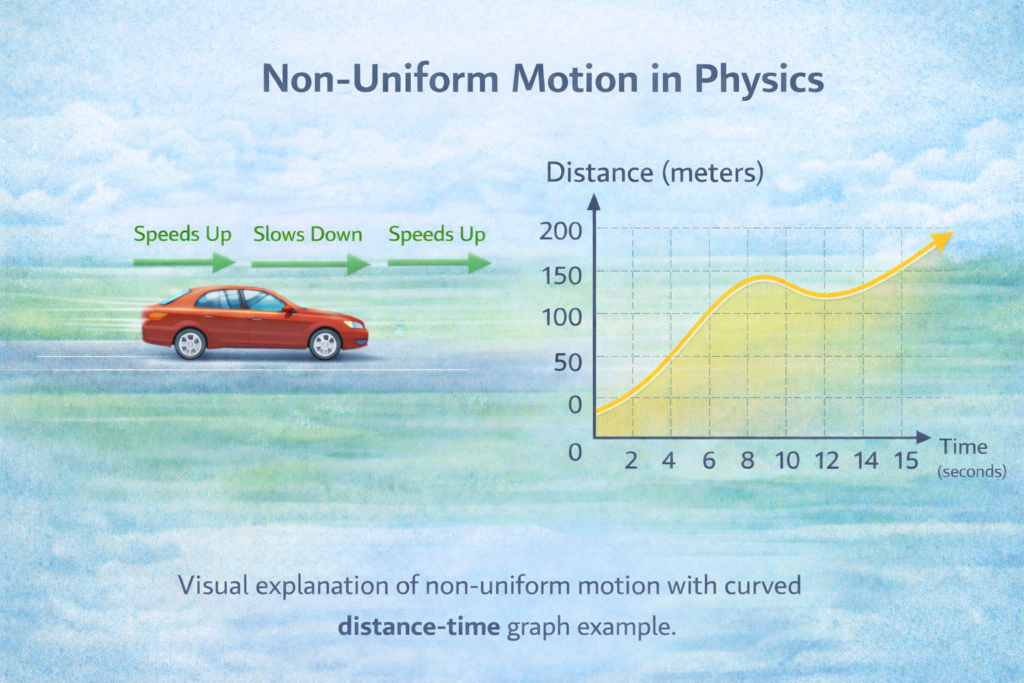
Non-uniform motion in physics occurs when an object’s speed or direction changes over time. In this guide, students will explore motion patterns, curved graphs, and practical examples that explain changing movement.
What is Non-Uniform Motion in Physics?
Non-uniform motion in physics refers to the movement of an object where it covers unequal distances in equal intervals of time or when its speed or direction changes continuously. Unlike uniform motion, where movement remains steady, non-uniform motion involves variations that make the motion less predictable.
For example, a car moving through city traffic rarely maintains constant speed. It speeds up, slows down, and sometimes stops. These changes indicate non-uniform motion. Understanding non-uniform motion in physics helps students analyse real-world situations more realistically because most objects in everyday life move in this way.
👉 Back to: Complete Guide to Motion in Physics.
Characteristics of Non-Uniform Motion
Non-uniform motion has several important features:
- Unequal distances are covered in equal time intervals.
- Speed changes during movement.
- Direction may also change.
- Acceleration is usually present.
These characteristics make non-uniform motion more complex than steady movement. Recognising these signs helps students distinguish it from uniform motion.
Examples of Non-Uniform Motion
Many everyday activities demonstrate non-uniform motion:
- A bus slowing down at a bus stop and speeding up again.
- A football rolling across uneven ground.
- A cyclist climbing a hill and then moving downhill.
These examples help learners connect theory with real-life observations, making the concept easier to understand.
Non-Uniform Motion vs Uniform Motion
Students often compare non-uniform motion with uniform motion to understand the differences clearly:
- Uniform motion involves constant speed and equal distances over equal time intervals.
- Non-uniform motion involves changing speed or direction.
For example, a train moving at constant speed on a straight track shows uniform motion, while a car navigating traffic shows non-uniform motion.
👉 You can explore uniform motion in physics for a deeper comparison.
Graphical Representation of Non-Uniform Motion
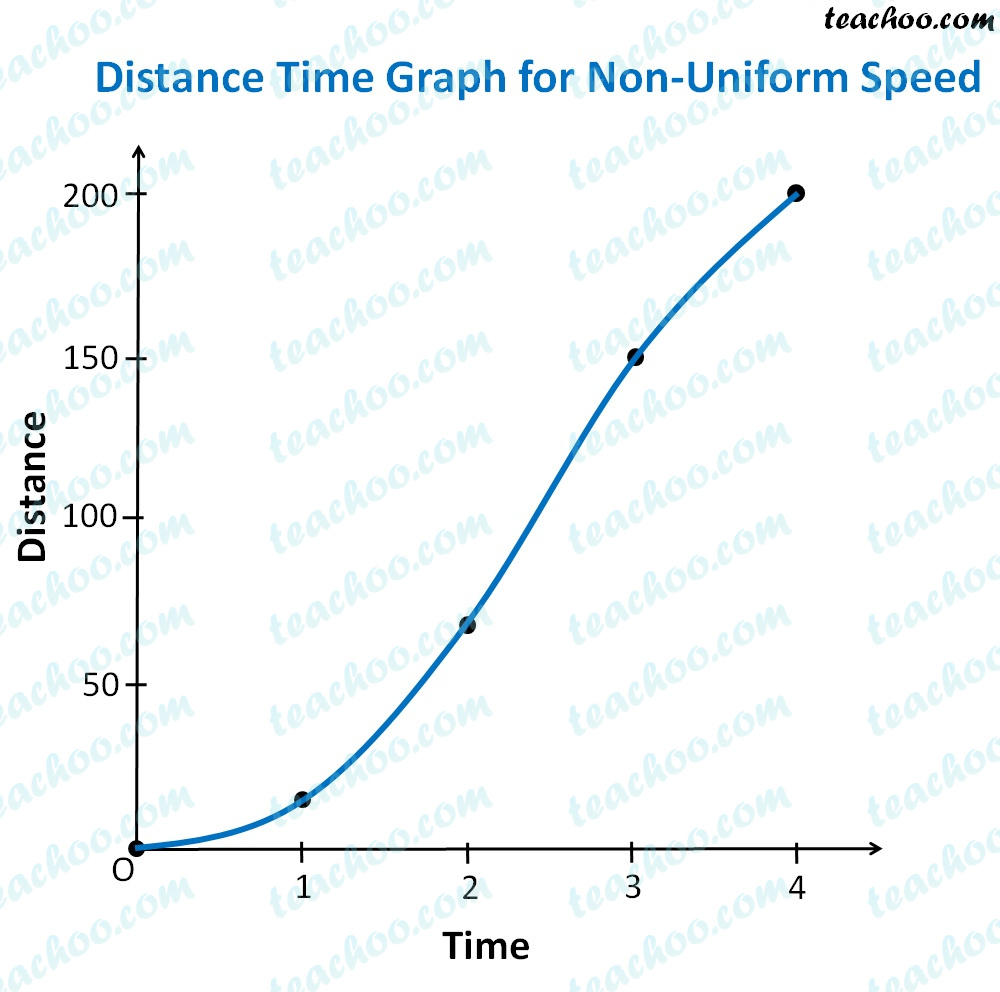
Non-uniform motion can be represented using distance-time graphs. In such graphs:
- A curved line indicates changing speed.
- A steeper curve shows increasing speed.
- A flatter curve shows decreasing speed.
Graphs help students visualise how movement changes over time without performing complicated calculations. Learning to interpret these graphs is an important skill in physics.
Role of Acceleration in Non-Uniform Motion
Acceleration plays a major role in non-uniform motion because velocity changes continuously. Whenever an object speeds up, slows down, or changes direction, acceleration is present.
Understanding acceleration in non-uniform motion helps students analyse more advanced topics such as forces and energy. It also explains why real-life movement rarely remains constant.
Importance of Non-Uniform Motion in Physics
Learning non-uniform motion in physics prepares students for deeper study of mechanics and real-world applications. Engineers, scientists, and designers use this concept when analysing vehicle movement, designing transportation systems, and studying natural phenomena.
Most real-life motion is non-uniform, so understanding this concept allows learners to interpret everyday situations more accurately.
Common Mistakes Students Make
While studying non-uniform motion, beginners often:
- Assume changing speed always means stopping completely
- Confuse non-uniform motion with random movement
- Ignore graphical representation while learning
Avoiding these mistakes improves understanding and builds confidence in physics.
Conclusion
Non-uniform motion in physics describes movement where speed or direction changes over time. By learning its characteristics, graphs, and real-life examples, students develop a deeper understanding of motion and prepare for advanced physics topics. Mastering non-uniform motion makes it easier to analyse complex movement patterns in everyday life.
FAQs About Non-Uniform Motion in Physics
1. What is non-uniform motion in physics?
Non-uniform motion occurs when an object’s speed or direction changes over time.
2. Is acceleration present in non-uniform motion?
Yes, acceleration is present because velocity changes continuously.
3. How is non-uniform motion shown on a graph?
A curved line on a distance-time graph represents non-uniform motion.
4. Why is non-uniform motion important?
It helps explain real-life movement where speed rarely stays constant.
🌐 Connect With Us
👉 Informosio Official – General updates, current affairs, and informative content
👉 Continue your physics journey with our expert guides — visit our official website to explore more motion topics and student-friendly lessons.