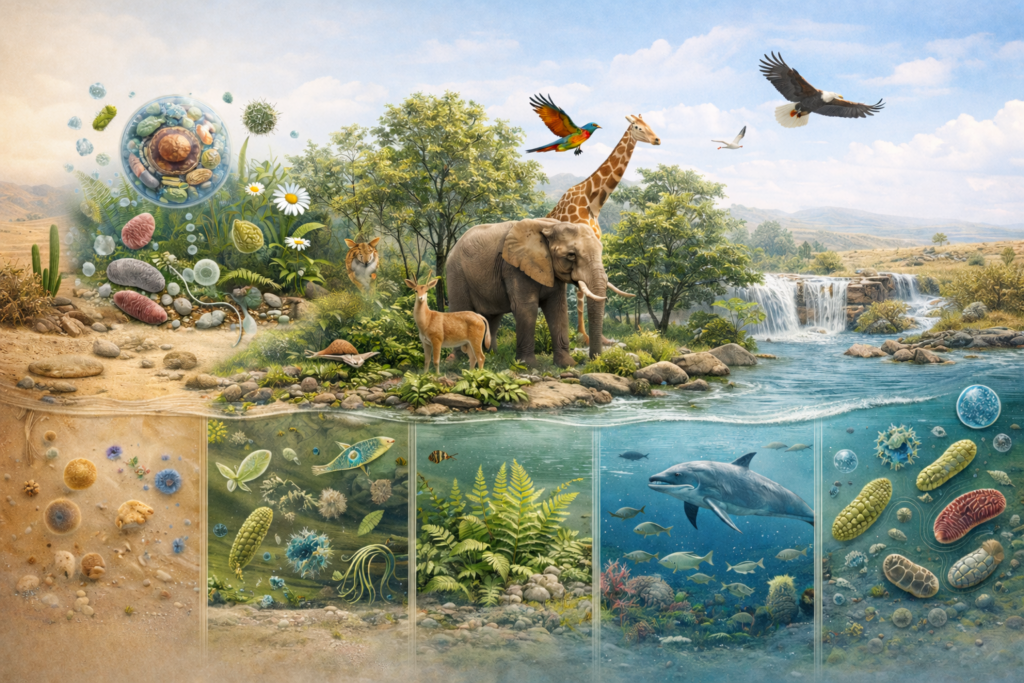
The Living World & Basics form the foundation of biological science, helping us understand what life is, how living organisms are organized, and how they interact with the environment. From microscopic bacteria to massive blue whales, life on Earth displays remarkable complexity, order, and diversity.
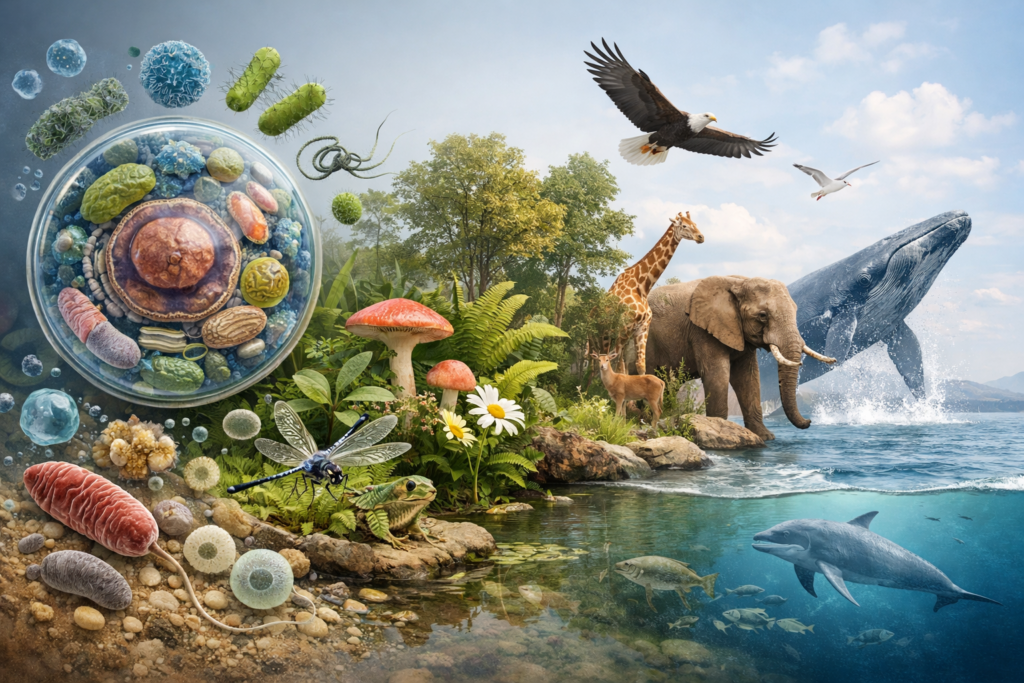
Biology begins with the study of the living world, where scientists seek to define life, classify organisms, and explore their structural and functional organization. Understanding Living World & Basics is essential not only for academic learning but also for appreciating biodiversity, conservation, medicine, agriculture, and environmental sustainability.
This article offers a comprehensive and structured exploration of the Living World & Basics, covering:
- Characteristics of living organisms
- Classification systems
- Binomial nomenclature
- Levels of biological organization
- Diversity in living organisms
Characteristics of Living Organisms
All living organisms share certain fundamental characteristics that distinguish them from non-living entities. These characteristics define life in biological terms.
1. Cellular Organization
Every living organism is made up of cells, which are the smallest units that carry out all life activities. Cells form the structure of the body and perform essential functions such as growth, respiration, and reproduction.
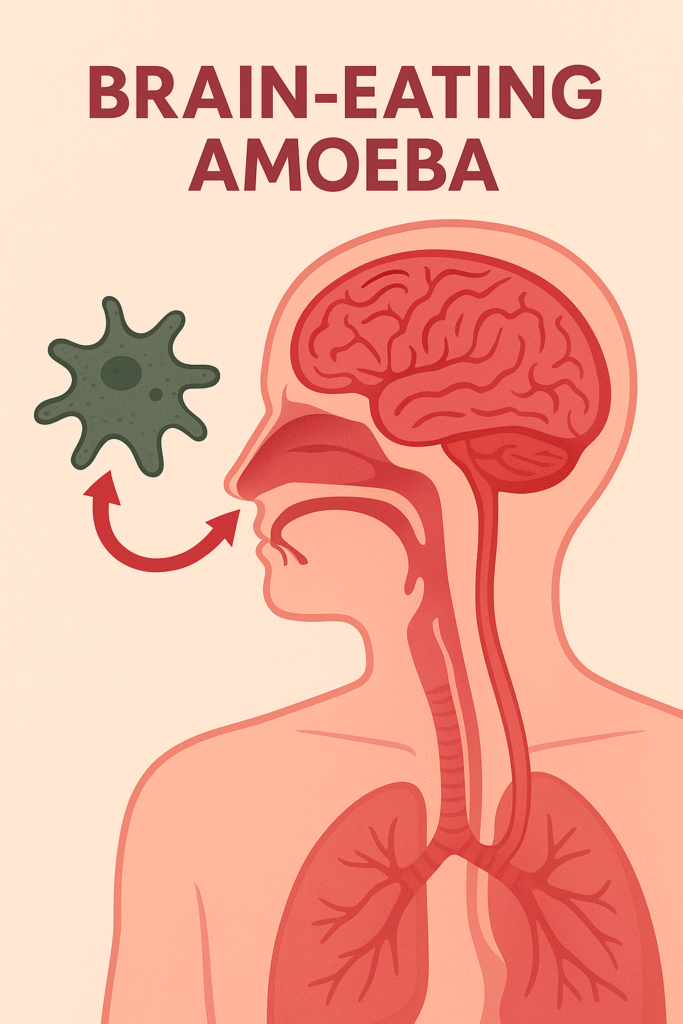
- Unicellular organisms have only one cell, and this single cell performs all life processes on its own (for example, bacteria and amoeba).
- Multicellular organisms have many cells that are specialized for different functions and work together to keep the organism alive (for example, plants and animals).
This cellular organization is a core concept within the Living World & Basics.
2. Metabolism
Metabolism refers to all the chemical reactions that take place inside a living organism to maintain life. These reactions help in growth, repair, and energy production.
- Anabolism involves the building up of complex molecules from simpler ones and requires energy.
- Catabolism involves the breaking down of complex molecules into simpler substances, releasing energy.
No non-living object exhibits metabolism, making it a defining feature of life.
3. Growth
Growth is a natural and permanent increase in the size and mass of a living organism. It occurs due to an increase in the number of cells through cell division and sometimes by an increase in the size of individual cells.
In living organisms:
- Growth takes place from within the body.
- It results in overall development and maturity of the organism.
This type of growth clearly distinguishes living organisms from non-living objects, which grow only by external addition.
4. Reproduction
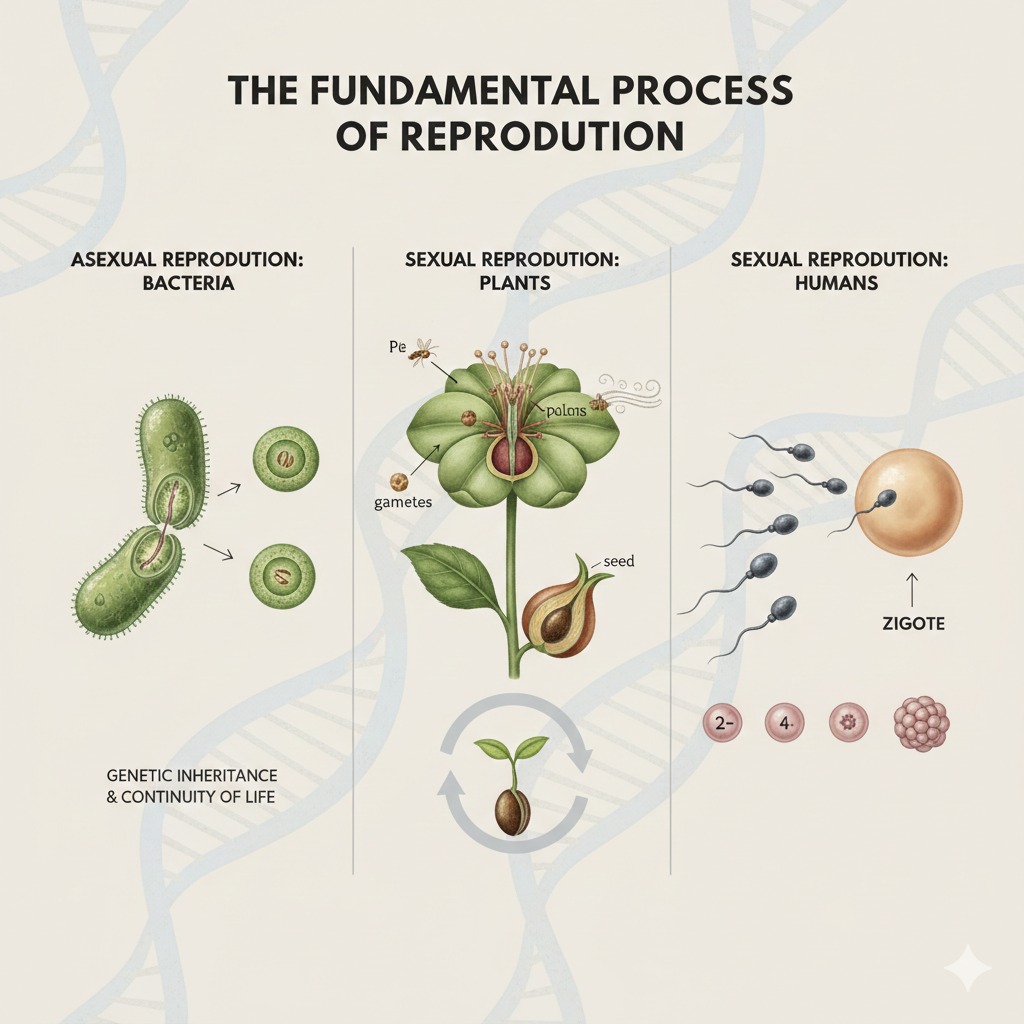
Reproduction is the biological process by which living organisms produce new individuals of the same species. It ensures the continuity of a species from one generation to the next.
There are two main types of reproduction:
- Asexual reproduction involves a single parent and does not require the formation of gametes. The offspring produced are genetically identical to the parent (examples include binary fission and budding).
- Sexual reproduction involves the fusion of male and female gametes, leading to the formation of offspring with genetic variations, which helps in evolution and adaptation.
Although reproduction is not essential for individual survival, it is crucial for species continuity in the Living World & Basics.
5. Consciousness and Response to Stimuli
Consciousness is the ability of living organisms to sense and respond to changes in their surroundings. This response helps organisms survive, protect themselves, and adapt to their environment.
Living organisms respond to various environmental stimuli such as:
- Light, for example, plants bending toward sunlight
- Temperature, such as sweating in humans or hibernation in animals
- Sound, like animals reacting to loud noises
- Chemicals, such as smell and taste responses
The ability to respond to stimuli is a key feature that clearly distinguishes living organisms from non-living things.
This sensitivity or irritability is the most defining property of living organisms.
6. Adaptation and Evolution
Adaptation is the process by which living organisms develop special features or behaviors that help them survive in their environment. These adaptations may be structural, physiological, or behavioral.
Over long periods of time, such adaptations lead to evolution, where organisms gradually change across generations. Evolution ensures better survival, reproduction, and continuity of species in changing environmental conditions.
Classification of Living Organisms
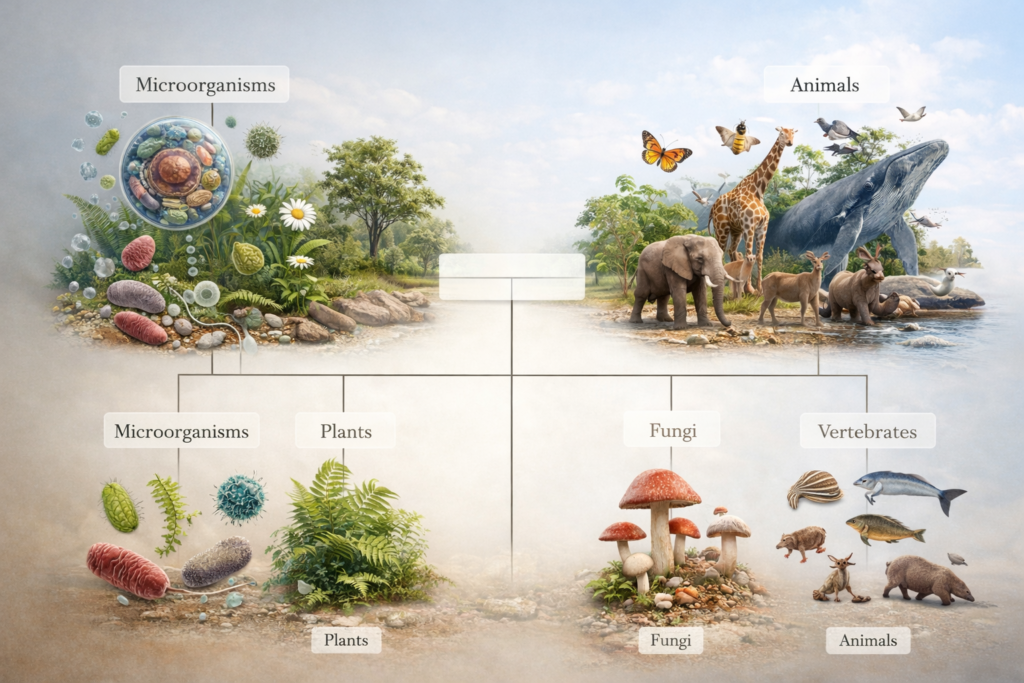
The immense diversity of life necessitates an organized system of classification. Classification helps scientists study organisms systematically and understand evolutionary relationships.
What Is Biological Classification?
Biological classification is the scientific method of grouping living organisms based on their shared characteristics and similarities. It helps in organizing the vast diversity of life into a systematic framework.
Importance of classification in Living World & Basics:
- It simplifies the study of a large number of organisms by arranging them into groups.
- It helps identify evolutionary relationships among different organisms.
- It enables universal communication by providing standardized scientific names used worldwide.
Historical Development of Classification
| Scientist | Contribution |
|---|---|
| Aristotle | Classified organisms as plants and animals |
| Linnaeus | Introduced systematic classification |
| Whittaker | Proposed Five Kingdom Classification |
Five Kingdom Classification System
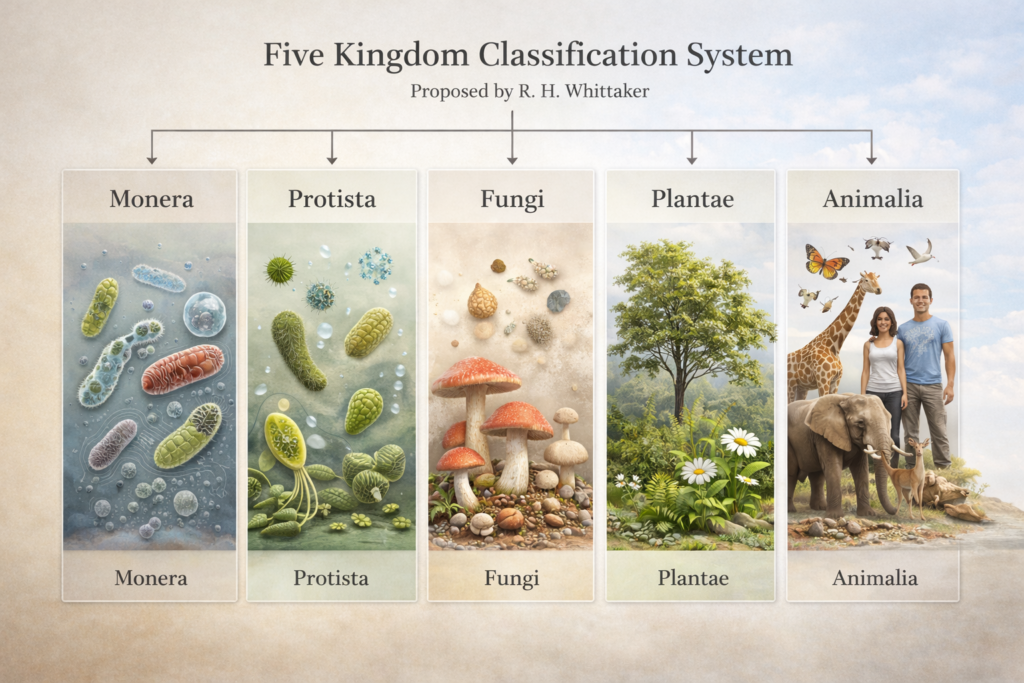
The Five Kingdom Classification System was proposed by R. H. Whittaker to scientifically classify living organisms based on their cell structure, body organization, mode of nutrition, and evolutionary relationships. This system divides all living organisms into five distinct kingdoms.
1. Monera
Organisms belonging to Monera are the simplest and most primitive forms of life.
- They are prokaryotic, meaning they lack a true nucleus and membrane-bound organelles.
- They are unicellular and mostly microscopic.
- Example: Bacteria
2. Protista
Protista includes a diverse group of mostly single-celled organisms.
- They are eukaryotic, having a true nucleus.
- Most are unicellular, though some may be multicellular.
- Examples: Algae and protozoa
3. Fungi
Fungi are eukaryotic organisms that depend on other organisms for nutrition.
- They are heterotrophic and absorb nutrients from organic matter.
- Their cell walls are made of chitin.
- Examples: Yeast and mushrooms
4. Plantae
Kingdom Plantae includes all green plants.
- They are multicellular and autotrophic, meaning they make their own food through photosynthesis.
- They contain chlorophyll and have cell walls made of cellulose.
- Examples: Trees and herbs
5. Animalia
Animalia consists of multicellular animals with complex body organization.
- They are heterotrophic and depend on plants or other animals for food.
- Most animals show locomotion and well-developed nervous systems.
- Examples: Humans and insects
This classification system helps in understanding the diversity, relationships, and evolutionary history of living organisms.This classification system is a cornerstone of Living World & Basics.
Binomial Nomenclature
What Is Binomial Nomenclature?
Binomial nomenclature is a scientific system of naming organisms using two Latin or Latinized words. This system provides a unique and universally accepted name to every species, avoiding confusion caused by local or common names.
- Genus indicates the broader group to which an organism belongs and shows close relationships among species.
- Species identifies the specific organism within that genus.
Together, these two names help scientists accurately identify and classify organisms across the world.
Example: Homo sapiens
Rules of Binomial Nomenclature:
- Scientific names are written in Latin or Latinized form, as Latin is a universal and unchanging language.
- The genus name always begins with a capital letter.
- The species name begins with a lowercase letter.
- Scientific names are written in italics when printed and underlined separately when handwritten.
Importance of Binomial Nomenclature:
- It eliminates confusion caused by different local or common names used in various regions.
- It provides universal recognition, allowing scientists across the world to communicate clearly.
- It reflects evolutionary relationships, as closely related organisms often share the same genus name.
This system ensures clarity, accuracy, and consistency in the scientific study of living organisms. Binomial nomenclature is essential to standardized communication in the Living World & Basics.
Levels of Biological Organization
Life exhibits organization at multiple hierarchical levels, each more complex than the previous.
Hierarchy of Biological Organization
| Level | Description |
|---|---|
| Atom | Basic chemical unit |
| Molecule | Chemical compounds |
| Organelle | Specialized cell components |
| Cell | Basic unit of life |
| Tissue | Group of similar cells |
| Organ | Functional unit |
| Organ System | Group of organs |
| Organism | Individual living being |
| Population | Same species group |
| Community | Multiple populations |
| Ecosystem | Living and non-living interaction |
| Biosphere | All life on Earth |
Importance of Organization
This hierarchical structure ensures efficiency, specialization, and survival, reinforcing key principles of Living World & Basics.
Diversity in Living Organisms
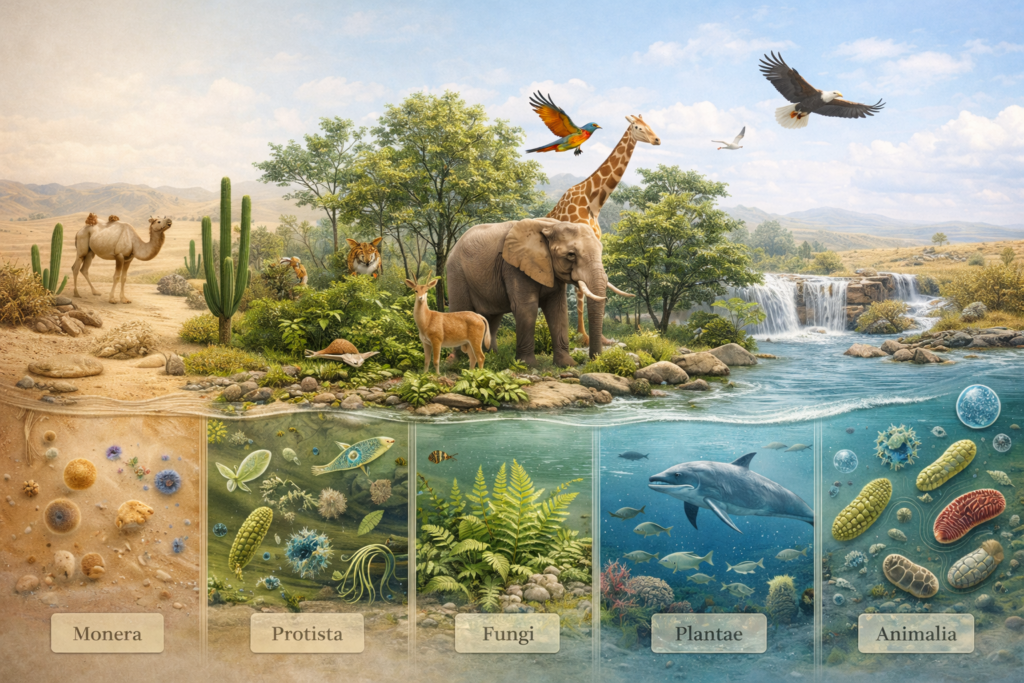
Earth is home to millions of species, displaying extraordinary diversity.
What Is Biodiversity?
Biodiversity refers to the wide variety and variability of living organisms found on Earth. It includes differences within species, between species, and among ecosystems, making life on the planet rich and balanced.
Types of biodiversity:
- Genetic diversity: Variation in genes within the same species, which helps organisms adapt to environmental changes.
- Species diversity: Variety of different species present in a particular area.
- Ecosystem diversity: Variety of ecosystems such as forests, deserts, grasslands, and aquatic habitats.
Biodiversity plays a vital role in maintaining ecological balance and supporting life on Earth.
Why Is Diversity Important?
- Maintains ecological balance
- Provides resources (food, medicine)
- Supports ecosystem stability
Factors Influencing Diversity
- Climate
- Geography
- Evolution
- Environmental changes
Diversity highlights the richness of the Living World & Basics and emphasizes conservation importance.
Importance of Studying Living World & Basics
Understanding the Living World & Basics is essential for:
- Medical science advancements
- Environmental protection
- Agricultural development
- Biotechnology innovation
- Conservation planning
It builds the foundation for all advanced biological studies.
Common Misconceptions About Living Organisms
- All living things are visible to the naked eye (false)
- Growth alone defines life (false)
- Plants do not respond to stimuli (false)
Clarifying these misconceptions strengthens conceptual clarity.
Conclusion: Understanding the Living World & Basics
The Living World & Basics provide a structured framework for understanding life in all its complexity and diversity. From defining what constitutes life to classifying millions of organisms, these concepts form the backbone of biological science.
A strong grasp of the Living World & Basics enables students, researchers, and professionals to appreciate the interconnectedness of life, make informed environmental decisions, and contribute meaningfully to scientific progress. As life continues to evolve, the principles of the living world remain central to understanding our place within nature.
if you want to learn more you may visit our Biology Concept.
FAQs on Living World & Basics
1. What is meant by Living World & Basics?
Living World & Basics refers to the fundamental concepts of life, including characteristics, classification, organization, and diversity of organisms.
2. Why is classification important in biology?
Classification simplifies the study of organisms and reveals evolutionary relationships.
3. Is metabolism unique to living organisms?
Yes, metabolism occurs only in living organisms.
4. Who introduced binomial nomenclature?
Binomial nomenclature was introduced by Carl Linnaeus.
5. What is the most basic unit of life?
The cell is the most basic unit of life.
6. Why is biodiversity important?
Biodiversity ensures ecosystem stability and provides essential resources.
7. Is reproduction essential for survival?
Reproduction is essential for species survival, not individual survival.