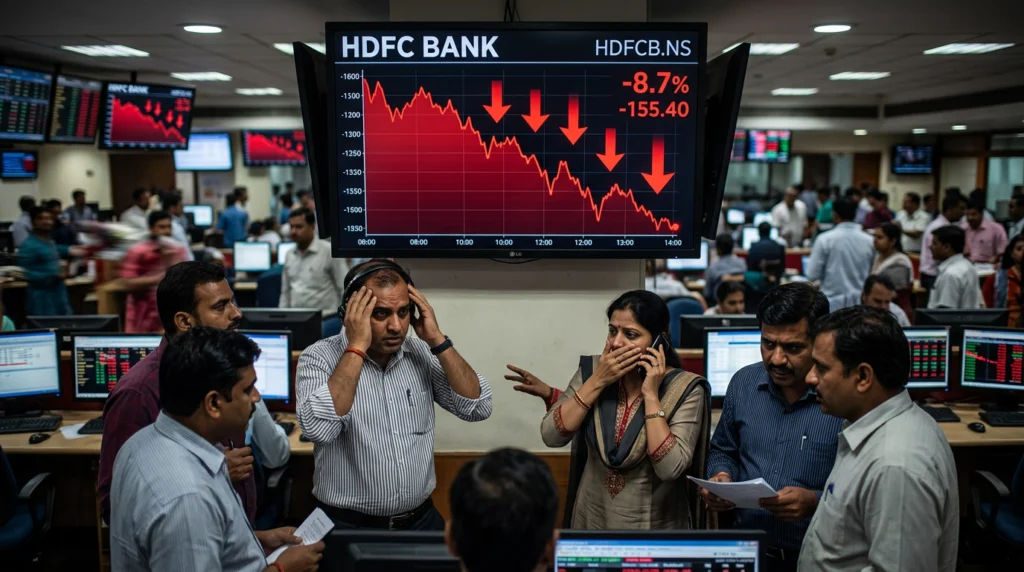
The HDFC Bank crash has stunned the Indian stock market, erasing nearly ₹35,000 crore in value and shaking investor confidence at a time when stability was expected. What triggered such a sharp fall in one of India’s most trusted banking stocks is now the biggest question on Dalal Street. From aggressive FII selling to deeper structural concerns, multiple factors are driving this sudden decline. But is this just a temporary correction or the beginning of a larger trend that investors should worry about.
At Informosio, we simplify complex market movements into clear, actionable insights so you can understand what’s driving the HDFC Bank crash, why FIIs are exiting, and what signals investors should watch next.
HDFC Bank Crash Shocks Investors as Massive Sell-Off Hits Market
The recent HDFC Bank crash has sent shockwaves across Dalal Street, wiping out nearly ₹35,000 crore in market value within a short span. Investors who once considered the stock a pillar of stability are now questioning what went wrong. The sudden decline has not only impacted retail investors but also raised serious concerns about the broader banking sector.
What makes this situation more alarming is the aggressive exit by Foreign Institutional Investors, commonly known as FIIs. Their selling pressure has intensified the HDFC Bank crash, turning what could have been a routine correction into a sharp and unsettling fall.
Why the HDFC Bank Crash Happened
Several underlying factors have contributed to the HDFC Bank crash, and it is not just a single trigger. One of the primary reasons is the consistent selling by FIIs. Over the past few months, foreign investors have been reducing their exposure to Indian banking stocks, and HDFC Bank has taken a major hit.
Another key reason is margin pressure. After the merger with HDFC Ltd, the bank has been dealing with tighter margins, which has affected investor sentiment. Market participants are closely watching how the bank manages its profitability in the coming quarters.
Additionally, concerns around deposit growth have also played a role. Slower deposit mobilization compared to loan growth has created an imbalance, adding to the worries surrounding the HDFC Bank crash.
FII Exit: The Biggest Trigger Behind the Fall
The most critical factor behind the HDFC Bank crash is the aggressive selling by FIIs. Foreign investors often move capital based on global economic trends, interest rate changes, and currency fluctuations.
With rising global interest rates, many FIIs are shifting their funds to safer or higher-yield markets. This has resulted in heavy outflows from Indian equities, especially large-cap banking stocks like HDFC Bank.
The scale of selling has created a domino effect. As FIIs continue to exit, domestic investors also become cautious, further accelerating the HDFC Bank crash.
Impact on the Indian Stock Market
The HDFC Bank crash is not an isolated event. Being one of the largest stocks in the Indian market, its decline has a ripple effect on major indices like Nifty and Sensex.
Banking stocks often act as market leaders. When a heavyweight like HDFC Bank falls sharply, it drags down the overall sentiment. This has led to increased volatility in the market, making investors more risk-averse.
Moreover, the crash has triggered panic among retail investors who see HDFC Bank as a long-term safe bet. This emotional reaction can sometimes lead to further selling, deepening the decline.
Is This a Temporary Correction or a Bigger Concern
One of the biggest questions investors are asking is whether the HDFC Bank crash is a temporary correction or a sign of deeper issues. While short-term factors like FII selling and market sentiment are clearly influencing the stock, the long-term fundamentals of the bank remain relatively strong.
However, the integration challenges post-merger and pressure on margins cannot be ignored. If these issues persist, the HDFC Bank crash could take longer to recover from.
On the other hand, if the bank manages to stabilize its growth and improve deposit ratios, investor confidence may return sooner than expected.
What Should Investors Do Now
The HDFC Bank crash has created both fear and opportunity. For short-term traders, the volatility may present quick trading opportunities, but it also comes with high risk.
Long-term investors, however, need to focus on fundamentals rather than panic. Historically, strong banking institutions have recovered from such corrections, but patience is key.
Diversification is another important strategy. Relying too heavily on a single stock, even one as reputed as HDFC Bank, can expose investors to unnecessary risk during events like the HDFC Bank crash.
Market Outlook After the Crash
Looking ahead, the market’s direction will largely depend on FII activity and global economic conditions. If foreign investors continue to pull out funds, the pressure on stocks like HDFC Bank may persist.
At the same time, domestic institutional investors could step in to provide support, limiting further downside. The coming weeks will be crucial in determining whether the HDFC Bank crash stabilizes or extends further.
Investors should also keep an eye on upcoming earnings reports and management commentary, as these will provide clearer insights into the bank’s future trajectory.
Stay Informed with Finance category.
Final Thoughts
The HDFC Bank crash serves as a reminder that even the most trusted stocks are not immune to market forces. While the fall has been sharp and unsettling, it is also part of the natural cycle of the stock market.
Understanding the reasons behind the crash, especially the role of FIIs, can help investors make informed decisions rather than reacting emotionally. As the situation evolves, staying informed and disciplined will be the key to navigating the uncertainty.
Source: Times Now
🌐Connect with us
Informosio Finance – Finance news, business insights, startups, and market trends