Glycolysis: The Ultimate Guide to Cellular Energy
Glycolysis is one of the most fundamental biochemical pathways in living organisms. It is the first step in cellular respiration and plays a critical role in energy production. Whether in humans, plants, or microorganisms, this metabolic pathway serves as a universal mechanism to break down glucose and extract usable energy.
At Informosio, In simple terms, glycolysis converts glucose into pyruvate while producing energy in the form of ATP and NADH. This process occurs in the cytoplasm of cells and does not require oxygen, making it essential for both aerobic and anaerobic conditions.
Understanding glycolysis is crucial for students, researchers, and anyone interested in biology because it forms the foundation of metabolism and energy flow in cells.
What is Glycolysis?
Glycolysis is the first step of cellular respiration in which glucose is broken down to release energy. It occurs in the cytoplasm of the cell and does not require oxygen, making it an essential process for both aerobic and anaerobic organisms.
This metabolic pathway is a metabolic pathway that breaks down one molecule of glucose into two molecules of pyruvate through a series of enzyme-catalyzed reactions. The word “glycolysis” comes from Greek terms meaning “sugar splitting.”
This pathway is highly conserved across species, highlighting its importance in evolution. It acts as the initial stage of cellular respiration and provides intermediates for other metabolic processes. The entire process takes place in the cytoplasm and consists of ten sequential steps, divided into the energy investment phase and the energy payoff phase.
Key Features of this metabolic pathway
Glycolysis is unique due to several defining characteristics that make it indispensable for cellular function.
First, it does not require oxygen, which means it can occur in both aerobic and anaerobic conditions. This makes it particularly important in tissues like muscles during intense activity when oxygen supply is limited.
Second, glucose breakdown process produces ATP quickly, although in smaller amounts compared to later stages of respiration. This rapid energy production is essential for immediate cellular needs.
Third, it generates metabolic intermediates that are used in other pathways, such as amino acid and lipid synthesis.
Steps of glucose breakdown process Explained
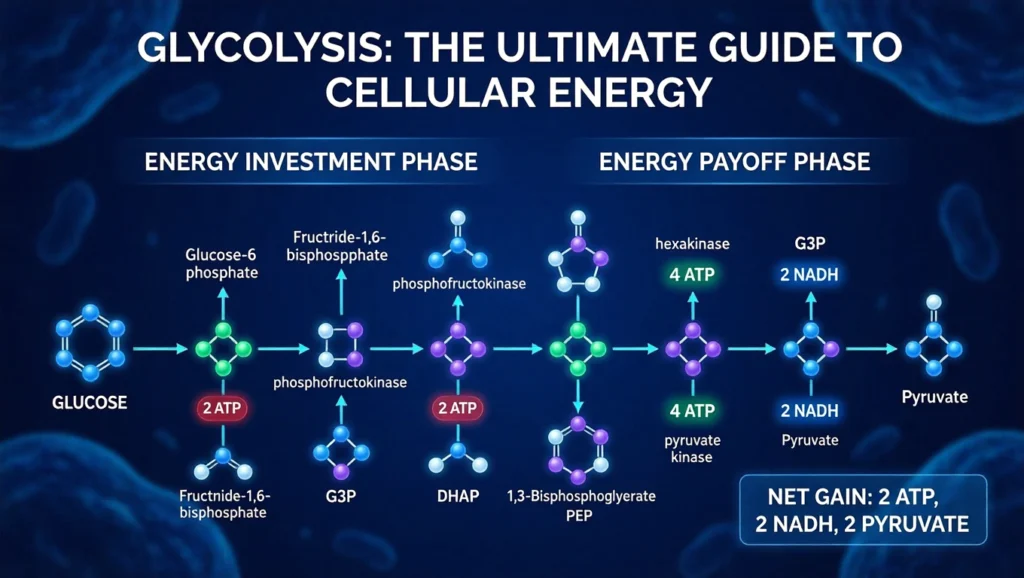
Glucose breakdown process consists of ten enzyme-driven steps. These steps can be grouped into two phases based on energy usage and production:
Energy Investment Phase
In the first phase, the cell invests energy to modify glucose and prepare it for breakdown. Glucose is first phosphorylated to glucose-6-phosphate using ATP. This step is catalyzed by hexokinase and prevents glucose from leaving the cell. Next, glucose-6-phosphate is converted into fructose-6-phosphate. This is followed by another phosphorylation step, forming fructose-1,6-bisphosphate using ATP.
The six-carbon molecule is then split into two three-carbon molecules: glyceraldehyde-3-phosphate (G3P) and dihydroxyacetone phosphate (DHAP). DHAP is quickly converted into G3P, ensuring both molecules continue through the pathway.
Energy Payoff Phase
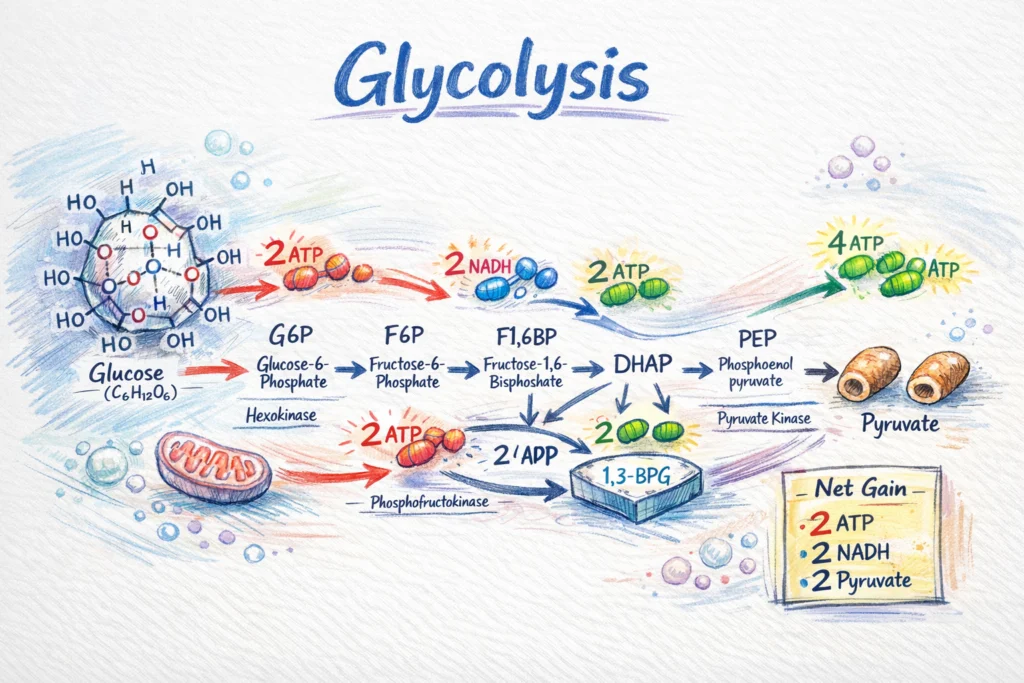
In the second phase, energy is generated. Each G3P molecule undergoes oxidation and phosphorylation, producing NADH. This is followed by substrate-level phosphorylation, which generates ATP. The pathway continues through several transformations until phosphoenolpyruvate (PEP) is formed. Finally, PEP is converted into pyruvate, producing another molecule of ATP. Since two G3P molecules are processed per glucose molecule, the energy yield is doubled in this phase.
Net Energy Yield of Glycolysis
The overall energy output of glucose breakdown process can be summarized clearly.
| Component | Quantity Produced |
|---|---|
| ATP (net) | 2 ATP |
| NADH | 2 NADH |
| Pyruvate | 2 molecules |
Although four ATP molecules are produced, two are consumed during the investment phase, resulting in a net gain of two ATP molecules.
This may seem small, but glucose breakdown process is extremely fast and provides immediate energy, especially under anaerobic conditions.
Enzymes Involved in Glycolysis
Each step of cellular respiration step is catalyzed by a specific enzyme, ensuring precision and regulation. Some of the key enzymes include hexokinase, phosphofructokinase, and pyruvate kinase. Among these, phosphofructokinase is considered the most important regulatory enzyme.
It acts as a rate-limiting step and controls the overall speed of this metabolic pathway based on the cell’s energy needs. Enzyme regulation ensures that glycolysis operates efficiently without wasting energy or resources.
Regulation of Glycolysis
Glycolysis is tightly regulated to maintain cellular energy balance. When ATP levels are high, cellular respiration step slows down because the cell does not need additional energy. Conversely, when ATP levels are low, the pathway speeds up to produce more energy.
Hormones such as insulin and glucagon also influence cellular respiration step. Insulin promotes this metabolic pathway by increasing glucose uptake and enzyme activity, while glucagon has the opposite effect. This regulation ensures that energy-producing pathway adapts to the physiological state of the organism.
Importance of Glycolysis in Living Organisms
Glycolysis plays a vital role in sustaining life. It provides energy quickly and supports various metabolic pathways. In muscle cells, energy-producing pathway allows rapid ATP production during intense exercise. In red blood cells, it is the only source of ATP because these cells lack mitochondria.
This metabolic pathway also supplies intermediates for biosynthesis, making it essential for cell growth and repair. Furthermore, it acts as a gateway to other metabolic pathways, such as the Krebs cycle and fermentation.
Glycolysis in Aerobic vs Anaerobic Conditions
The fate of pyruvate depends on the availability of oxygen. In aerobic conditions, pyruvate enters the mitochondria and is further oxidized in the Krebs cycle, leading to high ATP production.
In anaerobic conditions, pyruvate is converted into lactate in animals or ethanol in yeast. This process regenerates NAD⁺, allowing glucose breakdown process to continue. This flexibility makes this metabolic pathway a highly adaptable and essential pathway.
Clinical and Biological Significance
Glycolysis has significant implications in health and disease. In cancer cells, glucose breakdown process is often upregulated even in the presence of oxygen, a phenomenon known as the Warburg effect. This allows cancer cells to grow rapidly.
In metabolic disorders, defects in glycolytic enzymes can lead to serious health issues, including muscle weakness and anemia. Understanding energy-producing pathway also helps in developing treatments for diseases and improving metabolic health.
Common Misconceptions About Glycolysis
Many people misunderstand glycolysis as a simple or minor process. In reality, it is highly complex and tightly regulated. Another misconception is that energy-producing pathway produces large amounts of energy. While it produces less ATP than later stages, its speed and independence from oxygen make it indispensable.
Finally, some believe glucose breakdown process only occurs in humans, but it is present in almost all living organisms.
Conclusion
Glycolysis is a central metabolic pathway that sustains life by providing energy and essential intermediates. Despite producing a modest amount of ATP, its speed, efficiency, and ability to function without oxygen make it indispensable.
From powering muscle activity to supporting cellular growth, glucose breakdown process plays a critical role in biology. Its regulation ensures balance, while its universality highlights its evolutionary importance.
A clear understanding of glycolysis not only strengthens foundational knowledge in biology but also provides insights into health, disease, and metabolic processes.
You may also visit the Biology section.
FAQs About Glycolysis
What is glycolysis in simple terms?
Glycolysis is the process by which glucose is broken down into pyruvate to produce energy in the form of ATP.
Where does glycolysis occur?
It occurs in the cytoplasm of the cell.
Does glycolysis require oxygen?
No, glycolysis does not require oxygen and can occur under anaerobic conditions.
How many ATP are produced in glycolysis?
A net gain of 2 ATP molecules is produced per glucose molecule.
Why is glycolysis important?
It provides quick energy and serves as the first step in cellular respiration.
What happens to pyruvate after glycolysis?
It either enters the Krebs cycle (aerobic) or undergoes fermentation (anaerobic).
Which enzyme regulates glycolysis the most?
Phosphofructokinase is the key regulatory enzyme.
🌐 Connect With Us
👉 Informosio Tech – Science & Technology news, AI trends, gadgets, and innovations.