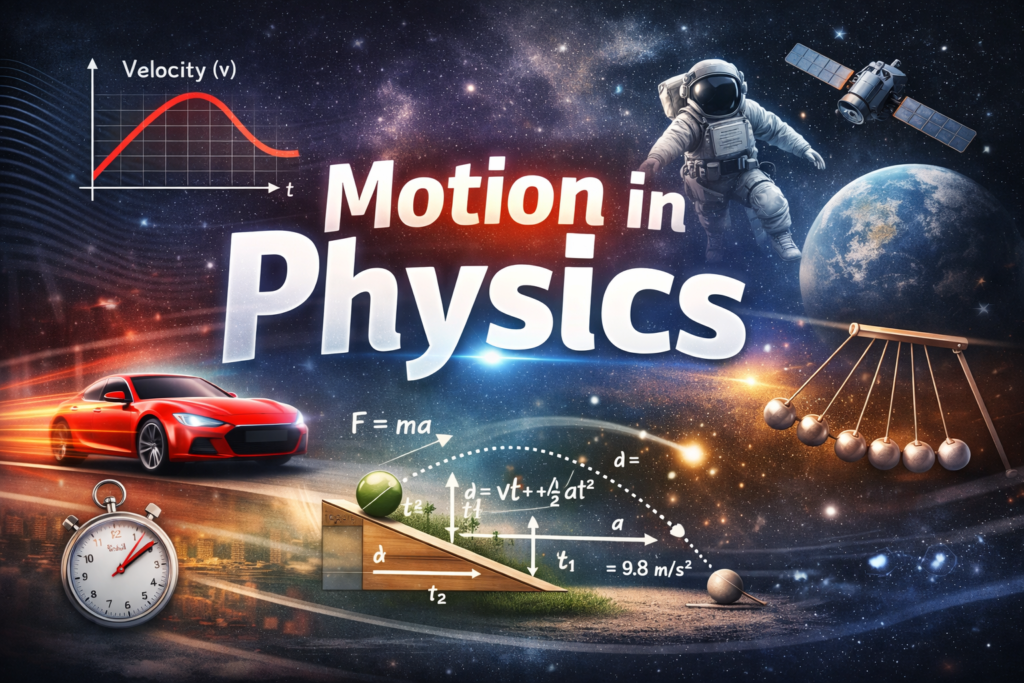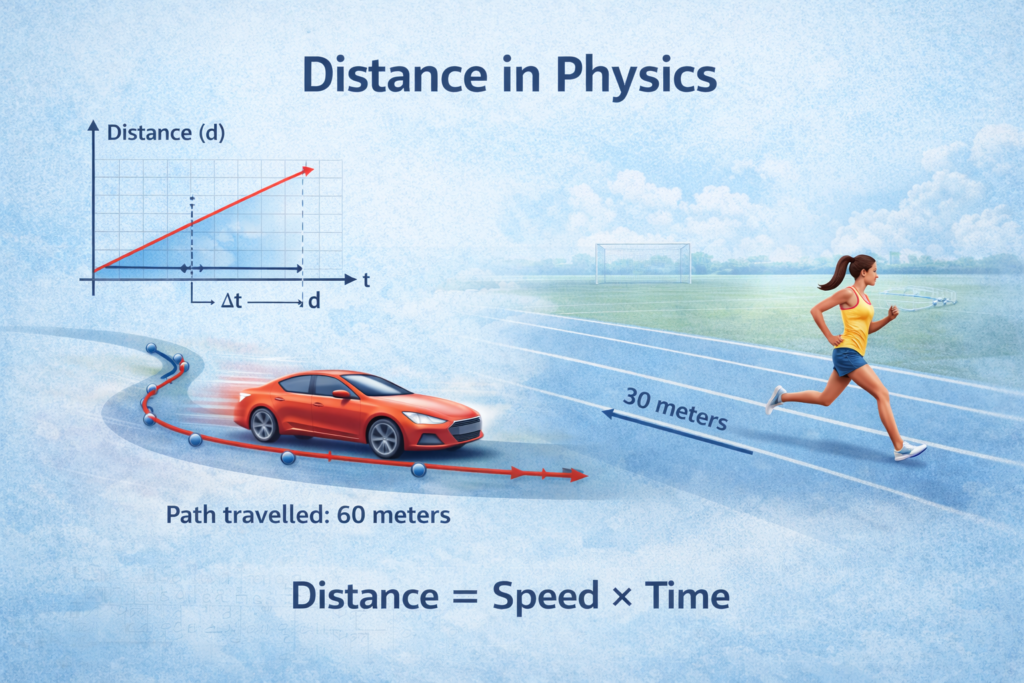
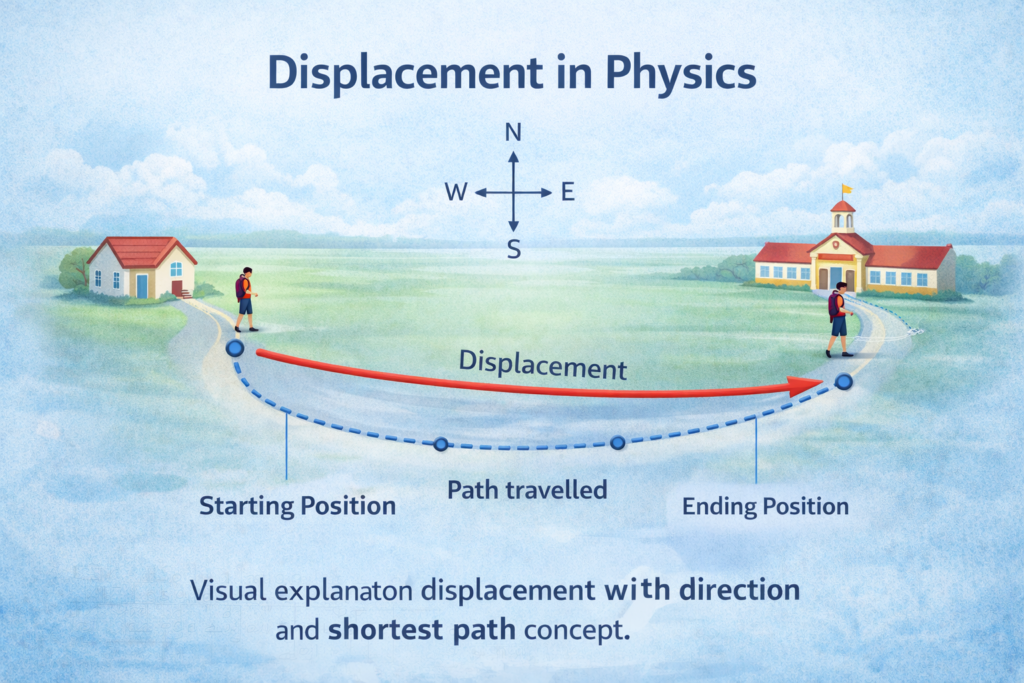
Displacement in physics explains the shortest change in position between starting and ending points. This article introduces direction-based motion, clear examples, and graphical understanding to help students build a strong foundation in kinematics.
What is Displacement in Physics?
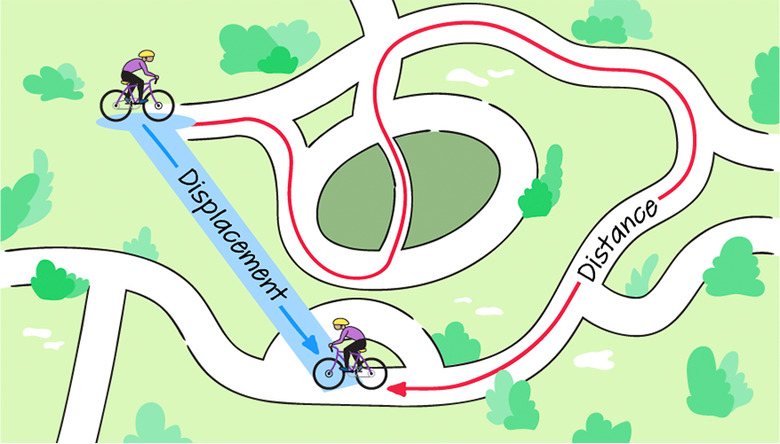
Displacement in physics refers to the shortest straight-line change in position between an object’s starting point and ending point. Unlike distance, which measures the total path travelled, displacement focuses on direction as well as magnitude. Because it includes direction, displacement is known as a vector quantity.
For example, if a person walks 10 meters east and then 10 meters west, the total distance covered is 20 meters, but the displacement becomes zero because the final position is the same as the starting point. Understanding displacement in physics helps students analyse movement more accurately and recognise how direction influences results.
👉 Back to: Complete Guide to Motion in Physics.
Displacement and Its Role in Motion
Displacement plays a major role when analysing how objects change their position over time. Scientists use displacement to describe how far and in which direction an object moves. This concept becomes especially important when studying velocity, acceleration, and graphical representations.
In everyday situations, displacement helps explain:
- The straight-line path between two locations
- Navigation using maps or GPS systems
- Directional changes during movement
By learning displacement in physics, students begin to understand why direction matters when analysing real-world scenarios.
Difference Between Distance and Displacement
Many beginners confuse distance with displacement because both describe movement. However, they represent different ideas:
- Distance measures total path length.
- Displacement measures the shortest straight-line change.
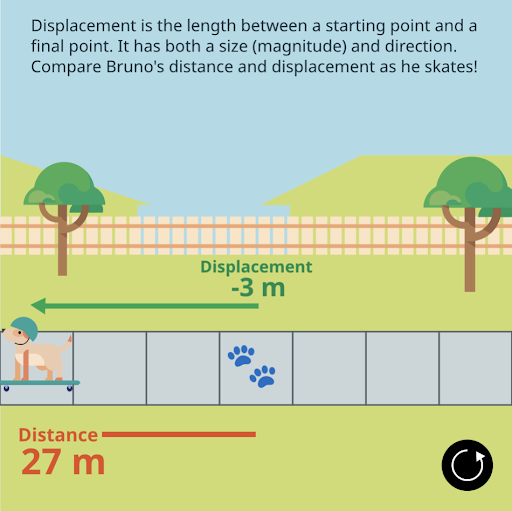
Imagine a runner completing one full circle around a track. The distance equals the entire lap length, but the displacement becomes zero because the runner ends where they started.
Understanding this difference improves problem-solving skills and prevents common mistakes in exams.
SI Unit of Displacement
The SI unit of displacement is the meter (m), just like distance. However, displacement always includes direction such as north, south, east, or west. Because of this directional component, displacement can have positive or negative values depending on the chosen reference direction.
For example:
- Moving 5 meters east may be considered positive.
- Moving 5 meters west may be considered negative.
Learning how direction affects displacement helps students interpret graphs and equations more clearly.
Displacement and Velocity
Velocity depends directly on displacement. While speed tells how fast something moves, velocity describes how fast and in which direction the object changes position. This makes displacement an essential part of advanced physics topics.
When students understand displacement in physics, they find it easier to calculate velocity using simple formulas and graphical analysis. Directional movement becomes clearer, and learners can interpret real-life examples more confidently.
👉 You can also explore speed in physics for deeper understanding.
Graphical Representation of Displacement
Displacement can be represented using position-time or displacement-time graphs. In such graphs:
- A straight line indicates steady directional change.
- A horizontal line shows no change in position.
- A sloped line represents constant velocity.
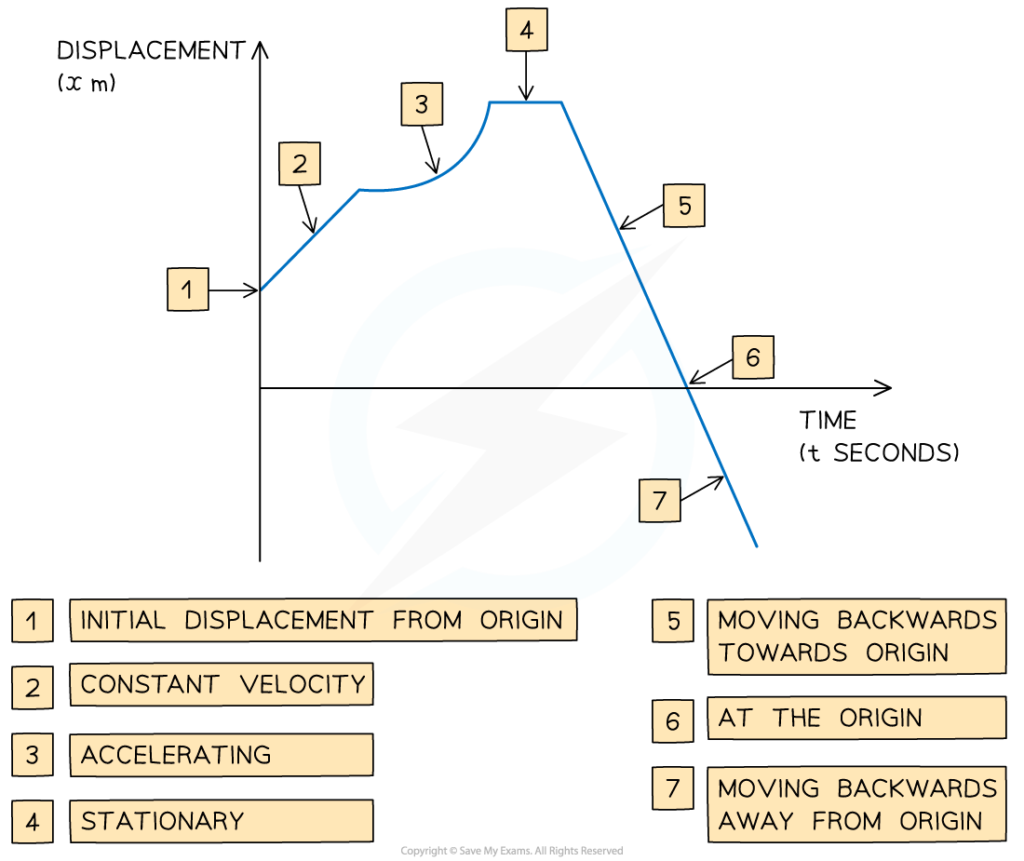
Graphs help visual learners quickly understand how an object’s position changes without needing long calculations. They also prepare students for more advanced kinematics topics.
Real-Life Examples of Displacement
Displacement appears in many real situations:
- A drone travelling directly from one point to another.
- A person walking straight from home to school.
- A car navigating using GPS directions.
These examples help students connect theoretical ideas with practical experiences, making physics more relatable.
Common Mistakes Students Make
While learning displacement, beginners often:
- Confuse displacement with distance
- Ignore direction while solving problems
- Assume displacement is always equal to distance
Avoiding these mistakes builds stronger conceptual understanding and improves exam performance.
Conclusion
Displacement in physics is a fundamental concept that describes the shortest change in position with direction included. By understanding displacement, students develop a clearer understanding of velocity, graphs, and advanced motion concepts. Mastering this idea strengthens the foundation needed for deeper studies in physics.
FAQs About Displacement in Physics
1. What is displacement in physics?
Displacement is the shortest straight-line change in position between starting and ending points.
2. Is displacement a scalar or vector quantity?
Displacement is a vector quantity because it includes direction.
3. Can displacement be negative?
Yes, displacement can be negative depending on the chosen reference direction.
4. Why is displacement important?
It helps describe directional movement and is essential for understanding velocity.
🌐 Connect With Us
👉 Informosio Official – General updates, current affairs, and informative content
👉 Continue your physics journey with our expert guides — visit our official website to explore more motion topics and student-friendly lessons.