Cytology
Cytology is one of the most important branches of biology because it focuses on the study of cells, the basic structural and functional units of life. Every living organism, from single-celled bacteria to complex multicellular humans, depends on cellular activity for survival.
The term this field comes from the Greek words kytos (cell) and logos (study). This field helps scientists understand how cells are formed, how they function, and how abnormalities in cells can lead to diseases. Today, the study of cells plays a crucial role in medical diagnosis, genetics, cancer detection, and biotechnology.
This article explains cellular science in a clear, structured, and beginner-friendly way while maintaining scientific accuracy.
What Is Cytology?
This field is the scientific study of cell structure, function, behavior, and life cycle. It examines cells under microscopes to understand their internal components and physiological processes.
Cells may be studied as:
- Individual units
- Groups forming tissues
- Samples taken from living organisms
The study of cells bridges biology and medicine by connecting cellular changes with health and disease.
Importance of Cytology in Biology and Medicine
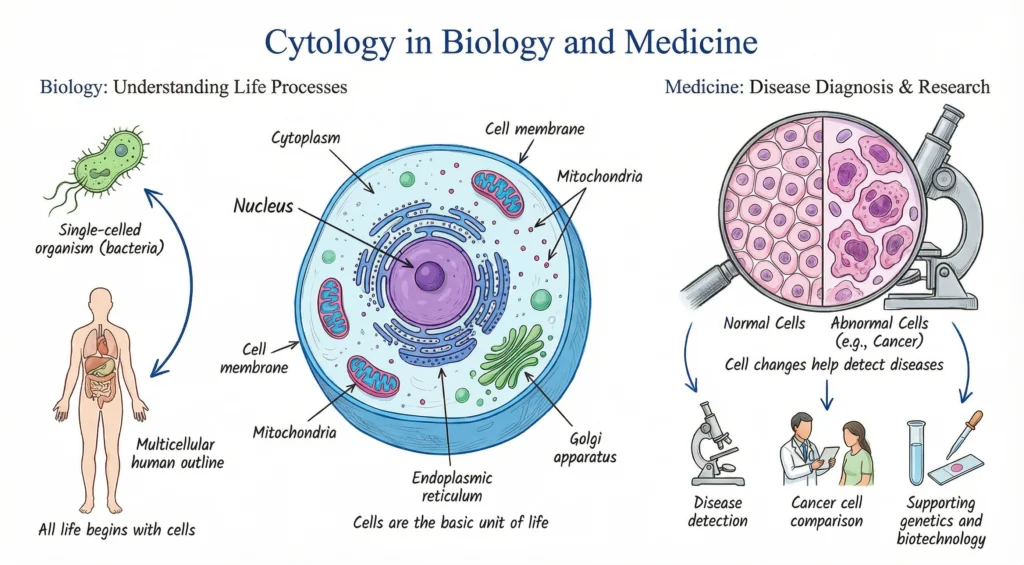
This field is essential because all biological functions begin at the cellular level.
Key reasons cellular science is important:
- Helps understand how life originates and develops
- Explains how diseases begin at the cellular stage
- Supports medical diagnostics and preventive healthcare
- Forms the foundation of genetics and molecular biology
Without this discipline, modern medicine and life sciences would be incomplete.
Cell Structure: The Core of Cytology
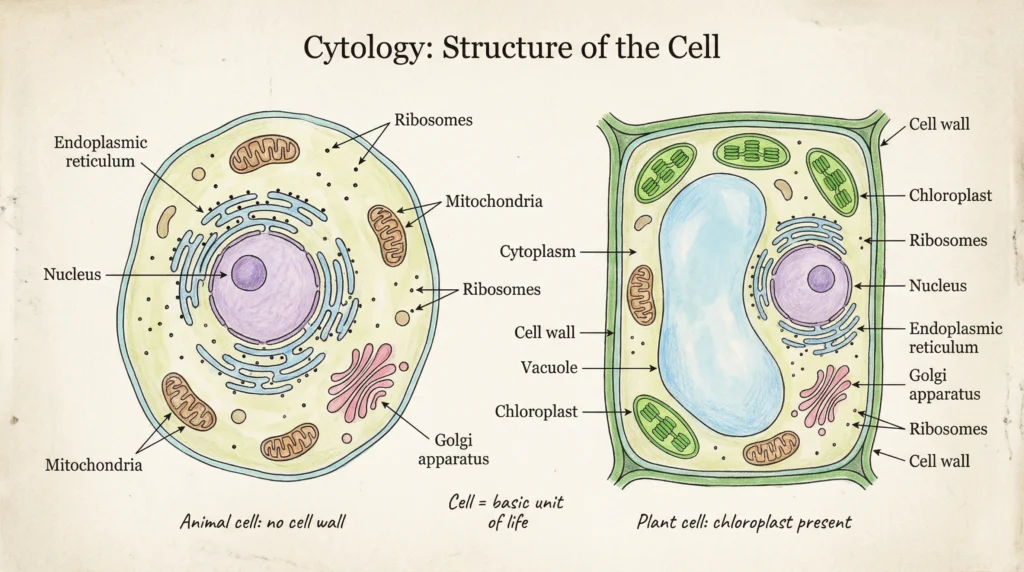
Understanding cell structure is central to cell biology branch. Cells are highly organized units with specialized components called organelles, each performing specific functions.
Major Components of a Cell
| Cell Component | Function |
|---|---|
| Cell membrane | Controls entry and exit of substances |
| Cytoplasm | Site of metabolic activities |
| Nucleus | Controls genetic material and cell division |
| Mitochondria | Produces energy (ATP) |
| Ribosomes | Protein synthesis |
| Endoplasmic reticulum | Transport and synthesis of molecules |
| Golgi apparatus | Packaging and secretion |
Plant cells additionally contain cell walls, chloroplasts, and large vacuoles, which are absent in animal cells.
Types of Cells Studied in Cytology
Cell biology branch classifies cells based on structure and complexity.
Prokaryotic Cells
- No true nucleus
- Found in bacteria
- Simple structure
Eukaryotic Cells
- True nucleus present
- Found in plants, animals, fungi, and protists
- Complex organelles
Specialized Cells
- Nerve cells for signal transmission
- Muscle cells for movement
- Blood cells for transport and immunity
Each type reflects adaptation to specific biological functions.
Cell examination techniques and Methods
Modern cellular science uses advanced tools to study cells accurately.
Common Cytological Techniques
- Light Microscopy – Basic cell observation
- Electron Microscopy – High-resolution internal details
- Staining Techniques – Enhances visibility of organelles
- Cytological Smears – Cells spread on slides for diagnosis
- Fine Needle Aspiration Cytology (FNAC) – Diagnostic sampling method
These techniques allow scientists to detect even minute cellular changes.
Role of Cytology in Medical Diagnosis
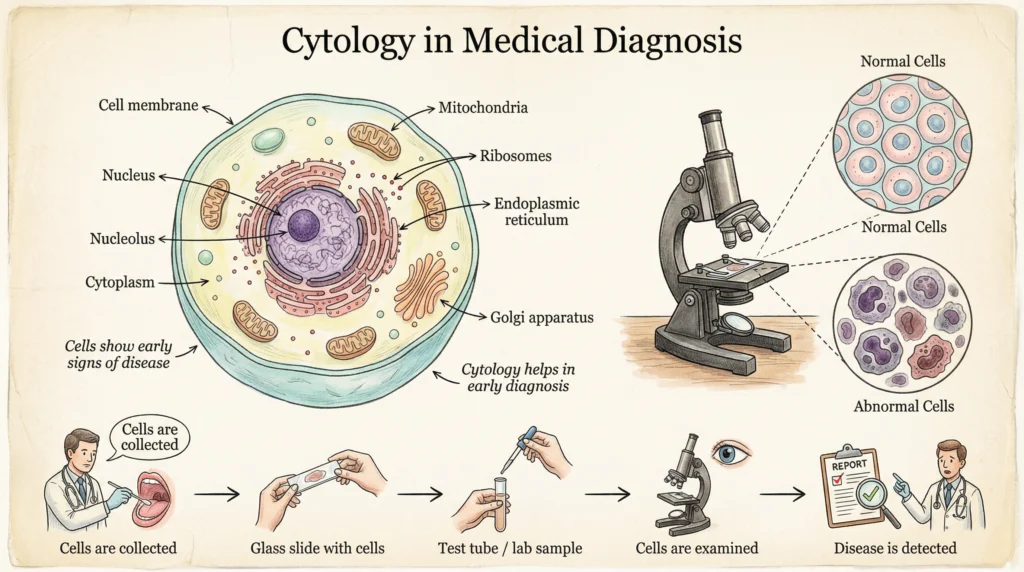
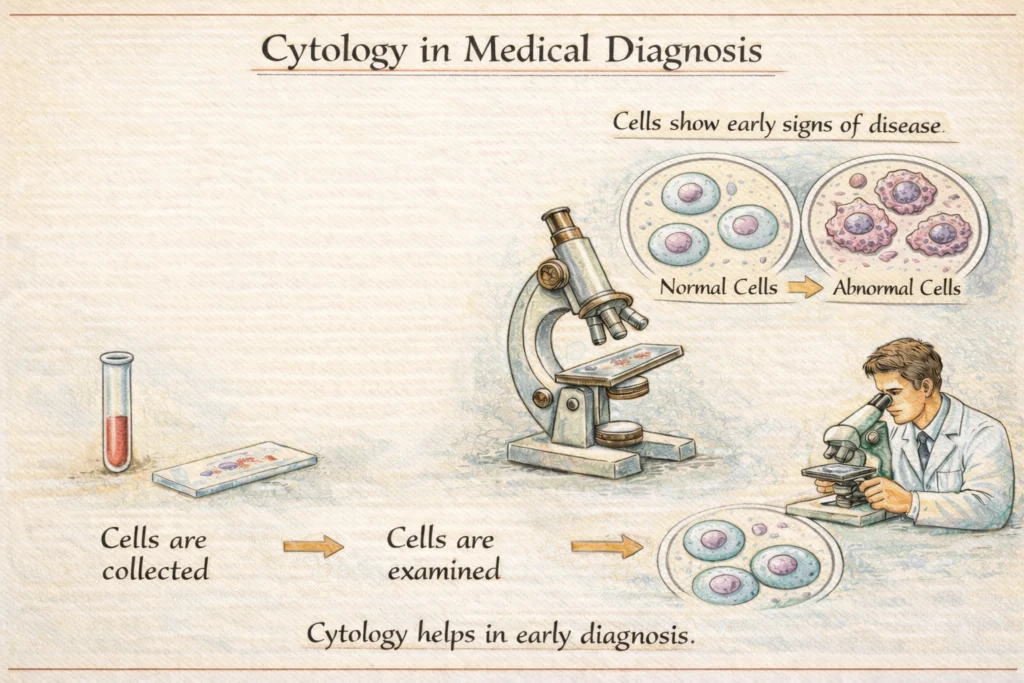
One of the most powerful applications of this field is early disease detection.
Medical Uses of this field
- Cancer screening (e.g., cervical cytology)
- Detection of infections
- Identification of inflammatory diseases
- Evaluation of tumors and cysts
This field is minimally invasive, cost-effective, and provides rapid results, making it ideal for clinical use.
Cytology and Cancer Detection
Cancer begins with abnormal cell growth. This approach helps identify:
- Changes in cell size and shape
- Irregular nuclear structures
- Abnormal cell division patterns
Early cytological diagnosis significantly increases survival rates by enabling timely treatment.
Relationship Between Cytology and Genetics
This field contributes to genetics by studying:
- Chromosome structure
- Cell division processes like mitosis and meiosis
- Genetic mutations at the cellular level
This connection helps explain inherited disorders and genetic diseases.
Educational and Research Value of Cytology
This field is a foundational subject for:
- Biology students
- Medical professionals
- Biotechnologists
- Researchers
It supports innovation in:
- Stem cell research
- Regenerative medicine
- Drug development
- Molecular diagnostics
Common Misconceptions About Cytology
- Cellular science is not limited to cancer detection only
- It studies both healthy and diseased cells
- It is different from histology, which studies tissues
Understanding these distinctions improves conceptual clarity.
Conclusion
Cytology is a cornerstone of modern biology and medicine because it explains life at its most fundamental level—the cell. From understanding basic cell structure to diagnosing life-threatening diseases, this field connects theory with real-world applications.
With advancements in technology, the study of cells continues to evolve, offering deeper insights into cellular behavior and disease prevention. Mastering the study of cells not only strengthens biological knowledge but also supports innovations that improve human health and scientific progress.
You might like to visit Biology.
FAQs About Cytology
What is Cytology in simple words?
Cell biology branch is the study of cells, including their structure, function, and behavior.
Why is Cytology important in medicine?
It helps detect diseases early by examining abnormal cells.
Is Cell biology branch the same as histology?
No, cell biology branch studies individual cells, while histology studies tissues.
What tools are used in Cytology?
Microscopes, stains, and cytological sampling techniques are commonly used.
Can Cytology detect cancer?
Yes, Cell biology branch plays a major role in early cancer detection.
Who studies Cytology?
Biologists, pathologists, medical researchers, and healthcare professionals
🌐 Connect With Us
👉 Informosio Tech – Science & Technology news, AI trends, gadgets, and innovations