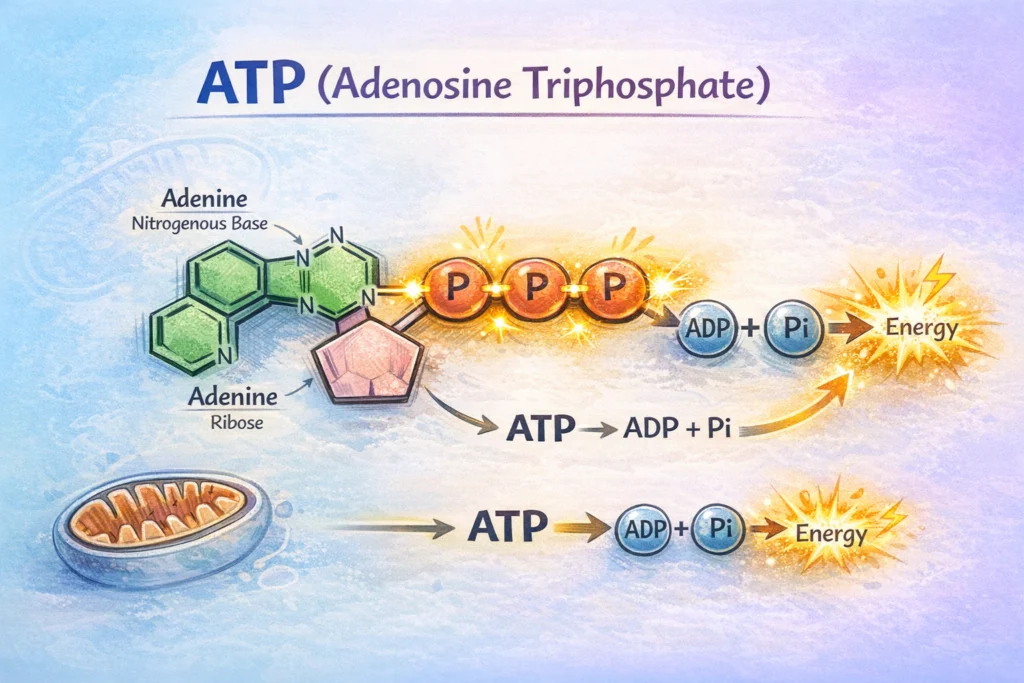
Adenosine triphosphate is often called the “energy currency” of the cell, and for good reason. Every living organism, from microscopic bacteria to complex humans, relies on cell energy source to perform essential biological processes. Without biological energy unit, life as we know it would not exist. This molecule acts as a universal energy carrier, enabling cells to store and transfer energy efficiently.
At Informosio, Understanding cellular energy molecule is fundamental in biology because it connects nearly all cellular activities, including metabolism, movement, and active transport. This blog explores energy carrier of the cell in a clear, professional, and easy-to-understand way while maintaining strong SEO practices.
What is ATP
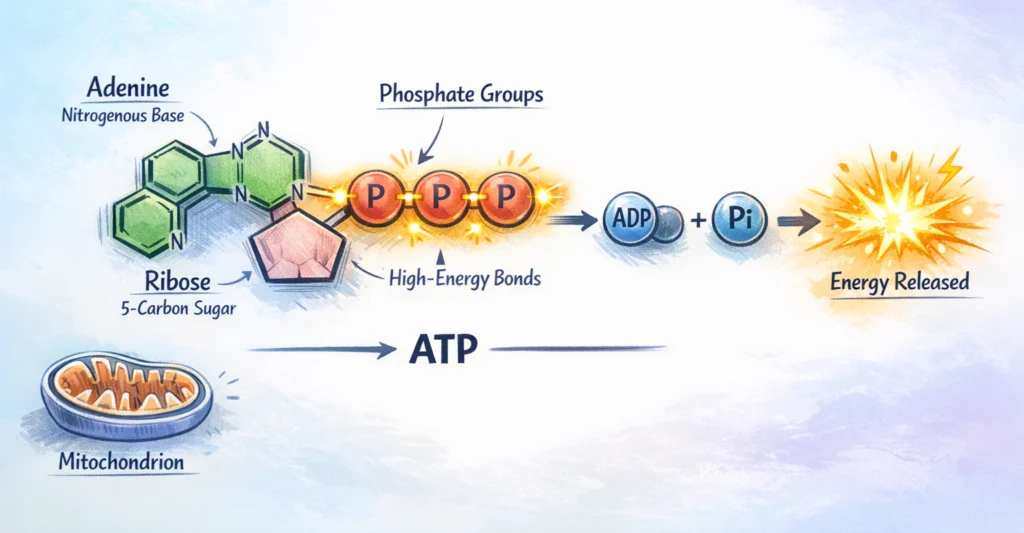
ATP (adenosine triphosphate) is a high-energy molecule found in all living cells. It stores chemical energy in its bonds and releases it when needed to drive cellular processes.
Structurally, energy carrier of the cell consists of three main components. It includes adenine, which is a nitrogenous base, ribose, a five-carbon sugar, and three phosphate groups. The bonds between these phosphate groups are where energy is stored.
When cell energy source loses one phosphate group, it becomes ADP (adenosine diphosphate), releasing energy in the process. This simple yet powerful mechanism makes energy molecule indispensable for life.
Structure of Adenosine Triphosphate
The structure of cell energy source is specifically designed for energy transfer. Each part of the molecule plays a crucial role in its function.
The three phosphate groups are linked by high-energy bonds. These bonds are unstable and easily broken, which allows energy molecule to release energy quickly when required.
The following table summarizes the structure of cell energy source:
| Component | Description | Function |
|---|---|---|
| Adenine | Nitrogenous base | Forms part of the molecule |
| Ribose | Five-carbon sugar | Connects adenine and phosphates |
| Phosphate Groups | Three linked phosphates | Store and release energy |
This structure makes ATP an efficient and reusable energy carrier.
How ATP Stores and Releases Energy
ATP (adenosine triphosphate) stores energy in the bonds between its phosphate groups. When the terminal phosphate bond is broken through hydrolysis, energy is released.
The reaction can be described simply as:
ATP → ADP + Pi + Energy
This released energy is used by cells for various functions such as muscle contraction, nerve impulse transmission, and biosynthesis.
What makes phosphate energy molecule unique is its ability to be recycled. After releasing energy, ADP can be converted back into cell energy source using energy from food or sunlight, depending on the organism.
Functions of biological energy unit in Living Cells
Adenosine triphosphate plays a central role in almost every cellular activity. It acts as a direct source of energy for multiple biological processes.
Cells use cell energy source to power active transport across membranes. This allows substances to move against their concentration gradient, which is essential for maintaining cellular balance.
Adenosine triphosphate is also required for mechanical work such as muscle contraction. In addition, it drives chemical work by helping synthesize proteins, DNA, and other essential molecules.
Another important role of cellular energy molecule is in signal transduction. It helps transmit signals within and between cells, ensuring proper communication in biological systems.
ATP Production in Cells
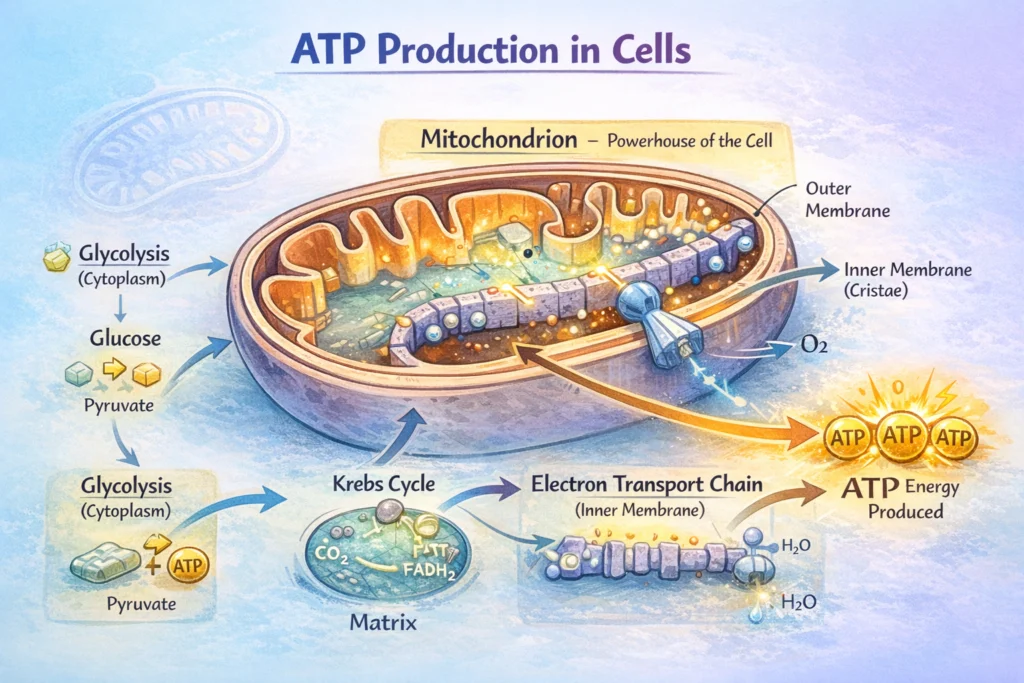
ATP (adenosine triphosphate) is continuously produced in cells through several metabolic pathways. The primary methods include cellular respiration and, in plants, photosynthesis.
In eukaryotic cells, cellular energy molecule is mainly produced in mitochondria through aerobic respiration. This process involves glycolysis, the Krebs cycle, and the electron transport chain.
During glycolysis, a small amount of biological energy unit is generated in the cytoplasm. The Krebs cycle and electron transport chain produce the majority of biological energy unit inside mitochondria.
In plants, cellular energy molecule is also produced during photosynthesis in chloroplasts. Light energy is converted into chemical energy, which is stored in energy carrier of the cell.
Importance of ATP in Metabolism
ATP (adenosine triphosphate) is the link between energy-releasing and energy-consuming reactions in metabolism. It acts as a bridge that transfers energy where it is needed.
Catabolic reactions break down molecules like glucose to release energy. This energy is captured in biological energy unit. On the other hand, anabolic reactions use cell energy source to build complex molecules such as proteins and nucleic acids.
Without phosphate energy molecule, metabolic processes would not be coordinated, and cells would not function efficiently. This makes cell energy source essential for maintaining life.
Why ATP is Called the Energy Currency
ATP (adenosine triphosphate) is often compared to money in an economy. Just as currency is used to pay for goods and services, phosphate energy molecule is used to “pay” for cellular activities.
Its universal presence in all living organisms highlights its importance. Cells do not store large amounts of biological energy unit, so it must be constantly produced and used.
This constant cycle ensures that energy is available whenever needed, making phosphate energy molecule the most efficient energy carrier in biological systems.
Key Facts About ATP
ATP is a small molecule, yet it plays a massive role in sustaining life. It is present in every cell and is used rapidly.
The human body uses and regenerates its weight in energy molecule every day. This shows how dynamic and essential this molecule is.
Adenosine triphosphate is the foundation of energy transfer in all living systems. Its unique structure allows it to store and release energy efficiently, making it indispensable for life. From powering cellular processes to maintaining metabolic balance, energy molecule plays a central role in biology.
Conclusion
ATP (adenosine triphosphate) is the foundation of energy transfer in all living systems. Its unique structure allows it to store and release energy efficiently, making it indispensable for life. From powering cellular processes to maintaining metabolic balance, cell energy source plays a central role in biology.
Understanding cell energy source helps us appreciate how cells function and how energy flows within living organisms. Its constant production and usage highlight the dynamic nature of life at the molecular level.
You may also visit the Biology section.
FAQs About ATP
What is cellular energy molecule in simple terms?
Cellular energy molecule is a molecule that stores and provides energy for cells to function.
Where is biological energy unit produced?
Bological energy unit is mainly produced in mitochondria during cellular respiration, and in chloroplasts during photosynthesis in plants.
Why is adenosine Triphosphate important?
Adenosine Triphosphate is an be recycled. ADP is converted back into biological energy unit using energy from food or sunlight.
How doescell energy source release energy?
Cell energy source releases energy when one of its phosphate bonds is broken, converting it into ADP.
Can biological energy unit be reused?
Yes, biological energy unit can be recycled. ADP is converted back into biological energy unit using energy from food or sunlight.
Is biological energy unit found in all living organisms?
Yes, biological energy unit is present in all living cells, making it a universal energy carrier.
How much cell energy source does the human body use daily?
The human body uses and regenerates a large amount of cell energy source daily, roughly equivalent to body weight.
🌐 Connect With Us
👉 Informosio Tech – Science & Technology news, AI trends, gadgets, and innovations.