
Artificial Intelligence & Tools have become one of the most important topics in modern education, workplaces, and daily life. From students writing assignments to professionals analyzing data, Artificial Intelligence (AI) is changing how people learn, work, and solve problems.
In recent years, the growth of Artificial Intelligence & Tools has accelerated due to powerful computers, large data availability, and advanced algorithms. AI is no longer limited to research laboratories; it is now used in classrooms, offices, hospitals, banks, and even mobile phones.
This article explains Artificial Intelligence & Tools in a clear, student-friendly, and academic manner. It covers definitions, working principles, biological inspiration, step-by-step processes, functions, importance, real-life examples, common misconceptions, exam-oriented notes, practice questions, and FAQs.
The goal is to help students and beginners understand AI clearly, not just memorize definitions.

What Is Artificial Intelligence & Tools?
Definition of Artificial Intelligence
Artificial Intelligence is a branch of computer science that focuses on creating machines and software that can think, learn, and make decisions like humans.
In simple words:
Artificial Intelligence is when a machine is made smart enough to perform tasks that normally require human intelligence.
Definition of AI Tools
AI Tools are software applications or platforms that use artificial intelligence techniques to perform tasks such as writing, analyzing data, recognizing images, translating languages, or answering questions.
Together, Artificial Intelligence & Tools refer to both:
- The science behind intelligence, and
- The applications that use that intelligence.
Why Artificial Intelligence & Tools Are Important Today
Artificial Intelligence & Tools are important because they:
- Reduce human effort
- Increase speed and accuracy
- Improve decision-making
- Support personalized learning
- Help businesses and students save time
In education and work environments, AI tools act as assistants, not replacements.
Biological Inspiration Behind Artificial Intelligence
Human Brain as a Model
Artificial Intelligence is inspired by the human brain. The brain contains billions of neurons that communicate using electrical signals. Similarly, AI systems use artificial neural networks.
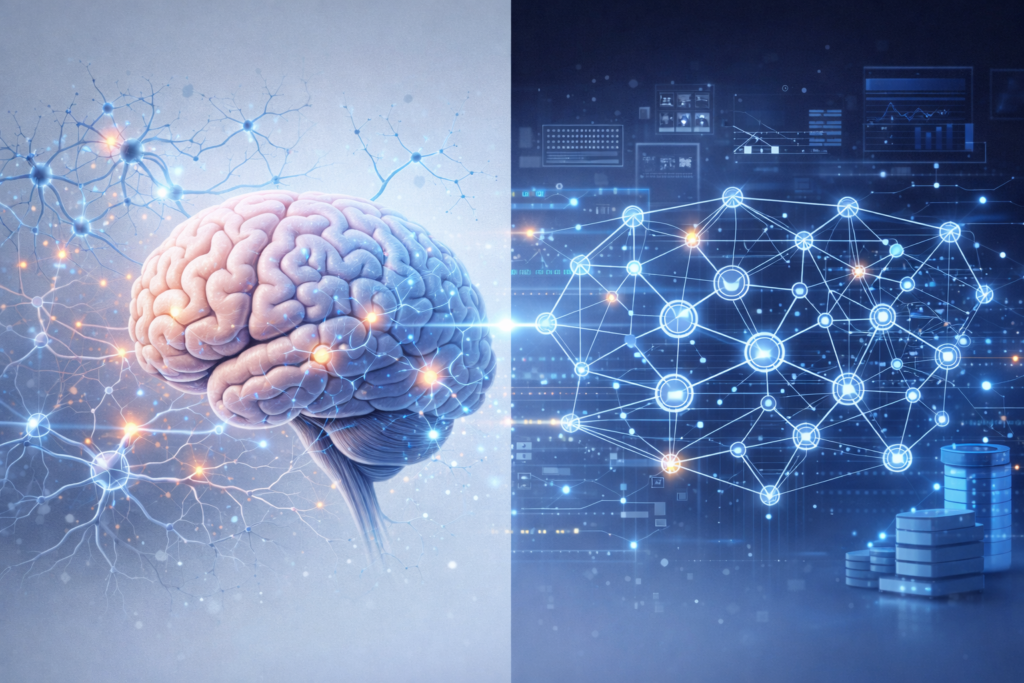
Comparison: Human Brain vs AI System
| Human Brain | AI System |
|---|---|
| Neurons | Artificial neurons |
| Learning from experience | Learning from data |
| Memory | Data storage |
| Decision making | Algorithmic output |
This biological inspiration helps AI systems learn patterns and make predictions.
How Artificial Intelligence Works (Step-by-Step)
Step 1: Data Collection
AI systems need data. Data can be:
- Text
- Images
- Audio
- Videos
- Numbers
Example: Student marks, attendance records, or online articles.
Step 2: Data Processing
The collected data is cleaned and organized. Errors, duplicates, and irrelevant data are removed.
Step 3: Algorithm Selection
An algorithm is a set of rules used to solve a problem. Common AI algorithms include:
- Decision trees
- Neural networks
- Regression models
Step 4: Training the Model
The AI model learns patterns from the data. This process is called training.
Step 5: Testing and Validation
The trained model is tested with new data to check accuracy.
Step 6: Output Generation
The AI system produces results such as:
- Predictions
- Answers
- Recommendations
Types of Artificial Intelligence
Narrow AI
- Performs one specific task
- Example: Voice assistants, chatbots
General AI
- Can perform multiple tasks like humans
- Still under research
Super AI
- More intelligent than humans
- Theoretical concept
Most AI tools today use Narrow AI.
Major Categories of AI Tools
1. Generative AI Tools
Generative AI tools create new content such as:
- Text
- Images
- Music
- Code
Examples include writing assistants and image generators.
2. Analytical AI Tools
These tools analyze data and find patterns. Used in:
- Business analytics
- Research
- Finance
3. Educational AI Tools
Designed for students and teachers:
- Study assistants
- Automated grading
- Personalized learning platforms
4. Workplace AI Tools
Used in offices for:
- Email drafting
- Data visualization
- Task automation
Best Artificial Intelligence & Tools for Students
Writing and Research Tools

These tools help students:
- Write essays
- Summarize articles
- Improve grammar
Study and Learning Tools
AI-based learning tools:
- Explain concepts step-by-step
- Adapt to student learning speed
- Provide practice questions
Coding and Technical Tools
Useful for engineering and computer science students:
- Code generation
- Debugging
- Algorithm explanation
Best Artificial Intelligence & Tools for Work
Productivity Tools
- Automate repetitive tasks
- Schedule meetings
- Draft professional documents
Data Analysis Tools
- Analyze large datasets
- Generate reports
- Predict trends
Creative Tools
- Design graphics
- Create presentations
- Generate marketing content
Comparison: AI Tools for Students vs Professionals
| Feature | Students | Professionals |
|---|---|---|
| Purpose | Learning & practice | Efficiency & productivity |
| Complexity | Simple | Advanced |
| Output | Explanations | Actionable insights |
Functions of Artificial Intelligence & Tools
- Automation of tasks
- Pattern recognition
- Decision support
- Content generation
- Personalization
Importance of Artificial Intelligence in Education

Artificial Intelligence & Tools improve education by:
- Supporting slow learners
- Providing instant feedback
- Reducing teacher workload
- Enabling remote learning
AI helps create inclusive and adaptive education systems.
Real-Life Examples of Artificial Intelligence & Tools
Example 1: Smart Classrooms
AI tools track student performance and suggest improvements.
Example 2: Virtual Assistants
Students use AI chat tools for doubt clearing.
Example 3: Workplace Automation
Companies use AI tools for resume screening and customer support.
Common Mistakes and Misconceptions
Misconception 1: AI Will Replace Teachers
AI supports teachers but cannot replace human guidance.
Misconception 2: AI Thinks Like Humans
AI processes data; it does not have emotions or consciousness.
Misconception 3: AI Is Always Accurate
AI depends on data quality. Wrong data leads to wrong results.
Ethical Issues in Artificial Intelligence
- Data privacy
- Bias in algorithms
- Over-dependence on AI
- Lack of transparency
Ethical use of Artificial Intelligence & Tools is essential.
Exam-Oriented Notes (Quick Revision)
- AI is data-driven
- AI tools use algorithms
- Machine learning is a subset of AI
- Generative AI creates content
- AI improves efficiency, not emotions
Practice Questions with Answers
Question 1
Define Artificial Intelligence.
Answer:
Artificial Intelligence is the ability of machines to perform tasks that require human intelligence.
Question 2
Name two AI tools used in education.
Answer:
AI writing assistants and personalized learning platforms.
Question 3
What is Generative AI?
Answer:
Generative AI creates new content such as text or images.
Summary for Revision
Artificial Intelligence & Tools represent a powerful combination of intelligent systems and practical applications. AI works using data, algorithms, and learning models inspired by the human brain. AI tools are widely used in education and workplaces to improve productivity, learning, and decision-making. While AI offers many benefits, ethical use and human supervision remain essential.
Frequently Asked Questions (FAQs)
FAQ 1: What is Artificial Intelligence & Tools?
Artificial Intelligence & Tools refer to intelligent systems and applications that perform human-like tasks.
FAQ 2: Are AI tools safe for students?
Yes, when used responsibly and ethically.
FAQ 3: Can AI tools help in exams?
AI tools help in preparation, not cheating.
FAQ 4: Is coding required to use AI tools?
Most AI tools do not require coding knowledge.
FAQ 5: Will AI replace jobs?
AI changes jobs but also creates new opportunities.
FAQ 6: What skills are needed to use AI tools?
Basic computer skills and critical thinking.