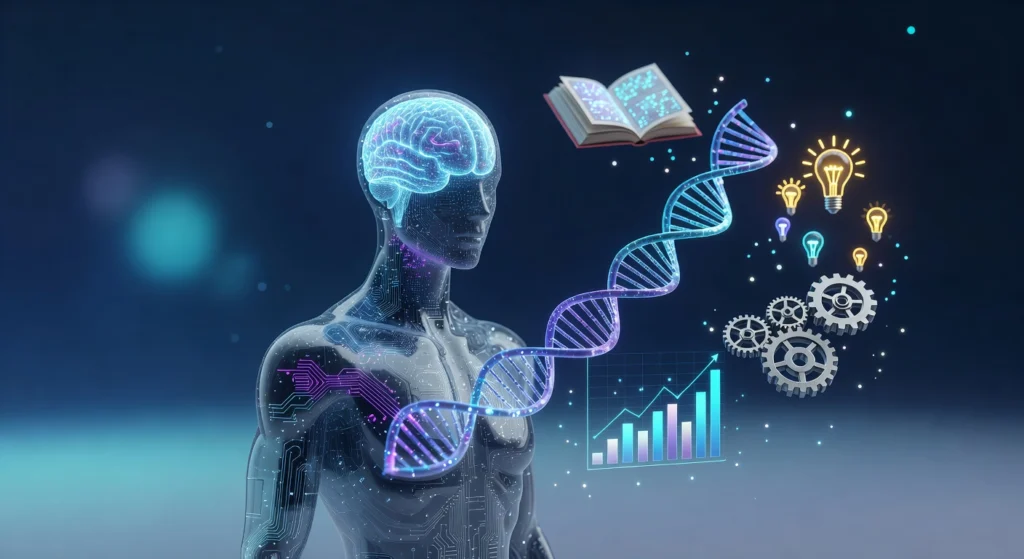
Artificial general intelligence (AGI) is one of the most transformative and debated concepts in modern science and technology. Unlike narrow AI systems that perform specific tasks, cognitive AI models aims to replicate human-level thinking across a wide range of activities. From problem-solving to creativity, AGI represents a leap toward machines that can understand, learn, and adapt in ways similar to humans.
At Informosio, In recent years, rapid advances in machine learning and computational power have made artificial general intelligence a central topic in both technology and biology-related discussions. Understanding AGI requires exploring not only computer science but also cognitive biology, as it attempts to mimic how the human brain functions.
What Is Artificial General Intelligence ?
Artificial general intelligence refers to a type of intelligence in machines that can perform any intellectual task that a human can do. Unlike narrow AI, which is designed for specific purposes such as image recognition or language translation, the human-level AI is flexible and adaptable.
The human-level AI systems are expected to possess reasoning, problem-solving, abstract thinking, and learning abilities across multiple domains. This makes AGI fundamentally different from existing artificial intelligence technologies.
From a biological perspective, the human-level AI is inspired by the human brain. Scientists study neural networks, brain plasticity, and learning behavior to design systems that can generalize knowledge instead of relying on predefined instructions.
Biological Inspiration Behind AGI
Artificial general intelligence is deeply rooted in biological principles, particularly neuroscience. The human brain is a highly complex organ capable of learning from experience, adapting to new situations, and making decisions based on incomplete information.
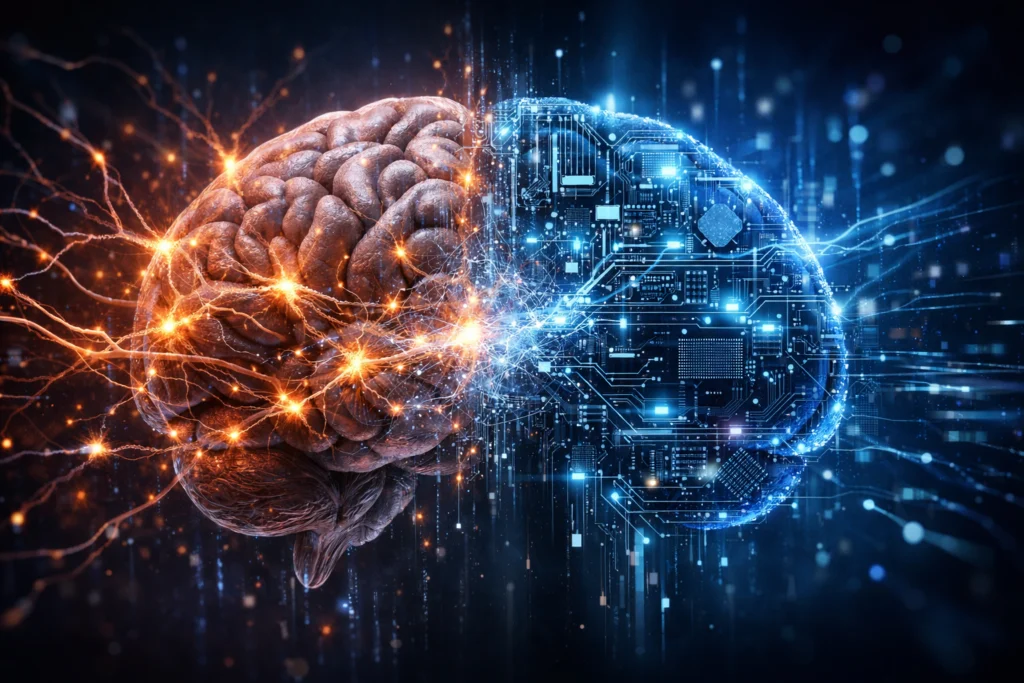
Researchers aim to replicate these biological processes using artificial neural networks. These networks are modeled after neurons in the brain, where each node processes information and communicates with others.
One key biological concept influencing the human-level AI is neuroplasticity. This refers to the brain’s ability to reorganize itself by forming new neural connections. The human-level AI systems attempt to mimic this adaptability, enabling machines to learn continuously without needing retraining from scratch.
Another important aspect is cognitive flexibility. Humans can switch between tasks and apply knowledge in different contexts. Artificial general intelligence seeks to achieve this same flexibility, allowing machines to operate effectively in diverse environments.
How AGI Differs from Narrow AI
Understanding the difference between cognitive AI models and narrow AI is essential to grasp its significance. Narrow AI systems are designed for specific tasks and operate within limited boundaries.
Artificial general intelligence, on the other hand, is not restricted to a single domain. It can learn new skills, apply knowledge across disciplines, and improve over time.
| Feature | Narrow AI | Artificial General Intelligence |
|---|---|---|
| Scope | Task-specific | General-purpose |
| Learning | Limited | Continuous and adaptive |
| Flexibility | Low | High |
| Human-like reasoning | No | Yes |
This distinction highlights why AGI is considered the next major milestone in artificial intelligence development.
Key Characteristics of Artificial General Intelligence
Artificial general intelligence is defined by several core characteristics that distinguish it from current AI systems. These characteristics are based on both computational and biological principles.
AGI systems are expected to demonstrate the ability to learn from minimal data, similar to how humans can learn new concepts quickly. They should also exhibit reasoning skills, enabling them to solve complex problems without explicit programming.
Another important trait is self-improvement. The human-level AI systems can analyze their own performance and optimize their behavior over time. This capability is inspired by human learning processes, where individuals refine their understanding through experience.
Additionally, the human-level AI involves contextual understanding. Unlike narrow AI, which relies on patterns, the human-level AI can interpret meaning and apply knowledge appropriately in different situations.
Applications of AGI in Biology and Beyond
Artificial general intelligence has the potential to revolutionize multiple fields, especially biology and healthcare. Its ability to analyze vast amounts of data and identify patterns can lead to breakthroughs in scientific research.
In biology, the human-level AI could accelerate drug discovery by simulating complex biological processes and predicting outcomes. This would significantly reduce the time required to develop new treatments.
AGI can also enhance personalized medicine. By analyzing genetic data and patient history, it can recommend tailored treatments that improve outcomes.
Beyond biology, the human-level AI could transform industries such as education, finance, and engineering. Its ability to learn and adapt makes it suitable for solving problems that require creativity and critical thinking.
Challenges and Risks of the human-level AI
Despite its potential, artificial general intelligence presents several challenges and risks. One of the primary concerns is safety. Ensuring that the human-level AI systems behave in ways aligned with human values is a complex problem.
Another challenge is computational complexity. Developing AGI requires massive computational resources and advanced algorithms, making it difficult to achieve in the near term.
Ethical concerns also play a significant role. The deployment of the human-level AI could lead to job displacement, privacy issues, and unequal access to technology.
There is also the risk of unintended consequences. The human-level AI systems, if not properly controlled, could make decisions that are harmful or unpredictable.
The Future of Cognitive AI models (AGI)
The future of artificial general intelligence is both exciting and uncertain. While significant progress has been made in AI, achieving true the human-level AI remains a long-term goal.
Researchers are exploring new approaches, including hybrid models that combine symbolic reasoning with neural networks. These methods aim to overcome the limitations of current AI systems.
Collaboration between disciplines such as biology, neuroscience, and computer science will be crucial in advancing the human-level AI. By understanding how the human brain works, scientists can design more effective and intelligent systems.
Although the human-level AI is not yet a reality, its development could redefine how humans interact with technology and solve global challenges.
Closing Insights
Artificial general intelligence represents a significant step toward creating machines that can think and learn like humans. By combining insights from biology and computer science, the human-level AI aims to replicate the adaptability and intelligence of the human brain. While challenges remain, the potential benefits of artificial general intelligence and the human-level AI are immense, ranging from scientific breakthroughs to solving complex global problems. As research continues, understanding AGI will become increasingly important for shaping the future of technology and society.
Visit our AI & Robotics section regularly to keep learning, growing, and working securely in the digital economy.
FAQs About Artificial General Intelligence
What is artificial general intelligence in simple terms?
Artificial general intelligence is a type of AI that can think, learn, and solve problems like a human across different tasks.
How is AGI different from AI?
The human-level AI refers to general intelligence, while most AI today is narrow and designed for specific tasks.
Is AGI already developed?
No, true artificial general intelligence has not yet been achieved, although research is ongoing.
Why is AGI important in biology?
The human-level AI can analyze complex biological systems, accelerating research in areas like genetics and drug discovery.
What are the risks of AGI?
Risks include ethical concerns, safety issues, and potential misuse if not properly regulated.
Can AGI replace humans?
The human-level AI aims to match human intelligence, but its role is more likely to assist rather than replace humans.
When will the human-level AI become a reality?
There is no clear timeline, but experts believe it may take several decades to develop.
🌐 Connect With Us
👉 Informosio Official – General updates, current affairs, and informative content.