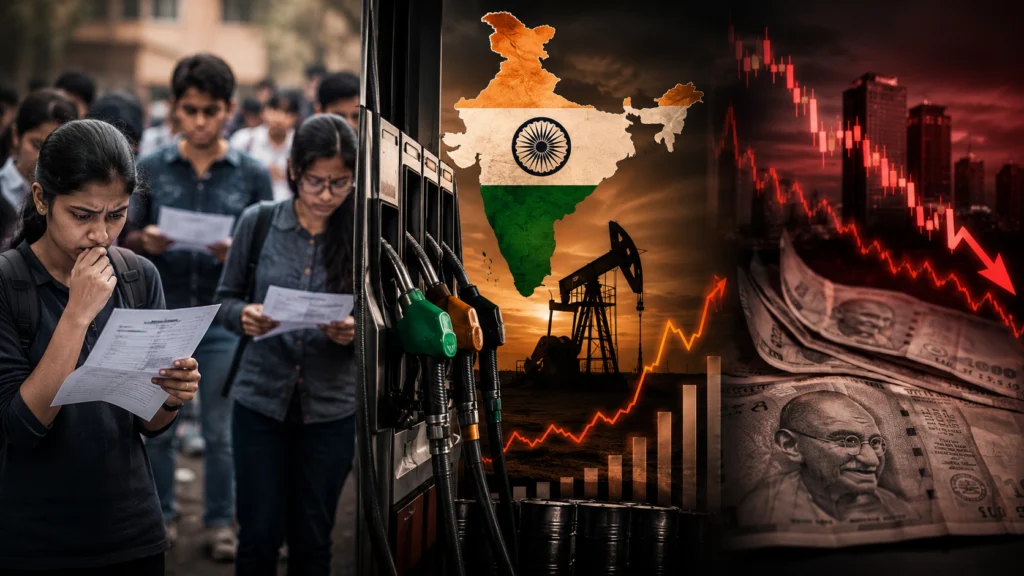
India is going through a moment where several concerns are arriving at once. Students are angry over examination controversies, families are watching fuel prices carefully, and economists are keeping a close eye on the rupee. None of these issues alone may define the country’s future, but together they have sparked an important conversation about why many people feel India under pressure today.
Across homes, social media, coaching centres, markets, and political discussions, one common question is growing louder: Is India facing a temporary period of uncertainty, or are these signals pointing to something deeper?
The reality is more complex than dramatic headlines suggest. India is not facing a collapse. However, a combination of educational controversy, economic anxiety, and global uncertainty is creating pressure that millions of people are beginning to feel in different ways. For many citizens, India under pressure is becoming more than a headline as concerns around education, inflation, and economic uncertainty continue growing.
At Informosio, we break down major national developments into clear, easy-to-understand insights so you can understand what’s driving India’s economic concerns, how fuel prices and the rupee may impact daily life, and why key policy decisions matter most during uncertain times.
Why India Under Pressure Is Becoming a Growing Concern
Countries often face moments where several unrelated concerns overlap. In India’s case, the current mood is shaped by three major discussions happening at the same time: the NEET examination controversy, concerns over fuel costs due to international tensions, and pressure on the rupee.
For many citizens, these developments feel connected because they all affect confidence. Students worry about fairness in education. Families worry about affordability. Businesses worry about expenses and uncertainty. Investors worry about economic signals.
That is why conversations around India under pressure are spreading quickly online. People are not only reading headlines. They are trying to understand how these developments may affect daily life in the coming months.
The concern becomes even stronger because each issue touches an emotionally sensitive area. Education shapes careers. Fuel prices affect household expenses. Currency movements influence inflation and business confidence. When these topics appear together in national discussion, anxiety naturally grows.
At the same time, India continues to remain one of the world’s fastest-growing major economies. Infrastructure projects continue expanding, startups are growing, digital payments remain strong, and foreign investment still shows confidence in India’s long-term future. Yet strong economies can also experience periods of stress.
NEET Leak Controversy Raises Serious Questions
Among all the current concerns, the NEET controversy has created perhaps the strongest emotional reaction.
For millions of Indian students, examinations are more than academic tests. They often represent years of hard work, sacrifices made by families, and hopes for financial stability. A medical seat through NEET can completely change a family’s future.
That is why allegations surrounding examination irregularities have sparked strong public frustration. For many students and parents, India under pressure feels personal because education directly shapes career opportunities and future stability.
Many students believe competitive examinations must remain transparent because fairness is the foundation of trust. When reports of leaks or irregularities emerge, it immediately raises concerns about whether merit is being protected.
Parents are equally worried. Across India, families invest heavily in coaching, relocation, books, and preparation. Some students spend years preparing for just one opportunity. Naturally, any controversy around the process feels deeply personal.
Social media has amplified these concerns even further. Students share emotional stories, educational experts debate reforms, and public pressure grows rapidly. Unlike previous decades, today’s concerns spread nationwide within hours.
This controversy has become one of the reasons why many citizens describe India under pressure emotionally rather than only economically. Young people already dealing with intense competition often feel uncertain about future opportunities. Educational trust matters deeply in a country where millions compete for limited seats.
At the same time, calls for stronger systems and accountability are increasing. Many believe reforms, stricter oversight, and transparent processes are essential to rebuild trust among students and families.
Why Fuel Price Fears Are Growing Again
Another major concern quietly affecting public sentiment is fuel uncertainty.
India imports a large share of its crude oil needs, meaning global tensions can quickly influence domestic conversations around petrol and diesel prices. Whenever geopolitical tensions rise in oil-producing regions, concerns naturally grow about whether India may face higher import costs.
Even before prices actually increase, public anxiety often begins. This growing uncertainty is one reason why India under pressure has become a widely discussed topic across households and business communities.
This happens because fuel affects nearly everything in everyday life. Transportation becomes expensive. Food delivery costs rise. Businesses pay more for logistics. Grocery prices sometimes increase because transportation costs influence supply chains.
For ordinary households, fuel prices are not just numbers displayed at petrol pumps. They directly affect monthly budgets.
As fuel uncertainty grows, conversations around India under pressure are becoming more common among middle-class families already managing rising costs.
A middle-class family managing school fees, rent, groceries, and transportation feels every small change in prices. This is why uncertainty around fuel often creates emotional reactions much faster than many other economic topics.
Experts say India is better prepared today than in earlier years because of diversified energy partnerships and strategic planning. However, international volatility can still create temporary pressure.
This broader uncertainty adds to the growing conversation around India under pressure, especially when combined with concerns around inflation and cost of living.
People begin asking practical questions.
Will travel become expensive? Will food prices rise? Will inflation return strongly?
Even if immediate impacts remain limited, public uncertainty itself affects confidence.
Rupee Weakness and What It Means for Ordinary Indians
The rupee is another issue making headlines.
Currency fluctuations are a normal part of global economics. Every country experiences periods where its currency strengthens or weakens depending on international conditions, interest rates, trade flows, and investor confidence.
However, when people hear phrases like “rupee weakening,” concerns rise quickly.
For ordinary Indians, currency discussions may sound technical, but the effects can eventually become visible in everyday life. A weaker rupee can make imports more expensive. Products relying on foreign materials or international supply chains may become costlier. At a time when India under pressure is already a growing public concern, currency movement naturally receives extra attention.
Electronics, fuel-related imports, and certain business expenses often feel the impact first.
That said, experts caution against panic.
A weaker currency does not automatically mean economic trouble. Sometimes currencies move due to global market behaviour rather than domestic weakness. For example, changes in US interest rates or international investor sentiment often influence emerging markets, including India.
Still, perception matters. Many experts believe India under pressure is not only about economics but also about public confidence during uncertain periods.
When economic headlines repeatedly discuss inflation risks, fuel uncertainty, and rupee movement together, public confidence can become shaky. That emotional factor is important.
The phrase India under pressure reflects not only measurable economic challenges but also public perception about uncertainty.
Confidence plays a major role in economic stability. When people feel uncertain, they spend less, businesses become cautious, and investment decisions slow down.
Why Public Scrutiny on Government Response Is Increasing
Public expectations from governments have changed dramatically.
Earlier, controversies often remained limited to newspaper discussions or evening television debates. Today, social media ensures every issue becomes a national conversation almost instantly.
Citizens expect faster explanations, stronger accountability, and visible responses. This growing scrutiny is another reason why India under pressure continues trending in online discussions and search results.
Whether it concerns education, fuel management, or economic policy, people increasingly want reassurance that authorities are acting quickly.
This explains why ministries linked to education, energy, and economic management often come under pressure during uncertain periods.
The public is no longer satisfied with delayed communication. Citizens want clarity.
Young people especially demand transparency because they feel directly affected by decisions involving education, employment, and economic opportunities. As expectations rise, India under pressure continues becoming a phrase many citizens use to describe the current national mood.
Political analysts believe today’s frustration is often cumulative. People may not react strongly to one isolated issue, but when several concerns appear together, emotions intensify.
That is another reason discussions around India under pressure continue gaining attention online.
Is India Really in Trouble or Facing Temporary Pressure?
This is perhaps the biggest question people are asking.
Despite growing concerns, India is not facing an economic collapse. However, India under pressure reflects a moment where several national concerns are overlapping at the same time.
The banking system remains stable. Economic growth continues. Large-scale infrastructure spending is ongoing. India continues attracting international investment, particularly in manufacturing, technology, and digital sectors.
However, ignoring public concerns would also be a mistake.
Periods of pressure often reveal weaknesses that require reforms. Educational controversies can expose system gaps. Fuel concerns can highlight economic vulnerabilities. Currency pressure can remind policymakers about global risks.
In many ways, difficult periods can create opportunities for stronger systems.
History shows India has navigated major challenges before, including inflation spikes, global recessions, currency pressure, and political uncertainty.
The difference today is speed.
Social media amplifies fear faster than ever before. Headlines spread instantly. Public reactions become emotional quickly. That makes transparent communication more important than ever.
Rather than panic, experts suggest focusing on preparedness and policy response.
Stay informed with Informosio’s in-depth coverage of Finance, where we bring you the latest updates on economic trends, fuel prices, inflation, currency movements, government policies, and business developments shaping India’s future.
What Happens Next for India?
The coming months will likely depend on how institutions respond.
In education, restoring trust will remain crucial. Students and families want confidence that hard work still matters and competitive examinations remain fair.
On fuel concerns, policymakers are expected to closely monitor international developments while protecting domestic stability as much as possible.
Regarding the rupee, economic institutions will likely continue balancing inflation, growth, and market confidence carefully.
For ordinary citizens, the biggest challenge may simply be uncertainty.
People want predictability. Students want fairness. Families want affordability. Businesses want confidence about the future.
This is ultimately why India under pressure has become a growing online discussion. It reflects genuine questions people are asking every day.
Yet pressure does not automatically mean crisis.
Sometimes pressure becomes the moment when systems improve, accountability strengthens, and institutions adapt.
India has faced difficult moments before and continued moving forward. For now, India under pressure remains more of a warning signal than a crisis, but public trust and policy response will shape what happens next.
The real story may not be whether India is under pressure, but how the country responds to it in the months ahead.
🌐Connect with us
Informosio Finance – Finance news, business insights, startups, and market trends