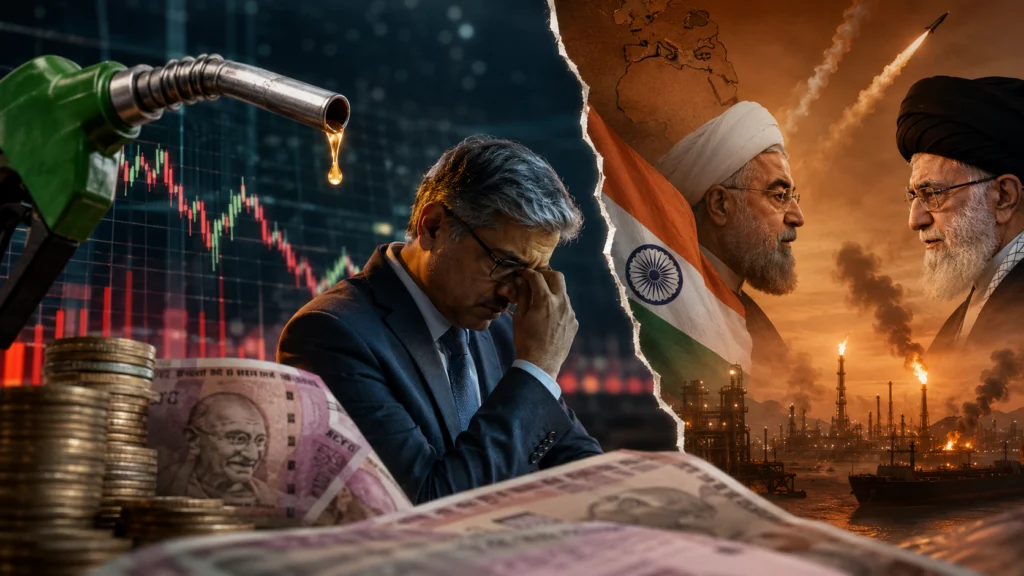
A growing geopolitical crisis in the Middle East is once again raising concerns about India’s economic stability. As tensions linked to Iran continue grabbing international attention, economists and market experts are warning that India could face a serious financial burden if the situation worsens. The estimated impact being discussed in policy and economic circles is massive, with figures touching nearly ₹10.9 lakh crore under severe disruption scenarios.
For millions of Indians, global geopolitical conflicts may sound distant. However, when a crisis affects major oil-producing regions, countries like India often feel the impact much faster than expected. Rising fuel prices, inflation, pressure on imports, and market uncertainty can quickly turn an international conflict into a domestic financial headache. The growing concern around Iran shock India is now becoming a major discussion among economists and market watchers.
This is exactly why Iran shock India discussions have started trending online. People are increasingly searching how a Middle East crisis could affect India’s economy, household spending, investments, and future growth.
India depends heavily on imported crude oil to meet domestic energy demands. Since the country imports a large percentage of its oil needs, even a small disruption in supply chains can create ripple effects across multiple sectors. Transportation becomes expensive, production costs increase, and eventually consumers may end up paying more for daily essentials.
At Informosio, we simplify complex economic stories into easy-to-understand insights so you can stay ahead of major financial shifts, market risks, inflation trends, and global events affecting India. Explore more updates in our Finance category.
Related Update: AI Stock Slump Wipes Out $1 Trillion as Oil Prices Surge and Markets Panic
Why Is Iran Important for India’s Economy?
Iran has historically remained an important region for India due to trade routes, energy supply concerns, and regional strategic balance. While India has diversified oil imports in recent years, tensions involving Iran still influence global oil prices.
Whenever geopolitical instability increases in the Middle East, international crude prices often react immediately. Traders begin pricing in risks of supply disruptions, shipping concerns, or sanctions-related uncertainties. Since oil powers transport, manufacturing, logistics, and electricity generation, any price increase affects multiple industries at once.
This explains why the phrase Iran shock India is becoming increasingly relevant among economists and financial analysts.
India may not directly suffer immediate losses from every geopolitical conflict, but the indirect economic pressure can be significant. A prolonged crisis could slowly increase inflation and reduce purchasing power for ordinary citizens.
1. Fuel Prices Could Rise Faster Than Expected
The biggest immediate concern for India remains fuel prices.
India imports a large amount of crude oil from global suppliers. If Middle East tensions push international oil prices higher, petrol and diesel costs in India could increase again.
For ordinary families, this matters more than many realize. Higher transport fuel costs eventually raise the prices of vegetables, groceries, online deliveries, travel, and manufactured goods. Many households, Iran shock India could directly affect monthly expenses if oil prices remain unstable.
A rise in fuel expenses can also reduce household savings. Families already managing rising living costs may find it harder to balance monthly budgets if another energy price shock emerges.
This is one of the strongest reasons why Iran shock India concerns are gaining momentum across search platforms.
2. Inflation Could Hurt Common People
When fuel becomes expensive, inflation usually follows.
Businesses often transfer higher transportation and operational costs to consumers. This means everything from food items to household products could become more expensive.
For middle-class and lower-income households, inflation creates immediate financial stress. Monthly spending increases while disposable income remains limited. Experts believe Iran shock India may also influence inflation trends in the coming months.
Economic experts frequently warn that inflation has a psychological effect too. Consumers begin spending cautiously, which can slow business activity and overall economic momentum.
If geopolitical instability remains prolonged, Iran shock India could become more than just a financial headline and start affecting everyday spending habits.
3. Stock Markets May Face Uncertainty
Financial markets dislike uncertainty.
Whenever geopolitical tensions rise globally, investors often become cautious. This can lead to volatility in stock markets, including India. Investors tracking Iran shock India are closely watching crude oil and stock market reactions.
Foreign investors sometimes pull money from emerging markets during unstable periods. If uncertainty continues, sectors such as aviation, logistics, transport, and energy-intensive businesses may experience pressure.
However, not all sectors react negatively. Oil exploration companies or energy-related firms may sometimes benefit depending on market conditions.
Still, investors searching for answers about Iran shock India are mainly worried about short-term instability.
4. Trade Costs Could Increase
India relies on international shipping routes for imports and exports.
If geopolitical tensions affect key maritime routes, transportation expenses may increase. Insurance costs for cargo movement can rise during unstable situations, affecting global trade. The Iran shock India debate is also connected to trade disruptions and shipping concerns.
This eventually raises import costs for businesses in India. Companies importing raw materials may face pricing pressure, which again could affect consumers.
Trade disruptions may not happen overnight, but prolonged instability increases risk for economies dependent on international commerce.
This is another reason Iran shock India has become an important economic discussion.
5. Rupee Pressure Could Create Challenges
A rising oil bill can increase pressure on India’s currency.
When oil prices climb sharply, India spends more foreign exchange reserves for imports. This sometimes weakens the rupee against global currencies.
A weaker rupee makes imports even more expensive, creating another layer of economic pressure.
Currency movements also influence investment confidence. Businesses planning international transactions may become cautious during periods of volatility.
6. Government Spending Pressure May Increase
Governments often face difficult choices during economic uncertainty.
If inflation rises sharply, policymakers may introduce measures to reduce public burden. Sometimes governments absorb costs or adjust taxes to manage price increases.
However, managing economic shocks comes with financial pressure.
Public spending priorities may shift depending on how severe international disruptions become. Large-scale external shocks can complicate budget planning and economic forecasts.
Because of this, discussions around Iran shock India are no longer limited to foreign affairs. The issue increasingly connects with domestic economic planning.
7. Long-Term Growth Could Slow
India remains one of the fastest-growing major economies in the world.
However, external disruptions can temporarily slow momentum. Businesses delay investments during uncertainty. Consumers reduce spending. Market confidence weakens.
A prolonged energy crisis may impact manufacturing, transport, and industrial output.
Still, economists believe India’s diversified economy offers resilience compared to earlier decades. Strong domestic demand and policy flexibility may help cushion major shocks.
Even then, Iran shock India concerns highlight how interconnected the global economy has become.
Stay informed with Informosio’s Finance category for in-depth coverage of business news, economic developments, market trends, inflation updates, global trade shifts, and the latest financial stories shaping India and the world.
Should Indians Be Worried?
Panic is not the answer, but awareness matters.
Not every geopolitical conflict turns into a major economic crisis. Sometimes tensions cool down faster than expected. Global markets also adapt quickly.
However, if instability continues for a long period, India may face economic pressure through inflation, fuel prices, and trade disruptions.
For ordinary citizens, keeping track of fuel trends, inflation, and market movements may help understand future financial changes.
For investors and businesses, cautious planning becomes important during uncertain global situations.
The coming weeks may decide whether current concerns remain temporary or become a larger financial challenge.
One thing is clear: global crises no longer stay limited to borders. When oil markets shake, countries dependent on imports often feel the pressure quickly. That is why Iran shock India discussions are growing online as people try to understand what lies ahead.
As global uncertainty rises, India’s ability to manage inflation, maintain stable growth, and protect consumers will remain closely watched. Whether the estimated burden becomes reality or stays only a warning depends largely on how international events unfold in the coming months.
Source: The Economic Times
🌐Connect with us
Informosio Finance – Finance news, business insights, startups, and market trends