
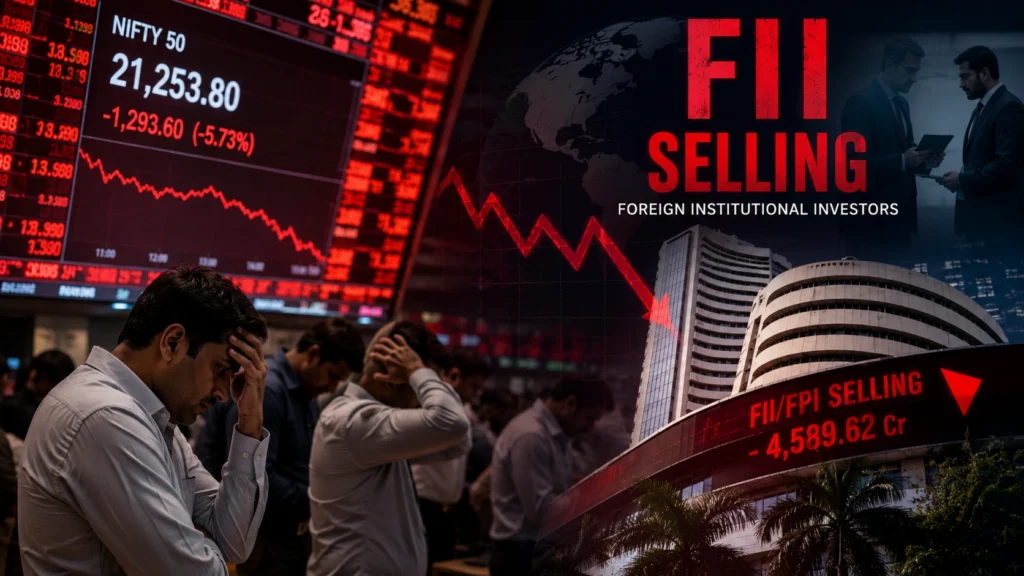
FII Selling Stocks are once again becoming one of the biggest concerns for Indian investors in 2026 as foreign institutional investors continue adjusting their portfolios amid global uncertainty. Whenever FIIs begin reducing exposure in major sectors, market sentiment often turns cautious, leading retail investors to closely monitor which companies could face the highest pressure.
Foreign institutional investors, commonly known as FIIs, are once again becoming one of the biggest talking points in the Indian stock market. Over the past few months, investors have closely tracked where foreign money is moving and which companies are facing heavy selling pressure. Whenever FIIs start reducing exposure in large numbers, market sentiment often turns cautious.
The latest market trend suggests that some companies could remain vulnerable if foreign investors continue pulling money out. While domestic institutional investors have supported parts of the market, experts believe a few stocks may still face downside risks if selling intensifies.
This is why FII selling stocks have become one of the most searched market topics recently.
At Informosio, we simplify complex stock market movements into clear, practical insights so you can understand why foreign investors are selling, which sectors face the biggest risks, and what smart investors should watch before making their next move.
Why Are FIIs Selling Stocks?
Foreign investors generally react quickly to global uncertainty. Rising US bond yields, inflation concerns, geopolitical risks, and shifting global capital flows often impact their investment decisions.
In 2026, investors are watching several major concerns:
1. Global Economic Uncertainty
Concerns about slowing global growth have pushed foreign funds to become more selective. Riskier markets often witness capital outflows during uncertain periods.
2. High Valuations in Some Sectors
Many Indian companies rallied sharply over the last few years. Analysts believe some stocks now trade at premium valuations, increasing the risk of profit booking.
3. Dollar Strength and Global Rates
A stronger US dollar can attract money back to developed markets. This often impacts emerging market investments, including India.
Because of these reasons, investors are closely tracking FII selling stocks to identify possible risks before making fresh investment decisions.
9 Stocks Facing Heavy FII Selling Pressure
While market conditions can change quickly, analysts believe these companies may remain vulnerable if foreign investor selling continues.
1. Banking and Financial Stocks
Several private banking stocks have experienced fluctuating foreign holdings. Banking shares often witness strong FII participation, which means selling pressure can become visible quickly during market uncertainty.
Investors are watching whether FIIs reduce exposure in major financial companies if global risks rise again.
2. IT Sector Companies
Technology stocks remain highly dependent on overseas business demand. Slower growth expectations in international markets can affect investor confidence.
Many traders consider IT among potential FII selling stocks because foreign investors hold significant ownership in large technology firms.
3. Auto Sector Leaders
Automobile stocks have shown mixed performance due to changing consumer demand and cost pressures. If FIIs reduce risk exposure, auto companies may see short-term volatility.
4. Chemical and Export-Based Companies
Export-focused businesses are sensitive to global demand changes. Weak international consumption may force investors to reassess growth expectations.
5. Metal Stocks
Metal companies often react sharply to global economic cycles. Slower industrial growth worldwide can create uncertainty, making them vulnerable during foreign selling phases.
6. Premium Consumer Stocks
Some consumer companies currently trade at premium valuations. When markets become uncertain, FIIs sometimes shift away from expensive stocks.
7. Realty Stocks
The real estate sector has gained momentum in recent years. However, interest rate concerns and market sentiment shifts could create pressure.
8. Mid-Cap Momentum Stocks
Mid-cap companies sometimes experience stronger volatility during periods of foreign selling. Since valuations can become stretched, corrections often happen quickly.
9. Highly Valued Growth Companies
Companies priced aggressively based on future expectations may face sharp reactions if investor sentiment weakens.
These categories have increasingly entered discussions around FII selling stocks, especially among traders looking for short-term opportunities and risks.
Should Investors Panic?
The short answer is no.
Experts say investors should study fundamentals instead of reacting emotionally to headlines around FII Selling Stocks. Foreign investor selling does not automatically mean a stock will crash. In many cases, domestic investors absorb selling pressure and stabilize the market.
India’s long-term growth story still remains attractive because of strong domestic demand, infrastructure spending, digital growth, and rising consumption.
However, investors should avoid blindly chasing stocks that are already expensive or showing signs of weakness.
Instead, experts suggest focusing on:
- Strong balance sheets
- Consistent earnings growth
- Reasonable valuations
- Low debt levels
- Sector leadership
Tracking FII selling stocks can help investors understand market sentiment, but investment decisions should not rely only on foreign activity.
What Should Retail Investors Watch?
Retail investors often panic after hearing about heavy foreign selling. But experienced investors usually focus on broader trends.
Here are key signals worth watching:
FII Ownership Pattern
Check whether foreign ownership is consistently falling over multiple quarters. Monitoring ownership patterns remains one of the smartest ways to evaluate FII Selling Stocks over the long term.
Earnings Performance
Even if FIIs sell, strong earnings can support stock prices over the long term.
Sector Rotation
Sometimes foreign investors sell one sector and shift money into another.
Domestic Buying Strength
Strong participation from domestic institutions may reduce downside pressure.
Understanding these signals can help investors navigate uncertainty around FII selling stocks without emotional decision-making.
Stay informed with Informosio in-depth coverage of Finance, Business News, Stock Market updates, IPO announcements and Company News.
Final Thoughts
Foreign investor activity always attracts market attention, and 2026 is no different. While certain sectors and companies may face higher pressure, investors should remember that temporary selling does not always signal long-term weakness.
The biggest mistake retail investors make is reacting emotionally to market fear. Instead of panic selling, focusing on quality companies and strong fundamentals may prove smarter during uncertain phases.
While market sentiment may fluctuate, tracking FII Selling Stocks can help investors better understand where risks and opportunities are developing.
For now, keeping a close watch on FII selling stocks could help investors understand where risks are building and where opportunities may emerge if valuations become attractive.
🌐Connect with us
Informosio Finance – Finance news, business insights, startups, and market trends