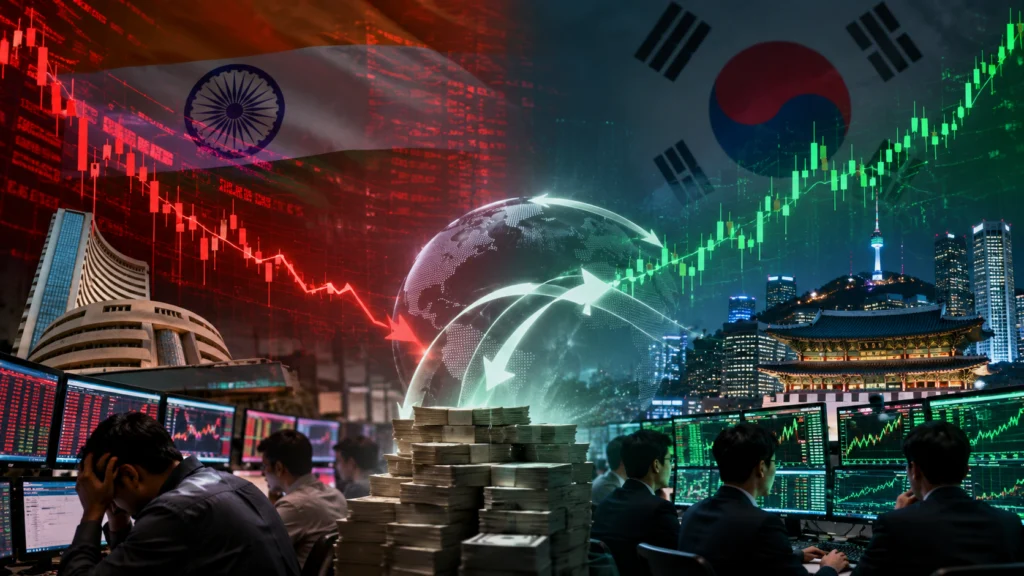
India Korea market trends have suddenly become one of the biggest talking points among investors after reports suggested India underperformed South Korea by nearly 180 percentage points over a certain period. For a country often seen as one of the world’s strongest growth stories, this comparison shocked many investors and raised serious questions about market momentum.
India’s stock market has long been viewed as a top investment destination because of strong economic growth, rising digital adoption, growing domestic consumption, and expanding infrastructure spending. But recent market performance has surprised both experts and retail investors.
At the same time, some analysts believe the worst phase of Foreign Institutional Investor (FII) selling may already be ending. If true, this could become a major turning point for Indian equities.
So what exactly caused this surprising India Korea market gap, and should investors worry or prepare for a possible comeback?
At Informosio, we simplify complex market trends into easy-to-understand insights so you can track foreign investor moves, understand stock market risks, and know what could shape India’s next big market recovery. Explore more expert coverage on stocks, economy, and global markets.
Why Has India Underperformed South Korea?
When people compare stock markets, they usually look at how major indexes perform over time. South Korea’s market saw stronger momentum in sectors that benefited heavily from global technology demand, especially semiconductor and manufacturing companies.
India, meanwhile, faced pressure from expensive valuations, slower earnings momentum in some sectors, and aggressive foreign investor selling.
The India Korea market debate is not about which country has a stronger economy overall. Instead, it reflects how investors reacted to opportunities in different regions over a specific period.
Several factors played a role in India’s slower performance.
1. Heavy FII Selling Hurt Indian Markets
One of the biggest reasons behind India’s weaker performance was continuous selling by foreign institutional investors.
FIIs often move large amounts of money between countries depending on risk, returns, currency movement, and global interest rates. Over the last phase, foreign investors pulled money out of Indian equities and shifted focus toward cheaper markets.
This created pressure on Indian benchmark indexes.
Whenever large foreign investors sell aggressively, market sentiment weakens. Retail investors often become nervous, leading to further selling pressure.
The India Korea market gap widened partly because South Korea attracted stronger institutional interest during the same period. Many analysts believe the India Korea market trend could improve if foreign money returns to Indian equities.
However, market experts now believe the worst of FII selling may be ending. If foreign money starts returning, India could regain momentum quickly.
2. South Korea Benefited From the AI and Chip Boom
Another major reason South Korea surged ahead was the global technology rally.
South Korean companies gained significantly from rising demand for semiconductors, artificial intelligence hardware, and advanced electronics. Since global investors aggressively chased technology-linked opportunities, Korean markets received strong support.
India has growing technology companies, but the market structure is different.
Indian indexes are more dependent on banking, financial services, energy, and domestic consumption. While these sectors remain strong long term, they may not benefit immediately from global tech enthusiasm in the same way.
That created a major difference in performance between the two countries.
The India Korea market comparison clearly shows how sector exposure can dramatically change market returns.
3. India Became Expensive Compared to Other Markets
Valuation matters a lot in investing.
For years, investors were willing to pay premium prices for Indian stocks because of strong economic growth expectations. But when valuations become too expensive, markets often struggle to maintain momentum.
During this period, some global investors started seeing better value elsewhere.
South Korea looked relatively cheaper in comparison, especially after technology-driven earnings improved.
This does not mean India suddenly became a weak economy. It simply means investors began asking whether they were paying too much for future growth.
The India Korea market discussion highlights an important investing lesson: even great economies can temporarily underperform if expectations become too high.
4. Global Interest Rates Changed Investor Behaviour
Another important reason was global monetary policy.
When interest rates remain high in major economies like the United States, investors become more selective about where they put money.
Emerging markets such as India often experience pressure during these periods because foreign capital looks for safer returns elsewhere.
South Korea benefited differently due to its export-driven sectors and technology exposure.
For Indian investors, this became frustrating because strong domestic growth did not automatically translate into better stock performance.
The India Korea market trend surprised many long-term investors who expected India to remain ahead.
Still, market history shows that temporary underperformance does not necessarily indicate long-term weakness.
5. India’s Growth Story Still Remains Strong
Despite the disappointing comparison, India still has several structural advantages.
The country continues to benefit from:
- Rapid digital transformation
- Rising domestic consumption
- Government infrastructure spending
- Manufacturing growth
- Expanding middle-class demand
Many global companies continue exploring India as an alternative manufacturing destination.
Long-term investors still view India positively because economic fundamentals remain relatively stable.
The recent India Korea market weakness may simply represent a correction phase rather than a long-term trend reversal.
That is exactly why many analysts believe investors should avoid panic.
Is the Worst FII Selling Really Over?
This is probably the biggest question investors are asking right now.
Some market analysts, including prominent investment experts, believe FII selling pressure may be close to ending.
There are several reasons behind this belief.
First, valuations in some sectors have become more reasonable after corrections.
Second, India’s economic growth still remains stronger than many major economies.
Third, if global interest rate pressure starts easing, foreign investors may once again prefer emerging markets with stronger long-term growth potential.
If these conditions improve, Indian equities could attract fresh inflows.
That does not mean markets will suddenly rise every day. Volatility may continue in the short term.
But sentiment can change quickly when institutional money returns.
The India Korea market narrative may also shift if India starts regaining momentum while South Korea faces slower global demand.
What Should Investors Do Now?
Many investors panic whenever headlines become negative.
But market history often rewards patience more than emotional decisions.
Instead of reacting emotionally to short-term underperformance, investors should ask:
- Are India’s long-term growth fundamentals broken?
- Has consumer demand disappeared?
- Is infrastructure spending slowing permanently?
- Are businesses fundamentally weaker?
For most experts, the answer remains no.
India still has strong economic drivers, even if stock market performance temporarily disappointed investors.
The smarter approach may be focusing on quality businesses, diversification, and long-term investing instead of chasing short-term market noise.
The India Korea market comparison may look worrying today, but markets often move in cycles.
Countries that underperform for one phase can outperform in the next.
Could the India Korea Market Gap Reverse?
The possibility cannot be ignored.
If foreign investors return, earnings improve, and global conditions stabilize, India could quickly regain investor confidence.
Markets often recover when sentiment is still weak because investors usually wait too long to re-enter.
That is why many experienced investors pay attention to periods of fear and pessimism.
The current situation in the India Korea market story may eventually become a reminder that market leadership changes over time.
For now, investors may need patience more than panic.
Stay informed with Informosio in-depth coverage of Finance, Business News, Stock Market updates, IPO announcements and Company News.
Conclusion
India falling behind South Korea by nearly 180 percentage points shocked many investors, but the full story is more complicated than headlines suggest.
Foreign investor selling, expensive valuations, technology-driven growth in South Korea, and changing global interest rates all contributed to the gap.
Yet India’s long-term economic story remains intact.
More importantly, some experts now believe the worst phase of FII selling may already be over. If that happens, Indian markets could see renewed momentum sooner than many expect.
The India Korea market debate may feel alarming today, but history shows markets rarely move in one direction forever. Sometimes, the strongest recoveries begin when confidence is at its lowest.
🌐Connect with us
Informosio Finance – Finance news, business insights, startups, and market trends