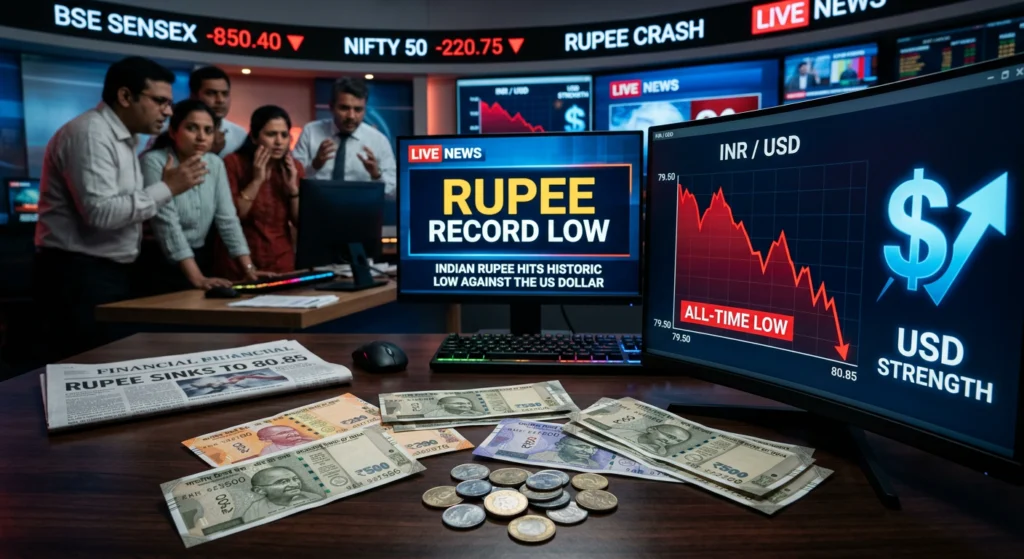
The Indian Rupee Record Low has become one of the biggest financial concerns in India after the rupee touched a historic level against the US dollar. The Indian Rupee Record Low has suddenly become one of the most discussed financial topics in India. After touching a historic level of nearly ₹96.05 against the US dollar, many Indians are wondering what exactly is happening and whether daily life will become more expensive.
For most people, currency movement may sound like something only economists and investors care about. But the reality is very different. A weaker rupee can directly affect fuel prices, imported goods, foreign education, travel costs, investments, and even inflation in your kitchen.
The recent Indian Rupee Record Low has raised concerns because India still depends heavily on imports for crude oil, electronics, machinery, and several important products. Whenever the rupee weakens against the dollar, India pays more to buy these goods from other countries. That extra cost eventually reaches consumers.
So, why is the rupee falling now? Should Indians be worried? And what hidden effects could this historic fall have on your money? Let’s understand everything in simple words.
At Informosio, we simplify complex economic and financial news into practical insights so you can understand what’s really driving the Indian rupee record low, how it could affect your money, and what major financial trends to watch next. Explore more expert analysis on inflation, stock markets, and India’s economy.
Why Did the Indian Rupee Fall to a Record Low?
Several major reasons are behind the recent Indian Rupee Record Low.
First, global crude oil prices have increased sharply. Since India imports most of its oil, higher prices mean more dollars are required for payments. This naturally puts pressure on the rupee.
Second, foreign investors have recently withdrawn money from Indian markets. When foreign funds move out, the demand for dollars rises, weakening the local currency.
Another reason is the strength of the US dollar itself. Whenever the American economy performs strongly or interest rates remain high, investors around the world prefer holding dollars instead of riskier currencies.
Global uncertainty has also played an important role. Rising geopolitical tensions and fears around international trade have pushed investors toward safer assets like the US dollar.
Experts believe the Indian Rupee Record Low is mainly linked to rising crude oil prices and global uncertainty. Because of all these reasons combined, the Indian Rupee Record Low became reality faster than many experts expected.
Why This Matters More Than You Think
Many people ignore currency news because they feel it has nothing to do with everyday life. But the truth is, when the rupee weakens, ordinary people often end up paying more.
Even if salaries remain the same, purchasing power slowly becomes weaker. Imported goods become expensive, businesses face higher costs, and inflation pressure rises.
This is exactly why experts are closely watching the current Indian Rupee Record Low.
What Could Become More Expensive for Indians?
1. Petrol and Diesel Prices
India imports a major portion of crude oil. Since oil payments happen in dollars, a weaker rupee increases import costs.
Even if international oil prices remain stable, Indians could still pay more for petrol and diesel due to currency weakness. Higher fuel prices also increase transport costs, which can make vegetables, groceries, and delivery services expensive.
2. Foreign Education
Students planning to study abroad may feel the impact quickly.
Tuition fees, accommodation expenses, and living costs become significantly higher when the rupee loses value against the dollar. Families paying fees in the US, UK, Canada, or Australia could face extra financial pressure.
The current Indian Rupee Record Low may especially worry middle-class families preparing for overseas education.
3. International Travel
Dreaming of an international vacation? A weaker rupee means foreign trips suddenly become more expensive.
Hotel bookings, shopping, transportation, and food bills all cost more when converted into dollars or other foreign currencies.
Travelers may need bigger budgets than expected.
4. Electronics and Gadgets
Smartphones, laptops, gaming devices, and premium electronics often depend on imported components.
Companies may eventually increase prices to offset rising import costs. That means consumers could soon pay more for gadgets they regularly buy.
5. Gold Prices
Gold often becomes costlier when the rupee weakens because India imports most of its gold.
This could impact families planning weddings or festive shopping. Investors buying gold may also notice price increases.
6. Inflation in Daily Life
Many businesses depend on imported materials and equipment. When import costs rise, companies may pass expenses to customers.
This can slowly increase the cost of food, household products, medicines, and services.
7. Imported Luxury Products
Cars, perfumes, luxury brands, and premium products from overseas may become noticeably more expensive.
Even brands assembling products in India could feel pricing pressure if imported parts cost more.
Will the Rupee Touch ₹100 Per Dollar?
This question is now becoming popular online.
Some analysts believe reaching ₹100 is possible if oil prices continue rising and global uncertainty remains high. Others believe the government and Reserve Bank of India may step in before such a situation happens.
The RBI often uses foreign exchange reserves to stabilize currency movements during extreme volatility. However, no one can predict exact currency levels with certainty.
Still, the recent Indian Rupee Record Low has sparked serious debate among economists and investors.
What Is the Government and RBI Likely to Do?
Whenever the rupee weakens too quickly, policymakers usually monitor the situation carefully.
The Reserve Bank of India may intervene by selling dollars in the market to reduce excessive pressure on the rupee.
The government may also focus on controlling inflation and strengthening economic growth to improve investor confidence.
Experts believe India’s strong economic fundamentals could prevent panic, but short-term volatility may continue.
Should Common Indians Be Worried?
Panic is not necessary, but awareness is important.
Currency movements are a normal part of global economics. However, when a major fall happens, households should prepare smartly.
If you are planning foreign travel, studying abroad, or making expensive imported purchases, budgeting carefully could help.
Investors should also avoid emotional decisions based on short-term fear. Markets often react strongly during uncertainty, but long-term financial planning matters more.
The biggest lesson from the Indian Rupee Record Low is simple: global economic events can quietly affect everyday life more than most people realize.
Stay informed with Informosio in-depth coverage of Finance, Business News, Stock Market updates, IPO announcements and Company News.
Final Thoughts
The historic Indian Rupee Record Low is more than just a headline in financial news. It has real consequences that can slowly influence everyday expenses, travel plans, education costs, and inflation.
While experts continue debating whether the rupee may weaken further, one thing is clear: Indians should stay informed and financially prepared.
The coming weeks will be important. Oil prices, foreign investments, RBI action, and global market sentiment will decide whether the rupee stabilizes or faces more pressure.
For now, understanding the hidden impact of this currency move can help you make smarter money decisions before prices begin changing around you.
🌐Connect with us
Informosio Official – General updates, current affairs, and informative content