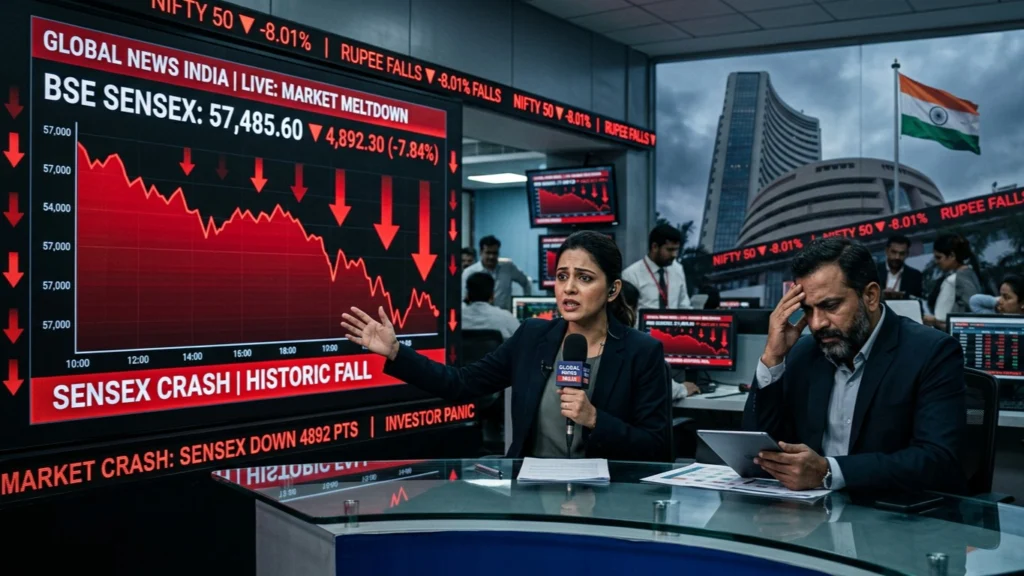
The Indian stock market has suddenly turned into a battlefield for investors. In just four trading sessions, more than ₹11 lakh crore in investor wealth disappeared as the Sensex and Nifty witnessed heavy selling pressure. What shocked many investors even more is this: while India struggled, several US and Asian markets continued showing strength.
So, what exactly is happening? Why are Indian markets bleeding when global peers appear relatively stable? Is this a temporary correction or the beginning of something bigger?
The answer lies in a combination of global fears, foreign investor behavior, rising oil prices, weak currency pressure, and valuation concerns that have suddenly made Indian equities vulnerable.
At Informosio, we turn complicated market crashes into clear, actionable insights so you can understand why Indian markets are bleeding, what’s moving Dalal Street, and whether this selloff is a warning sign or a buying opportunity.
What Happened in the Last 4 Days?
Indian benchmark indices have been under relentless pressure. The Sensex dropped thousands of points over four consecutive sessions, while the Nifty slipped below important psychological levels. Investor sentiment weakened sharply as panic selling spread across multiple sectors including IT, banking, and mid-cap stocks.
According to market estimates, investor wealth erosion crossed ₹11 lakh crore during the selloff period, leaving retail investors worried about what comes next.
However, experts say this decline is not happening because of one single issue. Multiple triggers are working together.
Why Are Indian Markets Bleeding? 7 Key Reasons Explained
Before understanding why Indian markets bleeding has become a major concern for investors, it is important to understand what triggered the recent selloff.
1. Crude Oil Prices Are Becoming a Big Problem
One of the biggest reasons Indian markets bleeding has become a trending topic is rising crude oil prices.
India imports a major share of its oil needs. When crude becomes expensive, it creates pressure on inflation, government finances, company earnings, and even household spending. Recent geopolitical tensions in West Asia pushed Brent crude prices sharply higher, creating fear in the market.
For countries heavily dependent on imported oil like India, expensive crude creates economic uncertainty.
Investors immediately begin questioning whether inflation will rise again and whether economic growth could slow down.
That uncertainty often leads to selling in equities.
2. Foreign Investors Are Pulling Out Money
Foreign Institutional Investors (FIIs) have once again started reducing exposure to Indian equities.
Whenever global uncertainty increases, international investors usually move money toward safer assets such as the US dollar or developed markets. India often faces heavy selling pressure during such phases. Persistent foreign outflows have played a major role in recent weakness across Dalal Street.
The problem becomes even bigger because FIIs hold large stakes in heavyweight companies.
Once heavy selling begins, benchmark indices start falling rapidly.
This is another major reason why Indian markets bleeding has become a concern among investors.
3. The Rupee Is Weakening
The Indian rupee has remained under pressure against the US dollar.
A weak rupee creates multiple economic concerns. Import bills become expensive, inflation risks increase, and foreign investors often turn cautious.
When investors see both falling markets and weakening currency at the same time, confidence takes a hit. Analysts believe rupee weakness has worsened negative sentiment during the current market decline.
This also explains why Indian markets have reacted more sharply than some Asian peers.
4. Indian Stocks Were Already Expensive
Another reason behind Indian markets bleeding is valuation pressure.
Before this correction started, many Indian stocks were trading at premium valuations compared to global peers. Investors were already questioning whether prices had become too stretched.
When markets are expensive, even a small negative trigger can cause sharp corrections.
That is exactly what happened.
As global uncertainty increased, investors quickly started booking profits in expensive stocks.
Several experts believe the market is simply adjusting to more realistic valuations.
5. IT Stocks Suddenly Came Under Pressure
The IT sector, usually considered a stable performer, also witnessed heavy selling.
Large technology companies faced pressure due to concerns around changing global AI dynamics and fears that traditional outsourcing models may face disruption in coming years. This triggered a broad-based selloff in major IT stocks.
Because IT companies carry strong weight in benchmark indices, weakness in this sector amplified overall market losses.
That further accelerated fears around Indian markets bleeding.
6. Global Tensions Have Increased Risk Sentiment
Geopolitical uncertainty always creates fear in financial markets.
Recent tensions involving West Asia and fears around energy supply disruptions have made investors nervous. Global markets dislike uncertainty, especially when it threatens oil supply chains.
For India, which depends heavily on imported energy, these tensions become even more important.
As soon as geopolitical headlines intensified, investors rushed to reduce risky bets.
This created a strong risk-off mood in Indian equities.
7. Why Are US and Asian Markets Rising Then?
This is the biggest question investors are asking.
If global uncertainty exists, why are some US and Asian markets still performing better?
The answer is simple: every market reacts differently.
The US market continues receiving support from technology optimism, especially around artificial intelligence companies. Meanwhile, countries less dependent on imported crude oil are facing lower pressure compared to India. Some Asian markets are also benefiting from semiconductor and manufacturing growth.
India, however, remains highly sensitive to oil prices, foreign fund flows, and currency movements.
That is why Indian markets bleeding has become more severe than in some global markets.
Is This a Market Crash or Just a Correction?
This is where investors need to stay calm.
Many market experts believe the current fall looks more like a correction rather than a full-scale market crash.
Corrections happen regularly in stock markets. After long periods of rally, markets often cool down to adjust valuations.
However, what happens next will depend on three major factors:
- Whether crude oil prices stabilize
- Whether foreign investors stop selling
- Whether geopolitical tensions cool down
If these pressures ease, Indian markets may recover faster than expected.
What Should Investors Do Now?
Panic selling often becomes the biggest mistake during volatile phases.
Long-term investors usually focus on quality businesses instead of reacting emotionally to short-term market swings.
Experts suggest investors should avoid impulsive decisions, maintain discipline in SIP investments, and keep cash ready for quality buying opportunities if markets become more attractive.
At the same time, blindly buying every dip without research can also be risky.
The smarter approach is staying patient and selective.
Stay informed with Informosio in-depth coverage of Finance, Business News, Stock Market updates, IPO announcements and Company News.
Final Thoughts
The recent selloff has undoubtedly shaken investor confidence. Losing over ₹11 lakh crore in just four days is serious, and concerns around oil prices, FIIs, rupee weakness, and global tensions cannot be ignored.
Still, history shows that market corrections are a normal part of investing.
The real question is not whether volatility exists. The real question is whether investors can stay disciplined during uncertainty.
For now, one thing is clear: Indian markets bleeding is not happening because of a single trigger. It is a combination of economic pressure, global fear, and investor sentiment that has created the perfect storm on Dalal Street.
🌐Connect with us
Informosio Finance – Finance news, business insights, startups, and market trends