
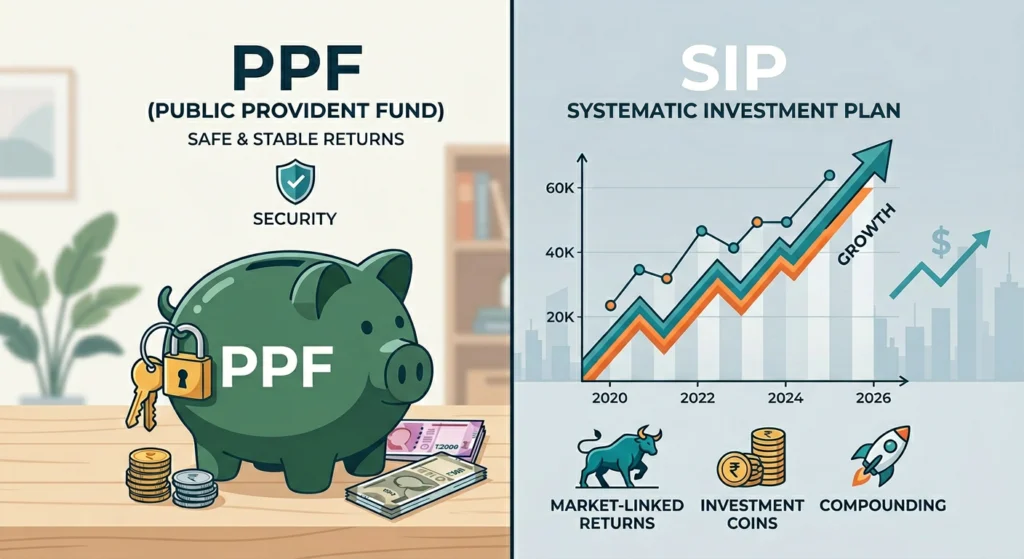
Choosing between PPF vs SIP has become one of the most searched financial questions in India today. With rising awareness about wealth creation and financial security, investors are no longer satisfied with just saving money, they want their money to grow faster. But the real confusion begins when deciding between a safe option like PPF and a growth-focused option like SIP. Both have strong advantages, but they serve very different purposes.
In 2026, this debate has intensified because interest rates, inflation, and market volatility are all influencing returns. So if you are planning for the next 10 years, the real question is not just safety or returns, but which option aligns with your financial goals.
At Informosio, we break down complex investment decisions like PPF vs SIP into simple, actionable insights so you can understand where your money grows faster, what risks truly matter, and how to build smarter wealth strategies for the next decade.
What is PPF and Why It Still Attracts Investors
Public Provident Fund remains one of the most trusted investment options in India. It is backed by the government, which makes it extremely secure. For investors who prioritize capital protection, PPF continues to be a go-to choice.
PPF offers fixed returns, which are revised quarterly but remain relatively stable. The biggest advantage is that it is completely risk-free and comes with tax benefits under Section 80C. Over a 10-year period, PPF provides predictable growth, making it ideal for conservative investors.
However, when comparing PPF vs SIP, one key limitation of PPF is its capped return potential. Since it is not market-linked, your returns remain limited even during economic growth phases.
What is SIP and Why It’s Gaining Popularity
Systematic Investment Plan, or SIP, is a method of investing in mutual funds regularly. Unlike PPF, SIP is directly linked to the stock market, which means returns can fluctuate.
But here’s where things get interesting. Over the long term, SIP has historically delivered higher returns compared to traditional savings instruments. Many equity mutual funds have generated returns between 10% to 15% annually over extended periods.
This is why the comparison of PPF vs SIP often tilts towards SIP when the goal is wealth creation. SIP also benefits from compounding and rupee cost averaging, making it a powerful investment tool for disciplined investors.
PPF vs SIP: Key Differences You Must Understand
When comparing PPF vs SIP, the differences go far beyond returns.
PPF is about safety, stability, and guaranteed returns. SIP is about growth, flexibility, and market participation. PPF locks your money for 15 years, while SIP allows liquidity depending on the mutual fund type.
Risk is another major factor. PPF carries zero risk, while SIP carries market risk. However, higher risk often brings higher reward, which is why SIP stands out in long-term comparisons.
10-Year Return Comparison: Which Performs Better
This is the most important part of the PPF vs SIP debate.
If you invest ₹5,000 per month in PPF for 10 years at an average interest rate of around 7.1%, your total investment of ₹6 lakh can grow to approximately ₹8.5–9 lakh.
Now compare this with SIP. Assuming a moderate return of 12% annually, the same ₹5,000 monthly investment can grow to around ₹11–12 lakh in 10 years.
This clearly shows that SIP has the potential to outperform PPF significantly. However, these returns are not guaranteed and depend on market conditions.
Risk vs Reward: The Real Decision Factor
The biggest difference in PPF vs SIP lies in how much risk you are willing to take.
PPF is ideal for those who cannot afford to lose money and prefer stable returns. It acts as a financial safety net.
SIP, on the other hand, is suitable for investors who can handle short-term volatility for long-term gains. If you stay invested for a longer period, the impact of market fluctuations reduces.
So the real question is not which is better universally, but which is better for you.
Tax Benefits: PPF vs SIP
PPF enjoys full tax exemption. Your investment, interest earned, and maturity amount are all tax-free.
SIP taxation depends on the type of mutual fund. Equity funds are taxed at 10% on long-term capital gains above ₹1 lakh. Debt funds have different taxation rules.
In the PPF vs SIP comparison, PPF clearly wins in terms of tax simplicity and benefits.
Liquidity and Flexibility
Liquidity plays a crucial role when comparing PPF vs SIP.
PPF has a lock-in period, which limits access to your money. Partial withdrawals are allowed but under specific conditions.
SIP offers much more flexibility. You can start, stop, or withdraw anytime, especially in open-ended mutual funds.
This makes SIP more suitable for investors who want financial flexibility.
Who Should Choose PPF
PPF is best suited for individuals who want guaranteed returns and capital safety. If your goal is to build a secure financial base without taking risks, PPF is a reliable option.
It is also ideal for retirement planning and long-term savings where stability matters more than aggressive growth.
Who Should Choose SIP
SIP is ideal for those who want to create wealth over time and are comfortable with market fluctuations. It is especially beneficial for young investors who have a longer investment horizon.
In the PPF vs SIP debate, SIP becomes the better choice when your goal is higher returns and inflation-beating growth.
Can You Combine PPF and SIP
One of the smartest strategies is not choosing between PPF vs SIP, but using both together.
PPF can provide stability and guaranteed returns, while SIP can drive growth. This combination helps balance risk and reward effectively.
Diversification is the key to smart investing, and combining these two options can give you the best of both worlds.
Final Verdict: Which is Better in 2026
The answer to PPF vs SIP depends entirely on your financial goals.
If you want safety and guaranteed returns, PPF is the right choice. If you want higher returns and are willing to take some risk, SIP is the better option.
However, for most investors, a balanced approach works best. Relying on just one option may limit your financial potential.
Stay informed with Informosio in-depth coverage of Finance, Business News, Stock Market updates, IPO announcements and Company News.
Conclusion
The debate around PPF vs SIP will continue, but the smartest investors are those who understand their own needs before making a decision. In today’s fast-changing financial environment, relying only on traditional savings may not be enough.
If your goal is long-term wealth creation, SIP offers a clear advantage. But if stability and peace of mind matter more, PPF remains unbeatable.
The real success lies in choosing wisely or combining both strategically.
Source: Newspoint
🌐Connect with us
Informosio Finance – Finance news, business insights, startups, and market trends