
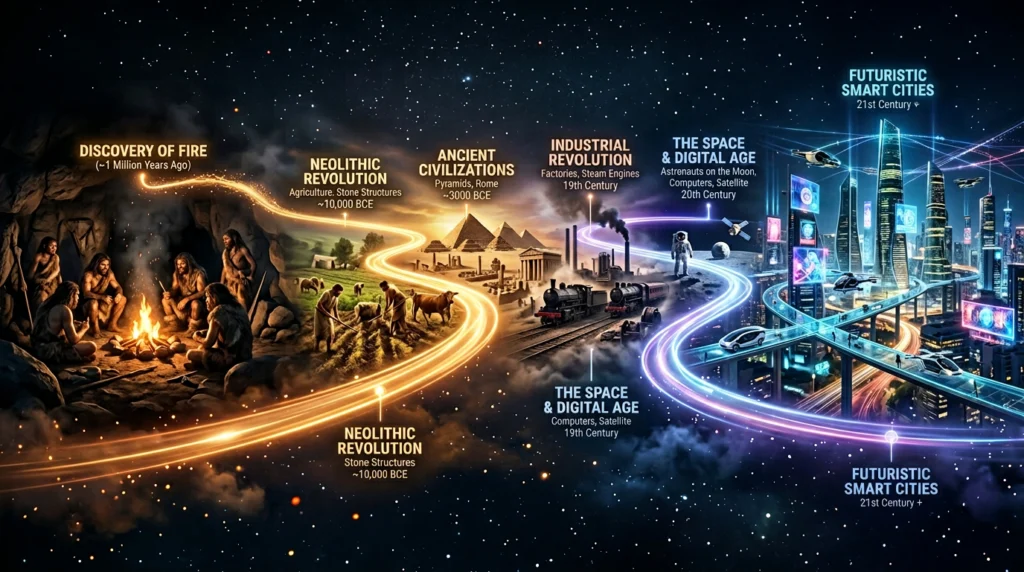
Human history is often presented as a sequence of dates, wars, and discoveries, but that version barely scratches the surface. In reality, human history is a deeply interconnected story of survival, ambition, adaptation, and transformation that continues to shape every aspect of our lives today. What makes this story so powerful is that many of its most important turning points were not obvious at the time they happened. Small decisions, accidental discoveries, and gradual shifts in behavior created ripple effects that transformed entire civilizations. When you look closely, human history is less about isolated events and more about chains of consequences that built the modern world step by step.
Understanding these turning points is not just about looking back, it is about recognizing the forces that still influence how we live, work, and think today.
At Informosio, we uncover the deeper layers of human history, breaking down complex historical events into clear, meaningful insights so you can understand what shaped civilizations, what patterns still influence the world today, and what lessons history holds for the future.
The Discovery of Fire and the Birth of Human Advantage
One of the earliest and most defining breakthroughs in human history was the control of fire, a development so fundamental that it is easy to overlook its true impact. Before fire, humans were limited by nature in almost every way, vulnerable to predators, restricted by daylight, and dependent on raw food for survival. The ability to create and control fire changed all of that in ways that went far beyond simple warmth or protection. Cooking food made it easier to digest, allowing the human body to extract more energy and nutrients, which played a crucial role in brain development. Fire also extended the day, creating space for social interaction, communication, and early forms of culture.
In many ways, this moment marked the beginning of human dominance over the environment, setting the stage for every major advancement that followed in human history.
Agriculture and the Shift from Survival to Stability
The transition from hunting and gathering to agriculture was not just a change in lifestyle, it was a complete transformation of how humans interacted with the world. For thousands of years, survival depended on movement, with small groups constantly searching for food and resources. The development of farming allowed humans to settle in one place, creating stable food supplies and enabling population growth. This stability led to the formation of villages and eventually cities, fundamentally reshaping human history. However, this shift also introduced new challenges that would define future societies. With surplus food came wealth, and with wealth came inequality, ownership, and competition. Social hierarchies began to form, and power structures emerged.
While agriculture made civilization possible, it also laid the foundation for many of the social and economic tensions that still exist today, making it one of the most complex turning points in human history.
The Rise of Civilizations and the Power of Systems
As human settlements grew into complex societies, the need for organization became essential. This led to the rise of early civilizations that introduced systems of governance, law, and communication. One of the most transformative innovations during this period was the development of writing, which allowed humans to record information, preserve knowledge, and manage increasingly complex societies. Writing turned human history into a shared memory, enabling ideas to travel across generations and distances. At the same time, legal systems created order but also reinforced authority and control. These developments marked a shift from simple communities to structured civilizations where power was centralized and systems dictated daily life.
The patterns established during this era continue to influence modern governments, institutions, and societal norms, showing how deeply rooted these early changes are in human history.
Exploration, Expansion, and the Collision of Worlds
The age of exploration represents one of the most dramatic and controversial chapters in human history, driven by a mix of curiosity, ambition, and economic desire. As explorers ventured beyond familiar territories, they connected distant parts of the world, creating new trade routes and cultural exchanges. This period expanded knowledge and introduced new goods, ideas, and technologies across continents. However, it also brought significant consequences, including colonization, exploitation, and cultural disruption. Entire populations were affected as new powers emerged and old systems were dismantled. This phase of human history highlights a recurring theme where progress and expansion often come with unintended costs.
It serves as a reminder that the benefits of connection and growth are frequently accompanied by complex ethical and social challenges.
The Industrial Revolution and the Acceleration of Change
Few periods in human history have reshaped society as rapidly and profoundly as the Industrial Revolution. What began as a series of technological innovations quickly transformed into a global shift in how people lived and worked. Machines replaced manual labor, increasing efficiency and production on an unprecedented scale. This led to the growth of cities as people moved in search of new opportunities, fundamentally changing social structures and daily life. The Industrial Revolution also introduced new economic systems that prioritized growth, competition, and innovation. While it created wealth and technological progress, it also exposed deep inequalities and environmental challenges that continue to affect the world today.
This era marked the beginning of a faster, more interconnected world, where change became constant rather than occasional in human history.
The Digital Era and the Redefinition of Reality
The digital revolution has transformed human history in ways that are still unfolding, making it one of the most significant turning points of the modern era. Unlike previous transformations, which took centuries to fully develop, the digital age has progressed at an extraordinary pace. The rise of the internet, smartphones, and artificial intelligence has redefined communication, work, and even identity. Information is no longer limited by geography or access, creating opportunities for learning and innovation on a global scale. At the same time, this shift has introduced new challenges, including data privacy concerns, digital dependency, and the spread of misinformation.
The digital era represents both the peak of human innovation and a new set of complexities that future generations will need to navigate, further proving that human history is a continuous process of adaptation.
Patterns That Reveal the Future of Human History
When examined closely, human history reveals patterns that repeat across different eras, offering valuable insights into what might come next. Each major turning point begins with a breakthrough that creates new opportunities, followed by a period of rapid growth and increasing complexity. Eventually, challenges emerge that force societies to adapt, leading to the next cycle of innovation. This pattern can be seen from the discovery of fire to the rise of digital technology, suggesting that change is not random but part of an ongoing process. Recognizing these patterns allows us to better understand current global trends and anticipate future developments, making human history not just a record of the past but a guide for the future.
Curious to uncover more hidden stories of human history? Explore our History & Culture section.
Conclusion
Human history is a powerful reminder of how far humanity has come and how much remains uncertain. Each turning point, from early survival strategies to modern technological advancements, has shaped the world in ways that continue to influence our daily lives. What makes human history truly remarkable is its ability to reveal both the strengths and limitations of human nature. It shows a constant drive to innovate and improve, balanced by challenges that test resilience and adaptability. As the world continues to evolve, understanding human history becomes more important than ever, offering insights that can help shape a more informed and thoughtful future.
Source: Wikipedia
🌐Connect with us
Informosio Official – General updates, current affairs, and informative content