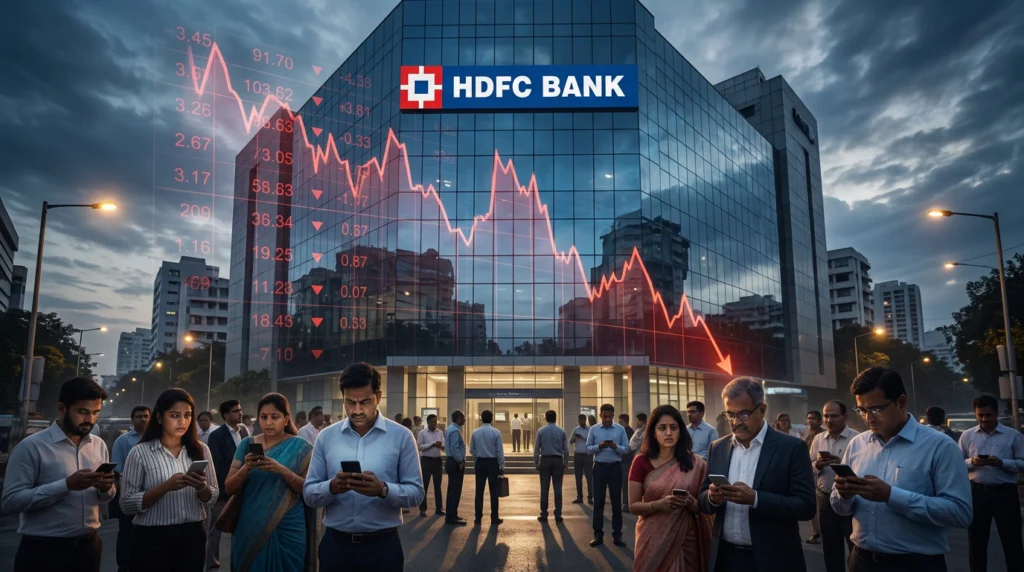
The sudden fall in HDFC Bank shares has left investors confused and concerned across the market. A stock once seen as a symbol of stability is now facing unexpected pressure, raising questions about what has changed behind the scenes. Is this just a temporary correction or a deeper signal that something bigger is unfolding in India’s banking sector? Understanding the real reasons behind this decline is now more important than ever for both new and experienced investors.
At Informosio, we break down major stock market movements like the fall in HDFC Bank shares into simple, actionable insights so you can understand what’s driving the decline, what risks investors are watching, and whether this dip signals a bigger opportunity or warning ahead.
HDFC Bank Shares Crash 25%: What’s Really Going On?
The sharp fall in HDFC Bank shares in 2026 has shocked investors across India. Once considered one of the most reliable and stable large-cap stocks, the sudden drop has raised serious questions about the future of India’s largest private lender, HDFC Bank.
For years, the bank has been a favorite on Dalal Street, attracting both retail and institutional investors. But now, sentiment has shifted. The decline of nearly 25% year-to-date is not just a number, it reflects deeper concerns about growth, profitability, and structural challenges.
So what exactly is driving this fall? And more importantly, should investors be worried or see this as an opportunity?
Slower Growth After the Mega Merger
One of the biggest reasons behind the fall in HDFC Bank shares is the lingering impact of its merger with Housing Development Finance Corporation. While the merger was expected to create a financial giant, integration challenges are still unfolding.
The bank is dealing with balance sheet adjustments, higher borrowing costs, and operational complexities. Growth, which was once smooth and predictable, now appears uneven. Investors expected immediate benefits, but the reality is taking longer to play out.
This mismatch between expectations and actual performance has triggered disappointment in the market.
Rising Cost of Funds Is Hurting Margins
Another major factor affecting HDFC Bank shares is the rising cost of funds. As interest rates remain elevated, banks are forced to offer higher returns on deposits to attract customers.
This directly impacts net interest margins, which are crucial for profitability. While loan growth continues, the profit earned on those loans is under pressure.
In simple terms, the bank is earning less from its core business compared to previous years, and that’s making investors cautious.
Deposit Growth Is Not Keeping Pace
A critical issue that analysts are highlighting is slower deposit growth. For any bank, deposits are the backbone of lending operations.
In the case of HDFC Bank shares, the growth in deposits has not kept pace with loan expansion. This imbalance creates liquidity pressure and forces the bank to rely on more expensive funding sources.
Investors are particularly sensitive to this metric, and any weakness here often leads to negative sentiment.
Regulatory Pressures Are Increasing
The banking sector in India is facing tighter regulatory scrutiny, and HDFC Bank is no exception. Compliance requirements, capital adequacy norms, and liquidity rules have become stricter.
These regulations are necessary for financial stability, but they also limit aggressive expansion. For a bank known for its consistent growth, these constraints are now being seen as a hurdle.
As a result, HDFC Bank shares are reflecting this cautious outlook.
Competition Is Getting Stronger
The Indian banking landscape is evolving rapidly. New-age fintech companies, digital banks, and aggressive competitors are challenging traditional players.
HDFC Bank, despite its strong legacy, is facing increasing competition in areas like digital lending, payments, and customer acquisition.
This rising competition is slowly impacting market share expectations, which in turn affects how investors value HDFC Bank shares.
Valuation Concerns Are Emerging
For years, HDFC Bank traded at a premium valuation compared to other banks. Investors were willing to pay more because of its consistent performance and strong management.
However, with growth slowing and challenges increasing, that premium is now being questioned.
Many analysts believe that HDFC Bank shares were overvalued earlier, and the current correction is simply a reality check. This shift in perception has played a significant role in the recent decline.
Market Sentiment Has Turned Cautious
Stock markets are driven not just by numbers, but also by sentiment. Right now, the sentiment around large-cap banking stocks is turning cautious.
Global uncertainties, interest rate concerns, and economic slowdown fears are influencing investor behavior. Even fundamentally strong companies are not immune to this shift.
This broader market mood is adding pressure on HDFC Bank shares, amplifying the decline.
Is This a Temporary Dip or a Long-Term Concern?
This is the biggest question every investor is asking right now.
On one hand, HDFC Bank remains a fundamentally strong institution with a proven track record. Its leadership, customer base, and long-term strategy are still intact.
On the other hand, the challenges it is facing are real and cannot be ignored. Integration issues, margin pressure, and slower growth are not short-term problems.
The truth likely lies somewhere in between. The fall in HDFC Bank shares may be partly temporary, but it also signals a transition phase for the bank.
What Should Investors Do Now?
For existing investors, panic selling may not be the best strategy. Historically, HDFC Bank has delivered strong returns over the long term, even after periods of correction.
For new investors, this dip could be an opportunity, but only with a long-term perspective. Short-term volatility is likely to continue.
It’s important to track key indicators like deposit growth, margins, and overall economic conditions before making any decision related to HDFC Bank shares.
The Bigger Picture Behind the Fall
The decline in HDFC Bank shares is not just about one company. It reflects a broader shift in the banking sector and market expectations.
Investors are no longer satisfied with stability alone. They are looking for growth, efficiency, and innovation.
As the financial landscape evolves, even the strongest players need to adapt quickly. HDFC Bank is currently navigating this transition, and the market is reacting in real time.
Stay informed with Informosio in-depth coverage of Finance, Business News, Stock Market updates, IPO announcements and Company News.
Final Thoughts
The 25% fall in HDFC Bank shares is a wake-up call for investors who assumed that large-cap banking stocks are always safe.
While the bank remains fundamentally strong, the challenges it faces are reshaping its growth story.
For now, caution is justified, but so is patience. The coming quarters will be crucial in determining whether this is just a temporary setback or a deeper structural shift.
Investors who understand the bigger picture will be better positioned to make informed decisions.
🌐Connect with us
Informosio Official – General updates, current affairs, and informative content