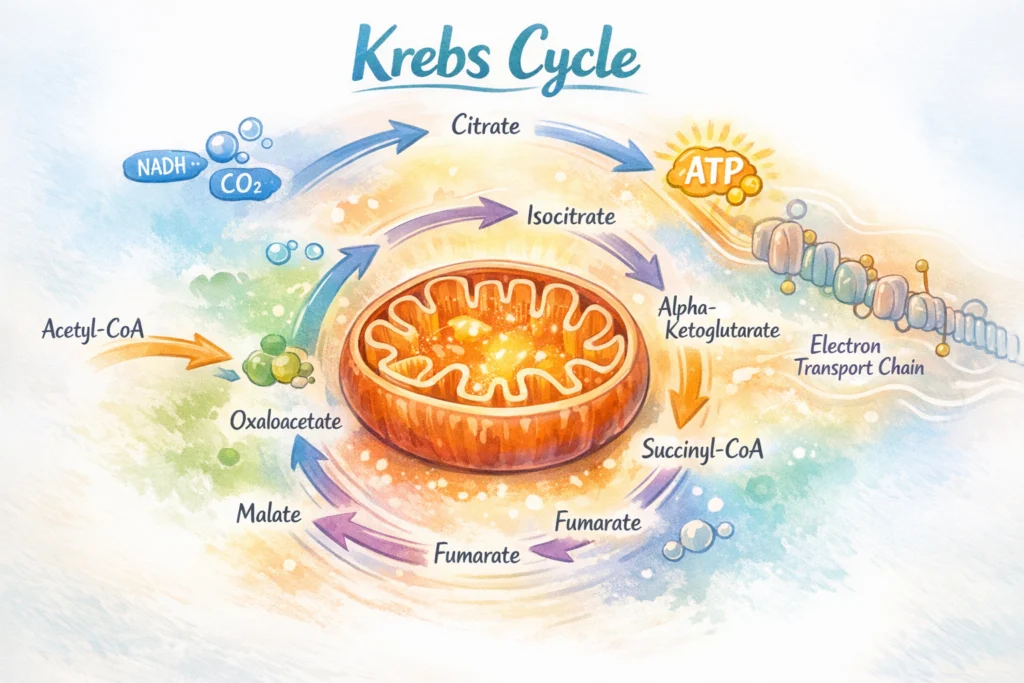
Krebs Cycle: A Complete and Clear Guide
The Krebs cycle is one of the most important processes in biology because it plays a central role in how cells produce energy. Without this cycle, living organisms would not be able to efficiently convert nutrients into usable energy. It occurs inside the mitochondria and is a key part of cellular respiration.
At Informosio, In simple terms, this metabolic pathway helps break down molecules derived from food to release energy stored in chemical bonds. This energy is then used to produce ATP, the main energy currency of the cell. Understanding This cycle is essential for students, researchers, and anyone interested in how life functions at a cellular level.
What is the Krebs Cycle?
The Krebs cycle, also known as the citric acid cycle or tricarboxylic acid (TCA) cycle, is a series of chemical reactions that occur in the mitochondrial matrix. It is the second major stage of cellular respiration, following glycolysis and preceding the electron transport chain.
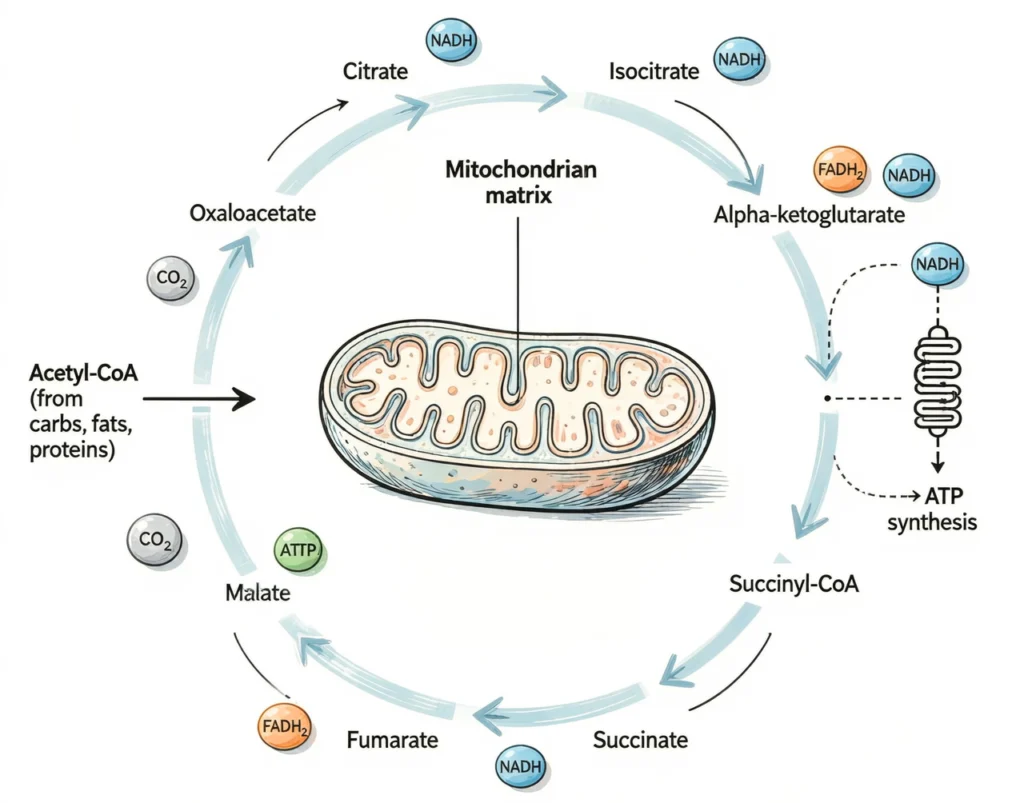
This cycle processes acetyl-CoA, a molecule derived from carbohydrates, fats, and proteins. Through a series of enzymatic reactions, it generates energy-rich molecules such as NADH and FADH₂, which are later used to produce ATP.
The Krebs cycle is considered an aerobic process because it depends indirectly on oxygen. Without oxygen, the electron transport chain cannot function, and this cycle eventually stops.
Location and Importance of the Krebs Cycle
The Krebs cycle takes place in the mitochondria, often referred to as the “powerhouse of the cell.” This location is ideal because mitochondria contain all the enzymes required for the cycle and are closely linked to the electron transport chain.
The importance of This cycle lies in its ability to:
- Generate high-energy electron carriers (NADH and FADH₂)
- Produce a small amount of ATP directly
- Provide intermediates for other metabolic pathways
It acts as a metabolic hub, connecting carbohydrate, fat, and protein metabolism. This makes it essential not only for energy production but also for biosynthesis.
Steps of the Krebs Cycle Explained
The Krebs cycle consists of eight sequential steps, each catalyzed by a specific enzyme. The process begins when acetyl-CoA combines with oxaloacetate to form citrate.
In the first step, citrate is formed through a condensation reaction. This molecule is then rearranged into isocitrate, preparing it for oxidation. During the next steps, isocitrate is oxidized to alpha-ketoglutarate, releasing carbon dioxide and producing NADH.
As the cycle continues, alpha-ketoglutarate is further oxidized to succinyl-CoA, again releasing carbon dioxide and generating NADH. This step is crucial because it contributes significantly to energy production.
Succinyl-CoA is then converted into succinate, producing ATP (or GTP) directly. This is one of the few steps in cellular respiration where ATP is formed without the electron transport chain.
Succinate is oxidized to fumarate, producing FADH₂. Fumarate is then converted into malate, which is finally oxidized to regenerate oxaloacetate. This regeneration allows the cycle to continue repeatedly.
Key Products of the Krebs Cycle
Each turn of the Krebs cycle produces several important molecules. These products are essential for the next stages of cellular respiration.
| Product | Quantity per Cycle | Function |
|---|---|---|
| NADH | 3 | Electron carrier for ATP production |
| FADH₂ | 1 | Electron carrier |
| ATP (or GTP) | 1 | Direct energy |
| CO₂ | 2 | Waste product |
Although only a small amount of ATP is produced directly, the NADH and FADH₂ generated are crucial because they drive the production of large amounts of ATP in the electron transport chain.
Regulation of the Krebs Cycle
The Krebs cycle is tightly regulated to ensure that energy production matches the needs of the cell. Several enzymes in the cycle are controlled by feedback mechanisms.
When energy levels are high, the cycle slows down. High levels of ATP and NADH inhibit key enzymes, preventing unnecessary energy production. Conversely, when energy is needed, molecules like ADP stimulate the cycle to increase activity.
This regulation ensures efficiency and prevents the waste of cellular resources.
Role of the Krebs Cycle in Metabolism
The Krebs cycle is not only involved in energy production but also plays a vital role in overall metabolism. It provides intermediates that are used in various biosynthetic pathways.
For example, alpha-ketoglutarate and oxaloacetate can be used to synthesize amino acids. Similarly, citrate can be transported out of the mitochondria and used for fatty acid synthesis.
Because of this versatility, this metabolic pathway is often described as an amphibolic pathway, meaning it participates in both catabolic (breaking down) and anabolic (building up) processes.
Why the Krebs Cycle is Essential for Life
This cycle is essential because it links multiple metabolic pathways and ensures efficient energy extraction from nutrients. Without it, cells would rely only on glycolysis, which produces far less ATP.
It also plays a role in maintaining the balance of metabolic intermediates, supporting the synthesis of important biomolecules. This makes this cycle indispensable for both energy production and cellular function.
Common Misconceptions About the Krebs Cycle
Many students believe that this cycle directly produces large amounts of ATP. In reality, most ATP is generated later in the electron transport chain.
Another misconception is that oxygen is directly used in this cycle. While the cycle itself does not use oxygen, it depends on oxygen indirectly because the electron transport chain requires it.
Understanding these points helps clarify how this cycle fits into the larger process of cellular respiration.
Conclusion
The Krebs cycle is a central pathway in cellular respiration that plays a critical role in energy production and metabolism. By breaking down acetyl-CoA into carbon dioxide and transferring energy to NADH and FADH₂, it ensures that cells can efficiently generate ATP.
Its importance goes beyond energy production, as it also provides essential intermediates for biosynthesis. A clear understanding of This cycle helps reveal how living organisms sustain life at the cellular level, making it one of the most fundamental processes in biology.
You may also visit the Biology section.
FAQs About Krebs Cycle
1. What is the main function of the Krebs cycle?
The Krebs cycle generates energy-rich molecules like NADH and FADH₂, which are used to produce ATP.
2. Where does the Krebs cycle occur?
It takes place in the mitochondrial matrix of eukaryotic cells.
3. Is the Krebs cycle aerobic or anaerobic?
It is considered aerobic because it depends indirectly on oxygen.
4. How many ATP molecules are produced in the Krebs cycle?
Only 1 ATP (or GTP) is produced per cycle directly.
5. Why is the Krebs cycle called a cycle?
Because it regenerates oxaloacetate at the end, allowing the process to repeat.
6. What enters the Krebs cycle?
Acetyl-CoA enters the cycle after being produced from pyruvate.
7. What are the end products of the Krebs cycle?
The main products are NADH, FADH₂, ATP, and carbon dioxide.
🌐 Connect With Us
👉 Informosio Tech – Science & Technology news, AI trends, gadgets, and innovations.