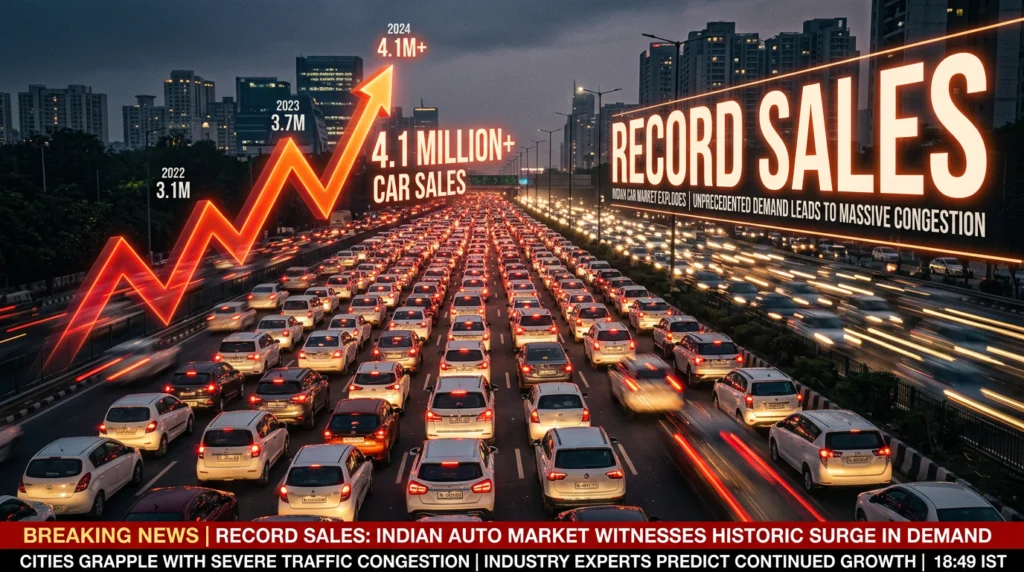
India’s automobile industry has just delivered a milestone that few expected to arrive this soon. In FY26, car sales India crossed an all-time high of approximately 47 lakh units, marking a strong year despite global uncertainties and rising costs. This surge is not just about numbers. It reflects a deeper shift in consumer behavior, economic confidence, and evolving mobility preferences across the country.
What makes this growth even more interesting is that not all automakers benefited equally. While some brands surged ahead with record-breaking performance, others struggled to keep pace in an increasingly competitive market.
At Informosio, we decode fast-changing automobile trends into clear, actionable insights so you can understand what’s driving record-breaking car sales in India, which segments are growing the fastest, and what it means for the future of the auto industry.
A Historic Year for Car Sales India
The FY26 performance signals a turning point for the Indian passenger vehicle market. After years of recovery post-pandemic, car sales India have now moved into a phase of structural growth rather than temporary rebound.
Several factors contributed to this historic milestone. Rising disposable incomes, better financing options, and improved infrastructure have all played a role. At the same time, consumer aspirations have evolved. Owning a car is no longer just a utility decision. It has become a lifestyle upgrade.
The result is clear. Car sales India are no longer driven only by entry-level buyers but increasingly by customers choosing premium and feature-rich vehicles.
SUVs Continue to Dominate the Market
One of the biggest drivers behind the surge in car sales India is the unstoppable rise of SUVs. Over the past few years, SUVs have transformed from niche products into mainstream choices.
Consumers today prefer higher ground clearance, bold design, and advanced features. Compact and mid-size SUVs, in particular, have seen explosive growth. This segment now accounts for a major share of total passenger vehicle sales.
The SUV trend is not slowing down. In fact, it is reshaping the entire strategy of automakers. Companies are launching new models, upgrading existing ones, and focusing heavily on this segment to capture demand.
Rural Demand is Back Stronger Than Expected
Another key factor fueling car sales India is the revival of rural demand. After facing pressure in previous years, rural markets have shown strong recovery.
Improved agricultural income, government spending, and better connectivity have boosted purchasing power in smaller towns and villages. First-time buyers from rural areas are contributing significantly to the overall sales growth.
This shift is crucial because it indicates that the growth in car sales India is not limited to urban centers but is becoming more widespread across the country.
Premiumization Trend Gains Momentum
A noticeable trend in FY26 is the shift toward premium vehicles. Buyers are increasingly willing to spend more for better features, safety, and technology.
This has led to higher demand for top variants, automatic transmissions, and connected car features. Even within budget segments, customers are opting for upgraded models.
The premiumization wave has added significant value to car sales India, increasing not just volume but also revenue for automakers.
Winners and Losers in FY26
While the overall market expanded, performance varied across brands. Some automakers successfully aligned their strategies with changing consumer preferences, while others lagged behind.
Companies with strong SUV portfolios and fresh product launches managed to capture a larger share of car sales India. On the other hand, brands relying heavily on older models or limited segments faced challenges.
This divergence highlights an important reality. Growth in car sales India is no longer guaranteed. It depends on innovation, product mix, and understanding customer expectations.
Role of Financing and Affordability
Easy access to vehicle financing has played a critical role in boosting car sales India. Lower interest rates, flexible EMI options, and digital loan approvals have made car ownership more accessible.
Financial institutions and NBFCs have expanded their reach, especially in semi-urban and rural areas. This has reduced the entry barrier for first-time buyers.
As financing becomes even more seamless, it is expected to continue supporting growth in car sales India in the coming years.
Challenges Beneath the Growth Story
Despite the record numbers, the journey hasn’t been without challenges. Rising input costs, supply chain disruptions, and regulatory pressures have tested automakers.
Electric vehicle transition is another factor shaping the future of car sales India. While EV adoption is still in early stages, it is gradually influencing product strategies and investments.
At the same time, competition is intensifying. With more players entering the market and existing brands expanding their portfolios, sustaining growth will require constant innovation.
What This Means for the Future
The record-breaking performance in FY26 sets a strong foundation for the future. However, maintaining this momentum will depend on several factors.
Consumer expectations will continue to evolve. Technology, safety, and sustainability will play a bigger role in purchase decisions. Automakers that adapt quickly will benefit the most.
The trajectory of car sales India suggests that the market is entering a more mature and competitive phase. Growth will continue, but it will be driven by strategy rather than just demand.
Stay informed with Informosio in-depth coverage of Finance, Business News, Stock Market updates, IPO announcements and Company News.
Final Thoughts
The surge in car sales India to 47 lakh units is more than just a statistical achievement. It reflects a nation on the move, where mobility is becoming an essential part of growth and aspiration.
From the dominance of SUVs to the rise of rural buyers and premiumization, multiple forces are shaping this transformation. While challenges remain, the overall outlook remains optimistic.
For industry players, the message is clear. The opportunity is massive, but only those who understand the changing dynamics will truly benefit from the next phase of growth.
🌐Connect with us
Informosio Official – General updates, current affairs, and informative content