Compare Different Types of DNA Sequencing Services
DNA sequencing has transformed modern biology, enabling scientists, clinicians, and researchers to decode genetic information with remarkable precision. When you compare different types of DNA sequencing services, it becomes clear that each method offers unique advantages depending on accuracy, cost, speed, and application. Understanding these differences is essential for selecting the most suitable approach for research, diagnostics, or personalized medicine.
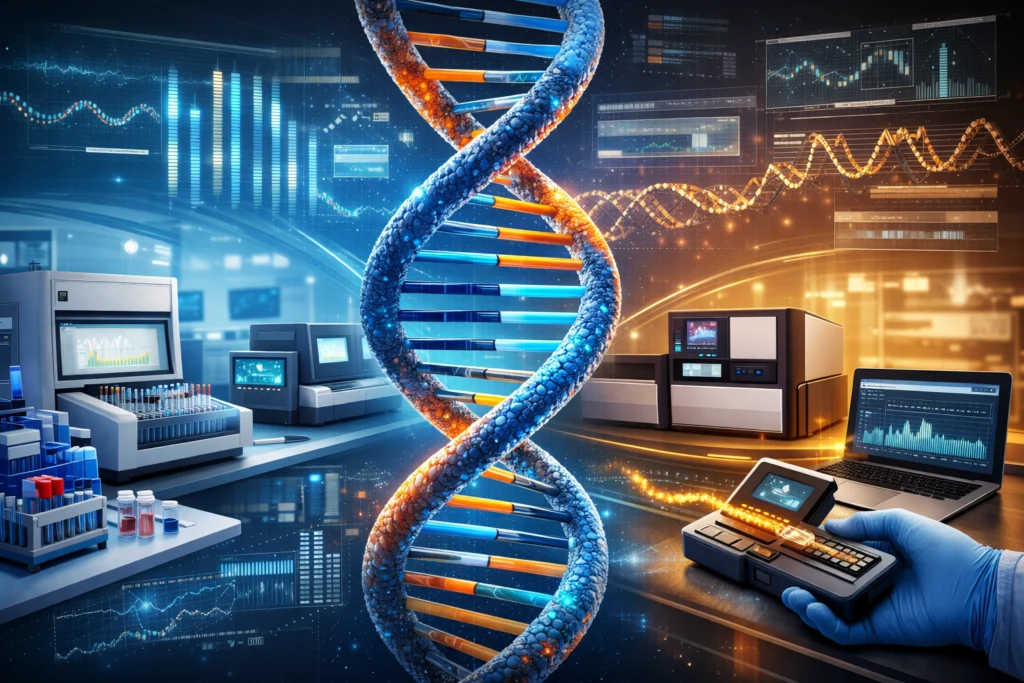
At Informosio, DNA sequencing technologies have evolved significantly from traditional methods to advanced high-throughput systems. Today, choosing the right sequencing service requires a balance between data quality, read length, scalability, and budget.
What Is DNA Sequencing and Why It Matters
DNA sequencing is the process of determining the exact order of nucleotides in a DNA molecule. It plays a crucial role in medical diagnostics, evolutionary biology, forensic science, and personalized medicine.
Modern sequencing services allow scientists to analyze genomes faster and more accurately than ever before. However, choosing the right service requires careful comparison of technology, cost, accuracy, and purpose.
Understanding DNA Sequencing Technologies
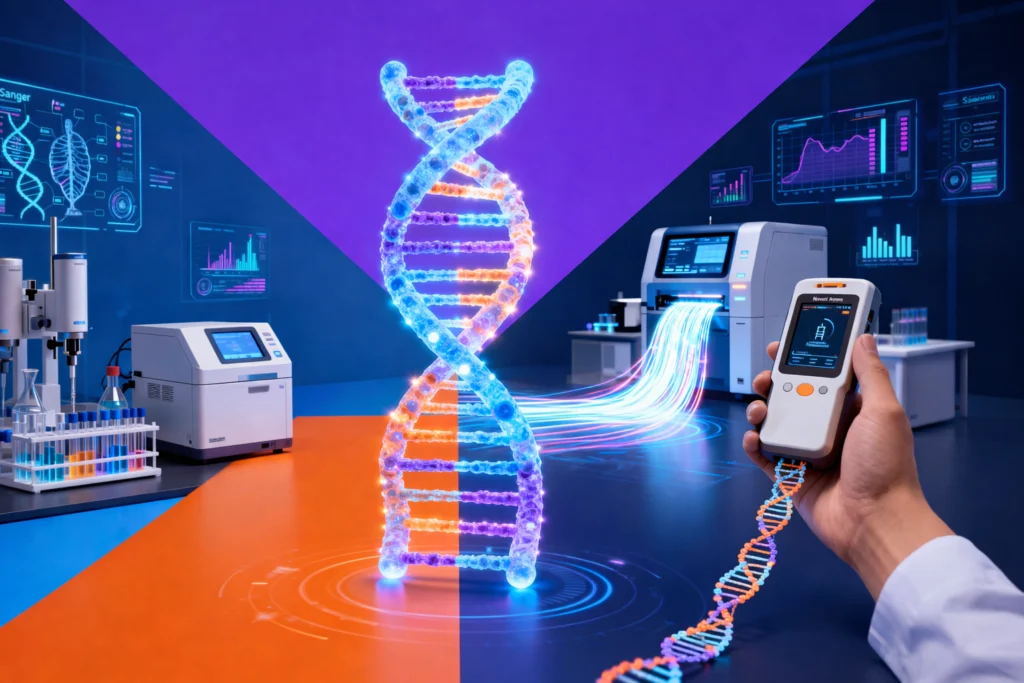
DNA sequencing is the process of determining the exact order of nucleotides within a DNA molecule. Over time, multiple technologies have emerged, each addressing specific limitations of earlier methods. When researchers compare different types of DNA sequencing services, they typically evaluate three main categories: first-generation, next-generation, and third-generation sequencing.
First-generation sequencing, particularly Sanger sequencing, laid the foundation for genomic science. Next-generation sequencing (NGS) introduced massive parallelization, drastically increasing throughput. Third-generation sequencing further advanced the field by enabling real-time sequencing of long DNA fragments.
These technologies differ not only in their technical approaches but also in their real-world applications, making it important to understand their core principles before selecting a service.
Sanger Sequencing: The Gold Standard of Accuracy
Sanger sequencing, developed in the 1970s, remains one of the most reliable DNA sequencing methods. It uses chain-terminating nucleotides to generate DNA fragments of varying lengths, which are then analyzed to determine the sequence.
This method is widely known for its high accuracy and is often used for validating results obtained from other sequencing technologies. However, when you compare different types of DNA sequencing services, Sanger sequencing stands out as being slower and less scalable.
Sanger sequencing is best suited for small-scale projects, such as sequencing individual genes or confirming mutations. Despite its limitations in throughput, it continues to play a crucial role in clinical diagnostics and research validation.
Next-Generation Sequencing (NGS): High Throughput and Efficiency
Next-generation sequencing revolutionized genomics by enabling the simultaneous sequencing of millions of DNA fragments. This massively parallel approach significantly reduces cost per base and increases speed compared to traditional methods.
NGS platforms, such as Illumina sequencing, rely on sequencing-by-synthesis technology. DNA fragments are amplified and sequenced in parallel, producing vast amounts of data in a single run.
When researchers compare different types of DNA sequencing services, NGS is often preferred for large-scale projects, including whole-genome sequencing, transcriptomics, and metagenomics. Its ability to generate high-throughput data makes it ideal for population studies and clinical research.
However, NGS typically produces shorter read lengths compared to third-generation technologies, which can make genome assembly more complex.
Third-Generation Sequencing: Long Reads and Real-Time Analysis
Third-generation sequencing technologies, such as PacBio and Oxford Nanopore, represent the latest advancement in DNA sequencing. These methods sequence individual DNA molecules in real time without the need for amplification.
One of the most significant advantages of third-generation sequencing is its ability to produce long reads. This makes it easier to analyze complex genomic regions, structural variations, and repetitive sequences.
When you compare different types of DNA sequencing services, third-generation platforms stand out for their flexibility and ability to provide deeper insights into genome structure. They are particularly useful in applications like de novo genome assembly and epigenetic studies.
Despite these advantages, third-generation sequencing may have higher error rates compared to Sanger sequencing, although continuous improvements are addressing this limitation.
Key Differences Between DNA Sequencing Services
Understanding the differences between sequencing technologies is essential for making informed decisions. Each method offers distinct benefits and limitations based on specific use cases.
| Feature | Sanger Sequencing | Next-Generation Sequencing | Third-Generation Sequencing |
|---|---|---|---|
| Read Length | Long (500–1000 bp) | Short (50–300 bp) | Very long (10,000+ bp) |
| Accuracy | Very high | High | Moderate to improving |
| Throughput | Low | Very high | Moderate |
| Cost per Sample | High | Low | Variable |
| Speed | Slow | Fast | Real-time |
| Best Use Case | Small projects | Large-scale studies | Complex genomes |
When scientists compare different types of DNA sequencing services, this comparison highlights why no single method is universally superior. Instead, the best choice depends on the research objective.
How to Choose the Right DNA Sequencing Service
Selecting the appropriate sequencing service involves careful consideration of several factors. Researchers must align their project goals with the strengths of each technology.
The first factor is project scale. Small-scale projects often benefit from Sanger sequencing due to its accuracy. Large-scale genomic studies, on the other hand, require the high throughput of NGS.
The second factor is read length. If the study involves complex genomic regions or structural variations, third-generation sequencing is more suitable due to its long-read capabilities.
Cost is another critical consideration. While NGS offers lower cost per base, initial setup and data analysis can be expensive. Third-generation sequencing may involve higher costs but provides unique advantages in specific applications.
Finally, turnaround time and data analysis requirements should also be considered. Some projects demand rapid results, while others require deep computational analysis.
Applications of Different DNA Sequencing Services
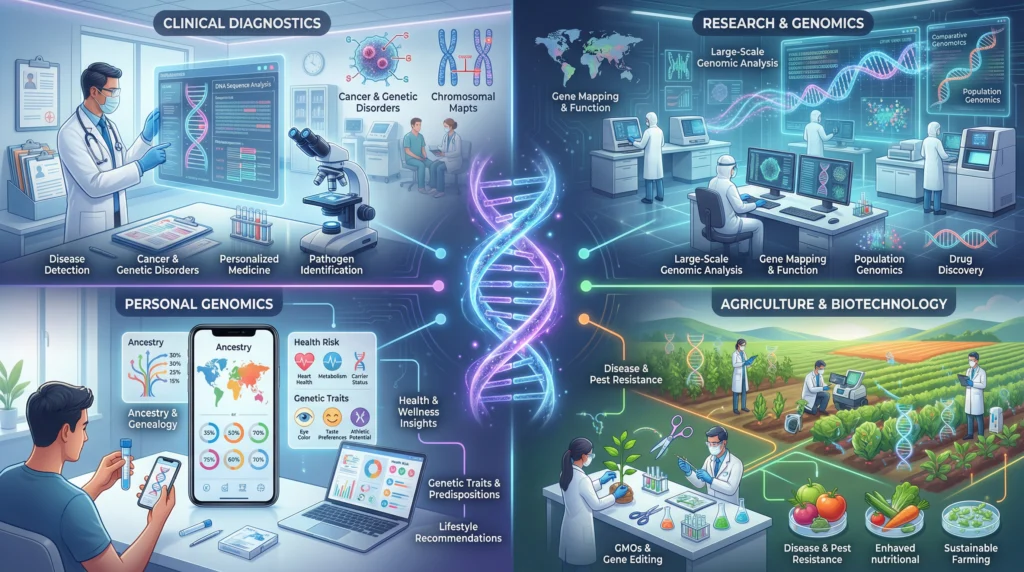
DNA sequencing services are used in many important fields. Each type of sequencing method is chosen based on its accuracy, speed, and purpose. Understanding these applications helps in selecting the right technology.
Clinical Diagnostics
DNA sequencing plays a major role in medical diagnosis. Methods like Sanger sequencing and targeted NGS are used to detect genetic mutations responsible for diseases. These techniques help identify conditions such as inherited disorders, cancer, and rare genetic diseases. Because of their high accuracy, they are widely used in hospitals and diagnostic labs. This also helps doctors decide the best treatment and personalized medicine.
Research and Genomics
In research, DNA sequencing is essential for studying genes and genomes. Next-generation sequencing (NGS) is commonly used because it can analyze large amounts of DNA quickly and at lower cost. Scientists use it to understand gene functions, discover new genes, and study genetic variations. It is also important in fields like evolutionary biology and drug development.
Personal Genomics
Personal genomics allows individuals to learn about their genetic information. Many consumer DNA testing services use NGS-based methods to provide details about ancestry, family history, and health risks. This helps people understand their genetic traits and possible future health conditions in a simple and accessible way.
Agriculture and Biotechnology
DNA sequencing is widely used in agriculture to improve crops and livestock. Scientists use it to develop plants that have higher yield, better quality, and resistance to diseases and environmental stress. In biotechnology, sequencing supports genetic engineering, helping create useful products like improved seeds, vaccines, and bio-based materials.
Advantages and Limitations of Each Service
Every sequencing technology comes with its own set of strengths and weaknesses. Understanding these helps researchers make better decisions. Sanger sequencing offers unmatched accuracy but lacks scalability. NGS provides high throughput and cost efficiency but produces shorter reads. Third-generation sequencing delivers long reads and real-time analysis but may require further refinement in accuracy.
When you compare different types of DNA sequencing services, it becomes evident that combining multiple technologies is often the best approach. Hybrid sequencing strategies are increasingly used to achieve both accuracy and comprehensive genome coverage.
How to Choose the Right DNA Sequencing Service
Selecting the appropriate sequencing service involves careful consideration of several factors. Researchers must align their project goals with the strengths of each technology.
The first factor is project scale. Small-scale projects often benefit from Sanger sequencing due to its accuracy. Large-scale genomic studies, on the other hand, require the high throughput of NGS.
The second factor is read length. If the study involves complex genomic regions or structural variations, third-generation sequencing is more suitable due to its long-read capabilities.
Cost is another critical consideration. While NGS offers lower cost per base, initial setup and data analysis can be expensive. Third-generation sequencing may involve higher costs but provides unique advantages in specific applications.
Finally, turnaround time and data analysis requirements should also be considered. Some projects demand rapid results, while others require deep computational analysis.
Future Trends in DNA Sequencing
The field of DNA sequencing continues to evolve rapidly. Advances in technology are making sequencing faster, cheaper, and more accessible.
Artificial intelligence and machine learning are being integrated into sequencing analysis, improving accuracy and interpretation. Portable sequencing devices are also becoming more common, enabling real-time analysis in remote locations.
As researchers continue to compare different types of DNA sequencing services, the trend is moving toward more personalized and application-specific solutions. The future of sequencing lies in integrating multiple technologies to achieve the best possible outcomes.
Conclusion
To successfully compare different types of DNA sequencing services, you must evaluate accuracy, cost, speed, read length, and application needs. Each technology—Sanger, NGS, and third-generation sequencing—offers unique advantages.
There is no universal best option. The right choice depends on your specific goals, whether it is clinical precision, large-scale research, or complex genome analysis. By understanding these differences clearly, you can confidently select the most suitable DNA sequencing service for your needs.
You may also visit the Biology section.
FAQs
1. What is the most accurate DNA sequencing method?
Sanger sequencing is considered the most accurate, especially for small-scale projects and validation studies.
2. Which sequencing method is best for whole-genome analysis?
Next-generation sequencing (NGS) is the most suitable for whole-genome and large-scale studies.
3. Is DNA sequencing expensive?
Costs vary depending on the method. NGS is cost-effective for large datasets, while Sanger sequencing can be expensive per sample.
4. What is long-read sequencing used for?
It is used for analyzing complex genomic regions, structural variations, and repetitive DNA sequences.
5. Do I need bioinformatics knowledge for DNA sequencing?
Yes, especially for NGS and long-read sequencing, as they generate large datasets requiring analysis.
6. How long does DNA sequencing take?
Turnaround time depends on the method. NGS is faster for large datasets, while Sanger sequencing takes longer.
7. Can DNA sequencing detect diseases?
Yes, it is widely used in diagnosing genetic disorders and identifying mutations linked to diseases.
🌐 Connect With Us
👉 Informosio Tech – Science & Technology news, AI trends, gadgets, and innovations.