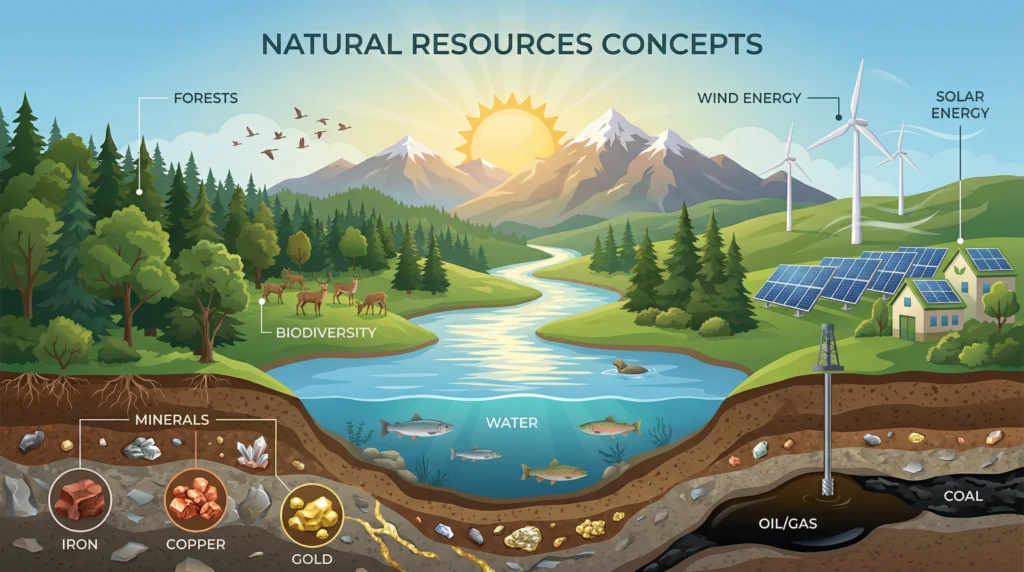
Natural resources are the foundation of life on Earth. Every organism, including humans, depends on materials obtained from nature for survival, development, and economic activity. Water, air, soil, sunlight, minerals, forests, and fossil fuels are all examples of resources that exist naturally in the environment without human creation.
In biology and environmental science, the study of Natural Resources focuses on understanding their origin, classification, use, and sustainable management. These resources support ecosystems, provide raw materials for industries, and maintain the balance necessary for life. However, rapid population growth, industrialization, and overconsumption have placed many natural resources under severe pressure.
Understanding natural resources helps students appreciate the relationship between humans and the environment. It also introduces the concept of sustainable use—using resources wisely so they remain available for future generations.
This article explains the concept of natural resources step by step, including definitions, classification, examples, real-life applications, conservation methods, exam tips, and practice questions.
Introduction to Natural Resources
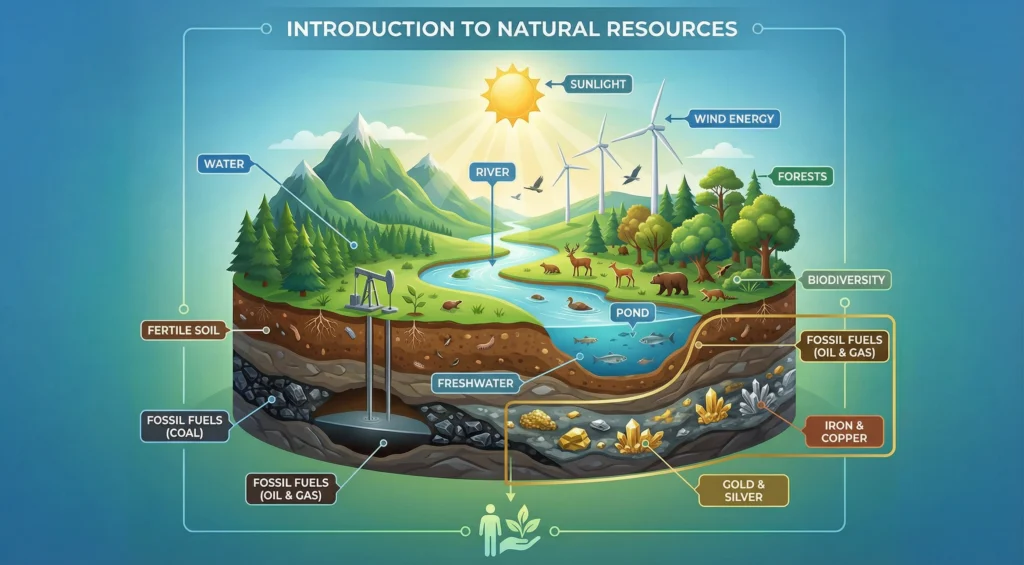
Natural resources are materials and substances that occur naturally in the environment and are used by humans for survival, development, and economic activities. These resources are not created by humans but are obtained directly from nature. They form the basic support system for life on Earth and play a crucial role in sustaining human civilization. Natural resources are essential for fulfilling fundamental human needs such as food, water, shelter, and energy.
Examples of natural resources include sunlight, air, water, forests, wildlife, soil, minerals, and fossil fuels such as coal and petroleum. These resources provide energy for daily activities and industrial processes, supply raw materials for manufacturing goods, and support agricultural production. In addition, natural resources help maintain ecosystems and biodiversity by supporting different forms of plant and animal life.
Natural resources also play an important role in economic development. Many industries depend directly on natural resources for production, transportation, and energy generation. Agriculture relies on fertile soil and water, while industries depend on minerals, metals, and fossil fuels for manufacturing and technological advancement.
However, many natural resources are limited and may become depleted if they are overused or poorly managed. Rapid population growth, industrialization, and environmental pollution have increased pressure on these resources. Therefore, the conservation and sustainable use of natural resources are essential to maintain ecological balance and ensure that these valuable resources remain available for future generations.
Meaning and Definition of Natural Resources
Natural resources can be defined as materials and components that occur naturally in the environment and are used by humans to meet their needs and improve their quality of life. These resources are obtained directly from nature and support many aspects of human survival and development. In environmental science, natural resources are considered part of the Earth’s natural capital. Natural capital refers to the stock of natural ecosystems that provide valuable goods and services, such as clean water, fertile soil, fresh air, and climate regulation, which are essential for maintaining life on Earth. In simple terms, natural resources include everything that humans obtain from nature for survival, economic activities, and technological advancement.
Classification of Natural Resources
Natural resources can be classified in several ways depending on their availability, origin, and stage of development.
Classification Based on Availability
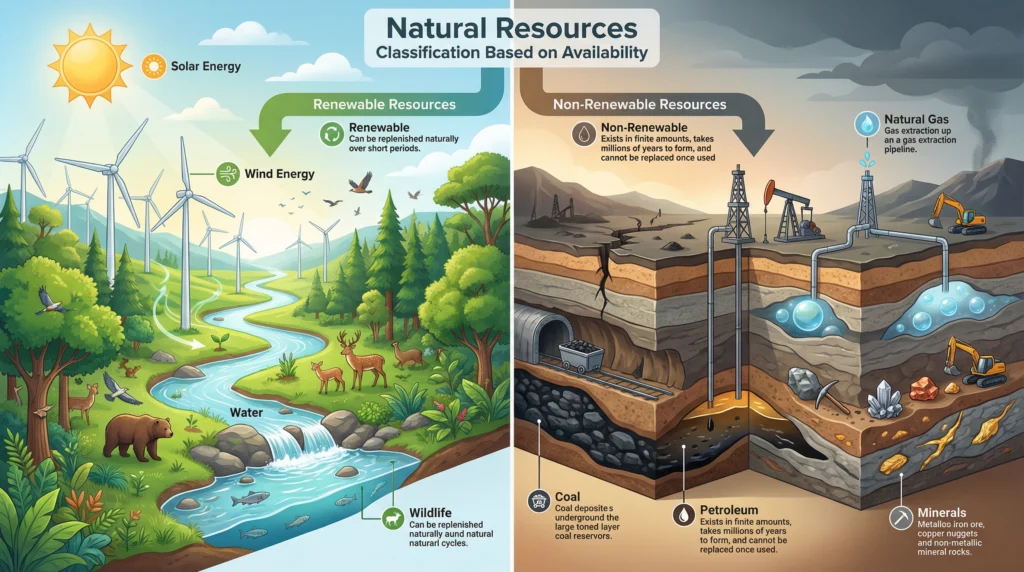
Natural resources are classified into renewable and non-renewable resources based on their availability and ability to regenerate. Renewable resources are those that can be naturally replenished within a relatively short period of time through natural processes. Examples include sunlight, wind energy, water, forests, and wildlife. Solar energy is one of the most abundant renewable resources because the Sun continuously supplies energy to the Earth, while wind energy is produced through natural atmospheric movements.
Non-renewable resources, on the other hand, exist in limited quantities and cannot be replaced within a human lifetime. Once these resources are used, they take millions of years to form again. Examples include coal, petroleum, natural gas, and many mineral resources. Fossil fuels are formed from the remains of ancient plants and animals that were buried under the Earth and transformed by heat and pressure over millions of years, which makes them non-renewable.
Classification Based on Origin
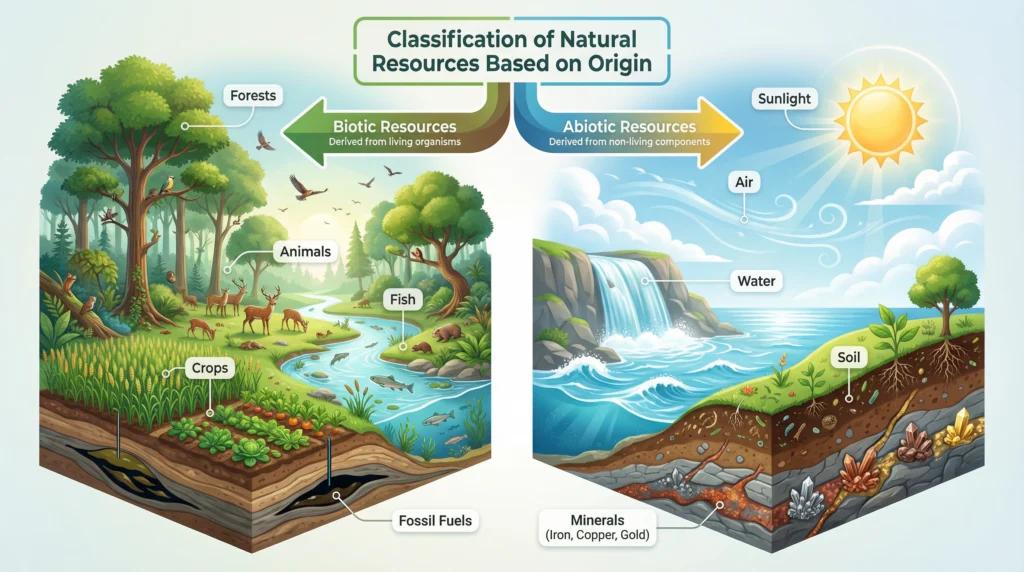
Natural resources can be classified according to their origin into biotic and abiotic resources. Biotic resources are derived from living organisms or biological processes. Examples of biotic resources include forests, animals, fish, crops, and fossil fuels that originated from ancient plants and animals. In contrast, abiotic resources come from non-living components of nature. These include water, air, sunlight, soil, and minerals such as iron, copper, and gold. This classification helps scientists understand the relationship between living organisms, non-living elements, and ecosystems.
Classification Based on Development
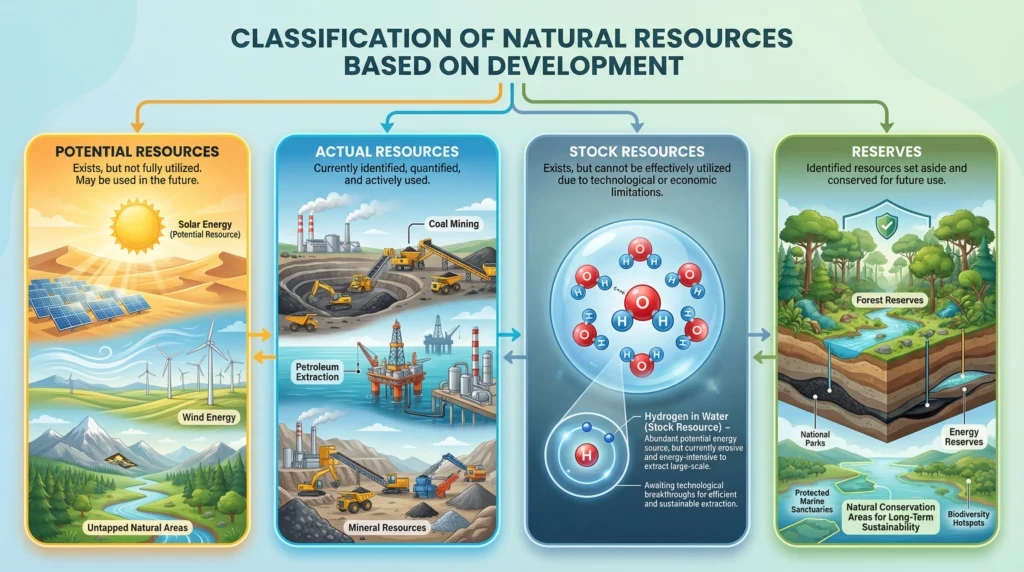
Natural resources can also be classified based on their stage of development and use into potential resources, actual resources, stock resources, and reserves. Potential resources are those that exist in a region but are not yet fully utilized, such as solar energy in desert areas. Actual resources are identified, measured, and currently used, for example coal mining in certain regions. Stock resources are materials that exist in nature but cannot be used effectively due to lack of suitable technology, such as hydrogen present in water. Reserves are resources that are known to exist and can be used in the future but are conserved for long-term use.
Importance of Natural Resources
- Provide Energy for Human Activities
Natural resources such as fossil fuels, solar energy, and wind energy provide the energy required to run industries, transportation systems, and household activities. - Supply Raw Materials for Industries
Natural resources supply essential raw materials used in manufacturing. Metals like iron and aluminum are used to produce machinery, vehicles, buildings, and infrastructure. - Support Agricultural Production
Agriculture depends heavily on natural resources. Fertile soil, adequate water, and sunlight are necessary for growing crops and producing food. - Maintain Ecosystem Services
Natural ecosystems provide important services such as climate regulation, water purification, and nutrient cycling. These are known as ecosystem services. - Foundation of Human Civilization
Natural resources are fundamental for the development and survival of modern civilization. Without them, economic growth and human life would not be possible.
Major Types of Natural Resources
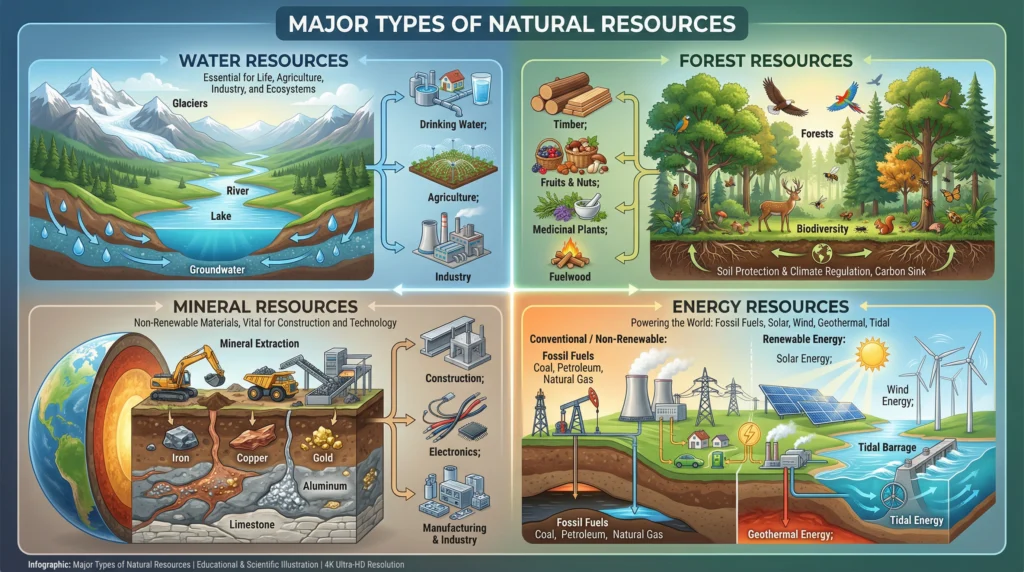
Several major categories of natural resources are commonly studied in biology and environmental science.
Water Resources
Water is one of the most essential natural resources. It is required for drinking, agriculture, sanitation, and industrial activities.
Approximately seventy percent of the Earth’s surface is covered by water. However, only a small fraction of this water is available as freshwater suitable for human consumption. Rivers, lakes, glaciers, and groundwater serve as major freshwater sources. Water scarcity has become a major global concern due to pollution, climate change, and increasing demand.
Forest Resources
Forests are ecosystems dominated by trees and other vegetation. They provide numerous ecological and economic benefits. Forests help regulate climate by absorbing carbon dioxide and releasing oxygen. They also protect soil from erosion and support biodiversity.
Forest products include timber, paper, medicinal plants, fruits, and fuelwood. Deforestation, caused by agricultural expansion and urban development, threatens forest resources worldwide.
Mineral Resources
Minerals are naturally occurring inorganic substances found in the Earth’s crust. Examples include iron, copper, gold, aluminum, and limestone.
Mineral resources are essential for construction, manufacturing, and technological development. For example, copper is widely used in electrical wiring because of its high conductivity. Since mineral formation takes millions of years, most minerals are considered non-renewable resources.
Energy Resources
Energy resources provide power for human activities. These resources are divided into conventional and non-conventional energy sources.
Conventional energy sources include fossil fuels such as coal, petroleum, and natural gas. Non-conventional energy sources include solar energy, wind energy, geothermal energy, and tidal energy.
Renewable energy sources are increasingly important because they reduce environmental pollution and dependence on fossil fuels.
Natural Resource Depletion
Natural resource depletion occurs when resources are consumed faster than they can be replenished. Several factors contribute to resource depletion:
Population growth increases demand for food, water, and energy. Industrialization requires large amounts of raw materials and energy.
Urbanization leads to land use changes and habitat destruction. Overexploitation of resources such as forests and fisheries disrupts ecosystems. Resource depletion can lead to environmental problems such as climate change, desertification, and biodiversity loss.
Conservation of Natural Resources
Conservation refers to the careful management and protection of natural resources to ensure their long-term availability. Several conservation strategies are commonly used.
Sustainable use involves using resources in a way that meets current needs without compromising the ability of future generations to meet their needs. Recycling and reuse reduce the demand for raw materials and decrease waste production.
Afforestation and reforestation help restore forest ecosystems. Water conservation techniques such as rainwater harvesting and efficient irrigation reduce water wastage. Renewable energy technologies help reduce dependence on fossil fuels. Government policies and international agreements also play an important role in resource conservation.
Real-Life Applications of Natural Resource Management
Natural resource management has practical applications in many areas. Agriculture uses soil conservation methods to prevent erosion and maintain fertility.
Urban planning incorporates green spaces and water management systems. Industries adopt cleaner technologies to reduce pollution and conserve resources.
Environmental impact assessments are conducted before large development projects to evaluate their effects on natural resources. These practices help maintain ecological balance while supporting economic growth.
Common Mistakes Students Make
Students often confuse renewable resources with resources that are unlimited. Renewable resources can regenerate, but they can still be depleted if used excessively.
Another common mistake is assuming that all natural resources are directly visible. Some resources, such as groundwater or mineral deposits, are hidden underground.
Students also tend to overlook the role of ecosystems in maintaining natural resources. For example, forests protect water resources and soil fertility. Understanding these relationships is important for accurate learning.
Exam-Oriented Tips
Students preparing for biology or environmental science exams should remember the main classifications of natural resources. It is important to clearly distinguish between renewable and non-renewable resources and provide examples for each category.
Students should also understand the concept of sustainable development and the importance of conservation. Diagrams explaining the classification of resources or the water cycle can help improve answers in descriptive exams.
Practice Questions with Answers
Question 1: What are natural resources?
Natural resources are materials or substances that occur in nature and can be used by humans to meet their needs, such as water, air, minerals, and forests.
Question 2: What is the difference between renewable and non-renewable resources?
Renewable resources can regenerate naturally within a short period of time, whereas non-renewable resources take millions of years to form and exist in limited quantities.
Question 3: Give two examples of biotic resources.
Examples include forests and animals.
Question 4: Why is conservation of natural resources important?
Conservation ensures that resources remain available for future generations and helps maintain ecological balance.
Question 5: What is sustainable development?
Sustainable development refers to development that meets present needs without compromising the ability of future generations to meet their own needs.
Important Concepts Recap
Natural resources are materials obtained from nature that support life and economic activities. These resources include water, air, minerals, forests, and energy sources.
Natural resources can be classified based on availability, origin, and stage of development. Renewable resources can regenerate naturally, while non-renewable resources exist in limited quantities.
Human activities have placed increasing pressure on natural resources, leading to depletion and environmental problems. Effective conservation strategies such as sustainable use, recycling, renewable energy adoption, and ecosystem protection are essential for maintaining these resources.
A clear understanding of Natural Resources helps students appreciate the relationship between human society and the environment while promoting responsible resource management for future generations.
You may also visit the Biology section.
Frequently Asked Questions (FAQs)
What are natural resources in simple terms?
Natural resources are materials that occur naturally in the environment and are used by humans for survival, energy, and economic activities.
What are the main types of natural resources?
The main types include renewable resources, non-renewable resources, biotic resources, and abiotic resources.
Why are natural resources important?
They provide energy, raw materials, and ecosystem services that support life and economic development.
What causes depletion of natural resources?
Overpopulation, industrialization, deforestation, pollution, and excessive consumption contribute to resource depletion.
How can natural resources be conserved?
Conservation methods include recycling, sustainable resource use, renewable energy adoption, afforestation, and efficient water management.
What is the difference between potential resources and actual resources?
Potential resources exist in a region but are not yet utilized, whereas actual resources are identified and currently used
🌐 Connect With Us
👉 Informosio Tech – Science & Technology news, AI trends, gadgets, and innovations.