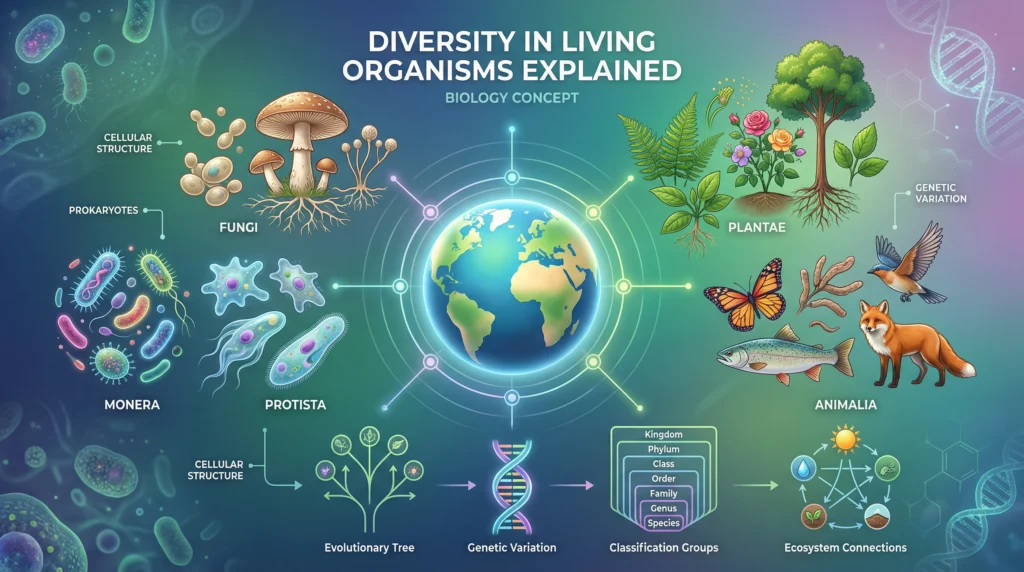
The natural world contains an enormous variety of life forms. From microscopic bacteria to giant trees and complex animals, living organisms show remarkable differences in structure, function, and behavior. The scientific study of this variety is known as Diversity in Living Organisms. Understanding this biological diversity helps scientists organize and study the vast number of species that exist on Earth.
In biology, Diversity in Living Organisms refers to the wide range of differences among living organisms in their structure, physiology, genetics, and ecological roles. The concept of Diversity in Living Organisms helps scientists understand how different life forms exist and interact within ecosystems. Studying Diversity in Living Organisms allows researchers to identify similarities and differences between species and understand their evolutionary relationships. Because the number of species on Earth is extremely large, understanding Diversity in Living Organisms without a systematic method would be very difficult. Therefore, scientists developed classification systems to organize Diversity in Living Organisms into meaningful groups based on shared characteristics and evolutionary connections.
The concept of Diversity in Living Organisms is an important part of biological science and forms a core topic in school biology curricula, including the NCERT Class 9 Science syllabus. Through classification, scientists are able to identify organisms, understand their relationships, and study their evolution. By examining structural features, modes of nutrition, reproductive patterns, and cellular organization, organisms are placed into different categories that make biological study easier and more systematic.
What Is Biological Classification?
Definition:
Biological classification is the scientific process of grouping organisms based on similarities in their structure, characteristics, and evolutionary relationships.
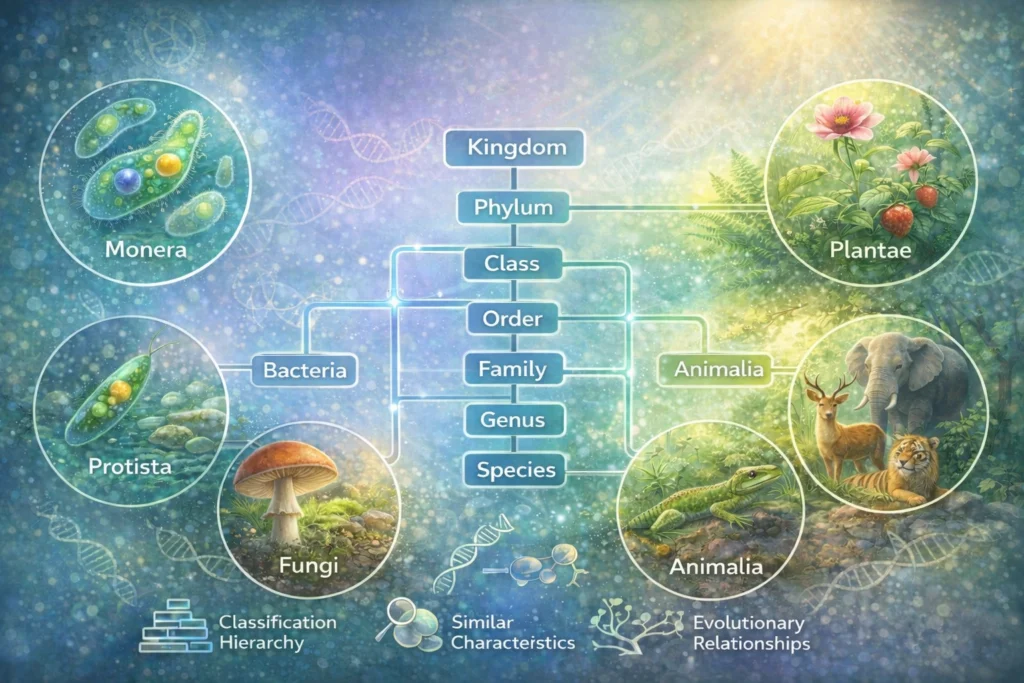
Biological classification is the scientific method used to organize living organisms into groups based on shared characteristics. The immense variety of species on Earth requires a structured system so that organisms can be studied efficiently. The process of classification involves comparing organisms and identifying similarities and differences in their structures and biological functions. Organisms that share many characteristics are grouped together, while those that are significantly different are placed in separate groups.
Classification also helps scientists understand evolutionary relationships. Species that share common ancestors tend to show similarities in their physical structures and genetic composition. Through classification, scientists can trace how organisms evolved over millions of years.
The hierarchical system of classification includes several levels such as kingdom, phylum, class, order, family, genus, and species. Each level represents a specific degree of similarity among organisms. The species level is the most specific category and includes organisms that can interbreed and produce fertile offspring.
Historical Development of Classification Systems
The study of Diversity in Living Organisms has evolved over time as scientific knowledge improved. Early scientists grouped organisms mainly based on visible characteristics, but modern classification systems consider cellular structure, molecular biology, and evolutionary history.
One of the earliest classification systems was proposed by Aristotle, who divided organisms into plants and animals. Plants were considered stationary organisms while animals were mobile. Although this classification was simple, it was insufficient to explain the vast diversity of life.
Later, the Swedish scientist Carl Linnaeus developed a more detailed system of classification known as the binomial nomenclature system. In this system, each organism receives a two-part scientific name consisting of its genus and species. This naming system is still used today and provides a universal method for identifying organisms.
In 1969, Robert H. Whittaker proposed the five kingdom classification system, which is widely accepted in modern biology. This system classified organisms into five major kingdoms based on cellular organization, mode of nutrition, and complexity of body structure.
The Five Kingdom Classification System
The five kingdom system is one of the most widely used frameworks for studying Diversity in Living Organisms. According to this system, all living organisms are classified into five major kingdoms: Monera, Protista, Fungi, Plantae, and Animalia.
The classification is based on important biological criteria including cell structure, number of cells, mode of nutrition, reproduction, and evolutionary relationships. This system helps scientists understand how different organisms are related and how they function within ecosystems.
Kingdom Monera
Kingdom Monera includes the simplest and most primitive organisms. These organisms are unicellular and possess prokaryotic cells, meaning their cells lack a true nucleus and membrane-bound organelles. Bacteria are the most common members of this kingdom. They are found in almost every environment on Earth, including soil, water, air, and even inside living organisms. Despite their simple structure, bacteria play essential roles in ecological processes such as decomposition and nutrient recycling.
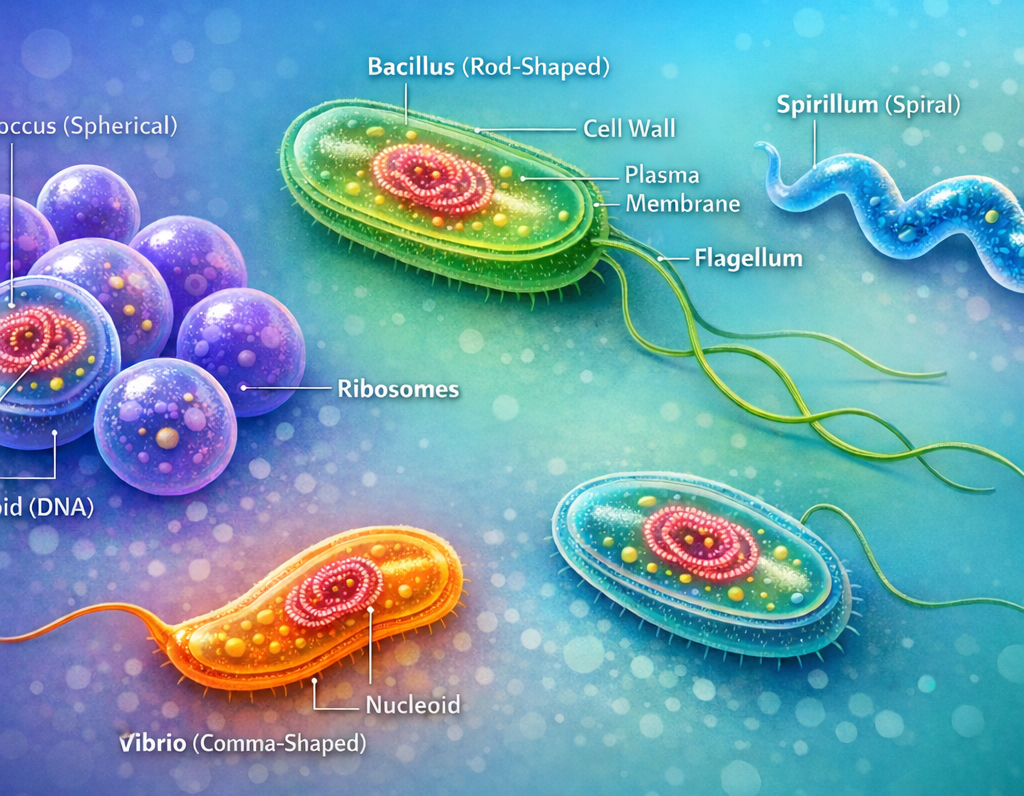
The typical bacterial cell includes a cell membrane, cytoplasm, ribosomes, and genetic material located in a region called the nucleoid. Unlike eukaryotic cells, bacterial DNA is not enclosed within a nuclear membrane.
In diagrammatic representation, a bacterial cell is usually shown as a small oval structure with a cell wall surrounding the membrane. Inside the cell, the nucleoid region contains the genetic material, while ribosomes are scattered throughout the cytoplasm. Many bacteria reproduce through a process known as binary fission, in which a single cell divides into two identical daughter cells.
Kingdom Protista
Protists are a diverse group of organisms that are primarily unicellular but possess eukaryotic cells. This means they have a well-defined nucleus and membrane-bound organelles. Protists are commonly found in aquatic environments such as ponds, lakes, and oceans. Some protists are capable of photosynthesis, while others obtain food by consuming organic material.
Amoeba and Paramecium are well-known examples of protists. Amoeba moves using temporary projections called pseudopodia, while Paramecium uses hair-like structures known as cilia for movement.
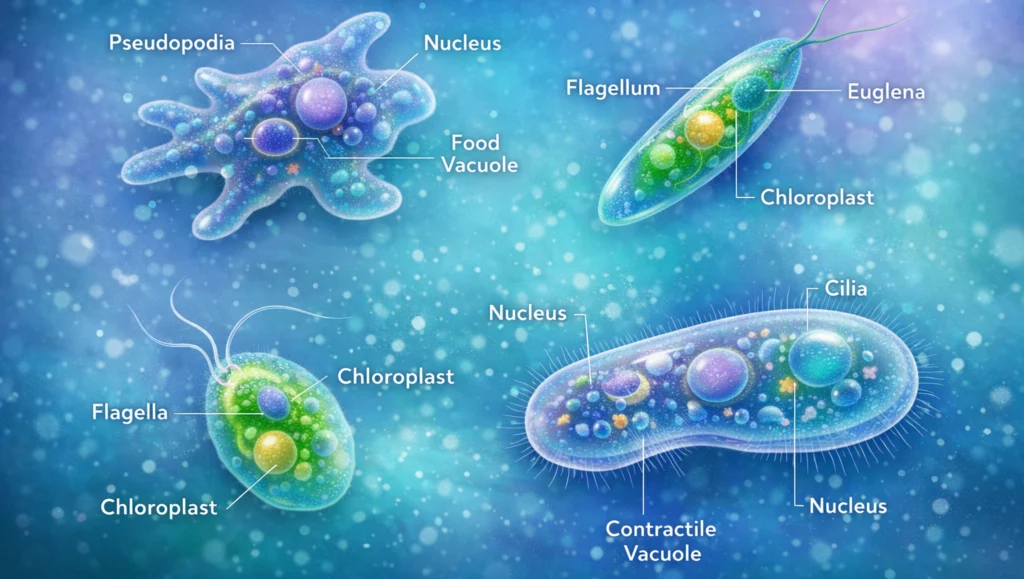
In a typical diagram of Amoeba, the organism appears as an irregularly shaped cell with cytoplasm divided into ectoplasm and endoplasm. The nucleus controls cellular activities, and food vacuoles store digested materials. Protists play important roles in aquatic ecosystems and form the base of many food chains.
Kingdom Fungi
Fungi are eukaryotic organisms that obtain nutrition by absorbing organic substances from their surroundings. Unlike plants, fungi do not perform photosynthesis because they lack chlorophyll. The body structure of fungi usually consists of thread-like structures called hyphae, which form a network known as mycelium. This structure allows fungi to absorb nutrients efficiently from the environment.
Common examples of fungi include mushrooms, molds, and yeast. Yeast is widely used in the baking industry because it ferments sugars to produce carbon dioxide, which causes bread dough to rise. Fungi also play an important role in medicine. The antibiotic penicillin, which revolutionized modern medicine, was derived from a fungus.
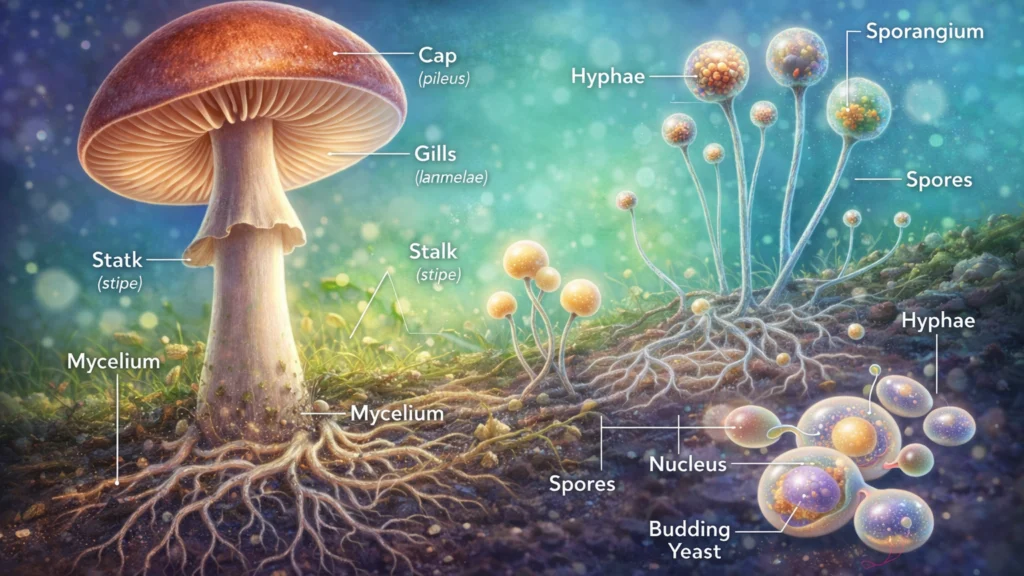
In diagrams, fungal structures are often represented as branching hyphae that spread through a substrate such as soil or decaying organic matter.
Kingdom Plantae
Plants are multicellular eukaryotic organisms that produce their own food through the process of photosynthesis. This process occurs in chloroplasts and uses sunlight, carbon dioxide, and water to produce glucose.
The chemical equation for photosynthesis can be expressed as:
6CO₂ + 6H₂O → C₆H₁₂O₆ + 6O₂
In this reaction, carbon dioxide and water are converted into glucose and oxygen using light energy and chlorophyll.
Plants have rigid cell walls composed of cellulose, which provide structural support. They also contain specialized tissues for transporting water, nutrients, and food throughout the organism.
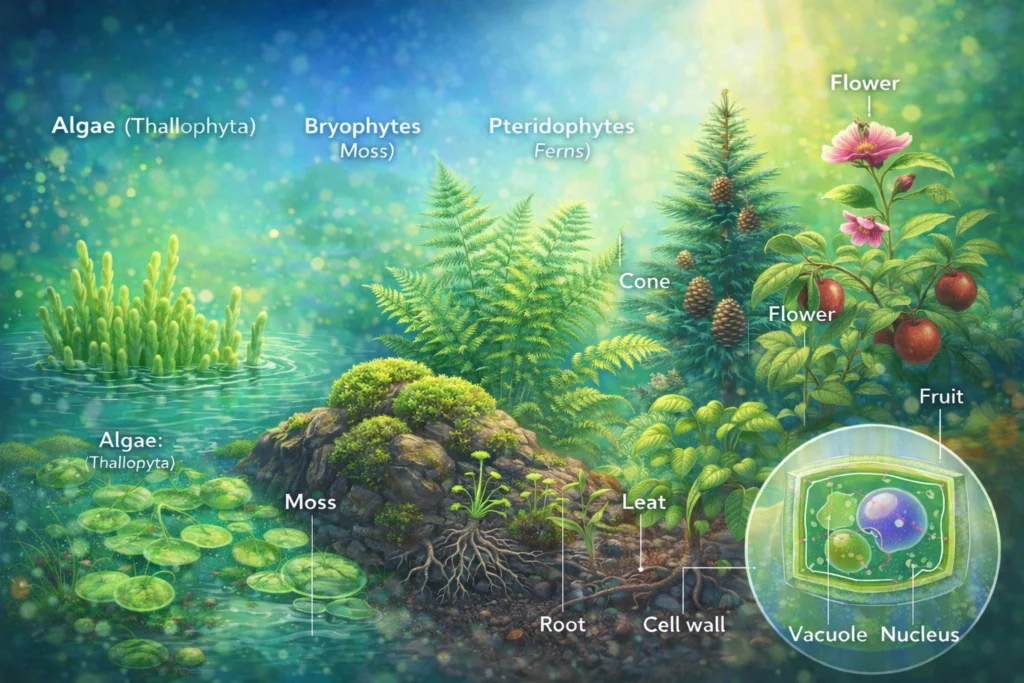
Plants are further classified into several groups based on structural complexity and reproductive features. These groups include algae, bryophytes, pteridophytes, gymnosperms, and angiosperms. Angiosperms are flowering plants that produce seeds enclosed within fruits, while gymnosperms produce naked seeds.
Kingdom Animalia
Animals are multicellular organisms that obtain food by consuming other organisms. They do not possess cell walls and generally have highly developed organ systems.
Animal bodies show a high level of organization, including tissues, organs, and organ systems. These systems perform specialized functions such as digestion, respiration, circulation, and reproduction. Animals are broadly classified into invertebrates and vertebrates. Invertebrates lack a backbone and include organisms such as insects, worms, and mollusks. Vertebrates possess a backbone and include fish, amphibians, reptiles, birds, and mammals.
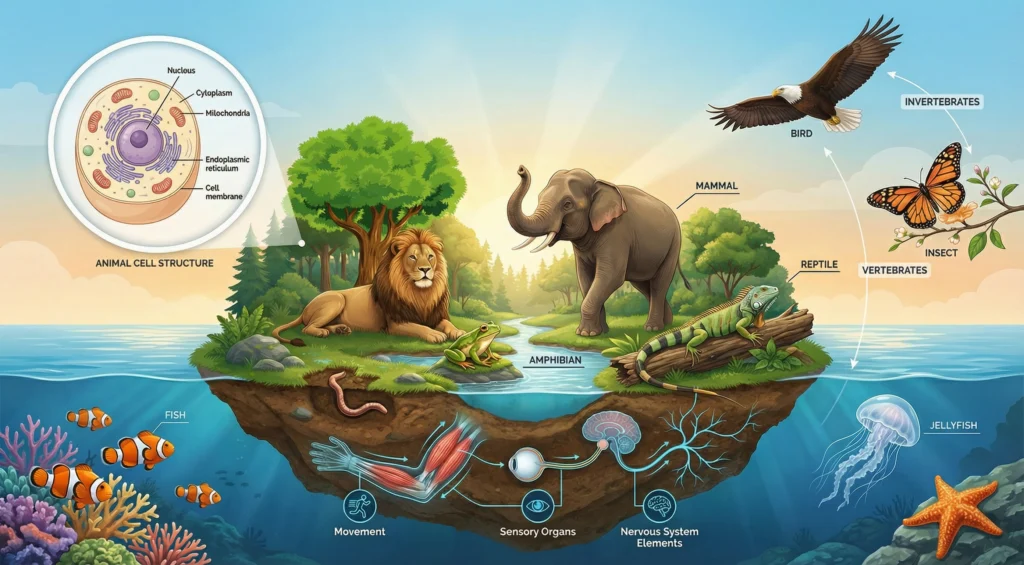
In diagrams illustrating animal anatomy, the body is often shown with specialized organs such as the heart, lungs, digestive system, and nervous system working together to maintain life processes.
Real-Life Importance of Studying Diversity in Living Organisms
Understanding Diversity in Living Organisms has significant practical importance in many fields of science and society.
In agriculture, knowledge of plant diversity helps scientists develop improved crop varieties that are resistant to pests and diseases. This contributes to higher agricultural productivity and food security.
In medicine, the study of microorganisms has led to the discovery of antibiotics, vaccines, and other medical treatments. Many medicines are derived from plants and fungi, highlighting the importance of preserving biodiversity.
Environmental scientists use classification systems to study ecosystems and understand how organisms interact with one another. This knowledge is essential for conservation efforts and protecting endangered species.
Common Mistakes Students Make While Studying Diversity in Living Organisms
Students often confuse the characteristics of different kingdoms, particularly Monera and Protista. Another common mistake is failing to understand the basis of classification and simply memorizing examples without understanding their features.
Some students also struggle to differentiate between plant groups such as bryophytes and pteridophytes. These mistakes usually occur because students focus only on memorization rather than conceptual understanding.
A careful study of structural features, reproduction, and nutrition helps avoid these misunderstandings.
Exam-Oriented Tips for Mastering the Topic
A strong understanding of Diversity in Living Organisms requires both conceptual clarity and systematic revision. Students should focus on understanding the characteristics that define each kingdom rather than memorizing isolated facts.
Practicing diagrams and comparing the features of different groups can improve retention. Writing answers with proper terminology and including examples also helps in scoring better marks in examinations.
Practice Questions with Answers
What is meant by Diversity in Living Organisms?
Answer: Diversity in Living Organisms refers to the variety of different species present on Earth and their classification based on structural and functional characteristics.
Who proposed the five kingdom classification system?
Answer: The five kingdom classification system was proposed by Robert H. Whittaker in 1969.
Which kingdom includes bacteria?
Answer: Bacteria belong to Kingdom Monera.
What is photosynthesis?
Answer: Photosynthesis is the process by which green plants produce glucose from carbon dioxide and water using sunlight and chlorophyll.
What is binomial nomenclature?
Answer: Binomial nomenclature is the scientific naming system in which each organism is given a two-part name consisting of genus and species.
Concept Review
The study of Diversity in Living Organisms reveals the extraordinary variety of life on Earth and provides a scientific method for organizing this diversity. Classification systems help scientists group organisms based on shared characteristics, making biological study more systematic and meaningful.
The five kingdom classification system divides living organisms into Monera, Protista, Fungi, Plantae, and Animalia based on cellular organization, complexity, and mode of nutrition. Understanding these groups allows students to explore evolutionary relationships and ecological roles.
A clear understanding of Diversity in Living Organisms not only supports academic learning but also promotes appreciation of biodiversity and the importance of conserving life on Earth. Through systematic classification and scientific study, humanity gains deeper insight into the interconnected nature of living systems.
You may also visit the Biology section.
Frequently Asked Questions (FAQs)
What does Diversity in Living Organisms mean?
Answer: It refers to the variety of living organisms on Earth and the scientific classification used to organize them.
Why is classification important in biology?
Answer: Classification helps scientists identify organisms, understand relationships between species, and study evolution more effectively.
What are the five kingdoms of life?
Answer: The five kingdoms are Monera, Protista, Fungi, Plantae, and Animalia.
What is the difference between prokaryotic and eukaryotic cells?
Answer: Prokaryotic cells lack a true nucleus and membrane-bound organelles, while eukaryotic cells possess both.
Which kingdom includes mushrooms?
Answer: Mushrooms belong to Kingdom Fungi.
Why is biodiversity important?
Answer: Biodiversity maintains ecological balance and provides resources for food, medicine, and environmental stability.
🌐 Connect With Us
👉 Informosio Tech – Science & Technology news, AI trends, gadgets, and innovations