
In biology, tissues are groups of similar cells with a common origin that work together to perform a specific function in the body. Cells are the basic structural and functional units of life, but when many similar cells organize and cooperate, they form tissues, which carry out specialized tasks efficiently.
The study of tissues is essential for understanding how plants and animals grow, develop, and maintain their life processes. In multicellular organisms, the body is organized in a hierarchy:
Levels of organization in multicellular organisms:
Cells → Tissues → Organs → Organ Systems → Organism
For example, muscle cells combine to form muscle tissue, which helps in body movement.
Understanding tissues helps students learn how complex organisms function, how organs are formed, and how diseases affect the body.
What Are Tissues?
A tissue can be defined as a group of similar cells with a common origin that work together to perform a specific function. In multicellular organisms, cells do not work independently; instead, they organize into specialized groups so that biological activities can be carried out efficiently. The cells within such a group usually share a similar structure and perform related functions because they originate from the same developmental source. This structural and functional similarity allows the body to maintain proper organization and coordination.

For example, muscle tissue enables movement by contracting and relaxing, while nervous tissue transmits electrical signals that help control body activities. In plants, these cellular groups are responsible for important processes such as growth, support, and transport of water and nutrients. The scientific study of this concept was first developed by the French anatomist Marie François Xavier Bichat, who classified different types in the human body even before the invention of the modern microscope. This discovery helped scientists understand how complex organisms are organized and how different body parts perform specialized roles.
Why Are Tissues Important?
Groups of specialized cells are important because they allow multicellular organisms to function in an organized and efficient way. Instead of every cell performing all life processes, different groups are specialized for particular tasks. This division of labour increases efficiency and helps the body carry out complex activities such as movement, coordination, and transport of substances.
Such cellular organization also forms the structural basis of organs and organ systems. For example, muscle groups help in body movement, while nerve groups coordinate signals throughout the body. In plants, these organized cell groups support growth and enable the transport of water, minerals, and food. Therefore, this level of biological organization plays a vital role in maintaining life processes and ensuring proper functioning of living organisms.
1. Division of Labour
Division of labour refers to the distribution of different functions among specialized groups of cells in multicellular organisms. Instead of every cell performing all activities, particular groups carry out specific tasks, which increases efficiency and coordination in the body.
For example, muscle cells are specialized for movement, while nerve cells are responsible for transmitting signals. This specialization allows organisms to perform complex life processes smoothly and maintain proper functioning of organs and body systems.
2. Structural Organization
Structural organization refers to the systematic arrangement of cells in multicellular organisms so that the body can function properly. Similar cells group together to form specialized structures that perform specific roles. This organized arrangement creates a hierarchy in the body, where cells form tissues, tissues form organs, and organs form organ systems.
Such organization helps maintain the shape, stability, and proper functioning of the body. For example, the heart is formed by specialized muscle cells that work together to pump blood throughout the body.
3. Improved Efficiency
Improved efficiency in multicellular organisms occurs because groups of similar cells specialize in particular functions. When specific cells focus on a single task, biological processes are performed faster and more effectively. This specialization allows the body to manage complex activities such as movement, coordination, and transport of substances.
For example, muscle cells are adapted for contraction and movement, while nerve cells quickly transmit signals throughout the body. Such specialization ensures that different body functions operate smoothly and efficiently.
4. Growth and Repair
Growth and repair are important processes that allow multicellular organisms to develop and maintain their body structures. Specialized groups of cells play a key role in increasing body size by producing new cells through division. These cells also help replace damaged or dead cells, ensuring that the body continues to function properly.
For example, skin cells regenerate to heal wounds and protect the body from infection. This ability to grow and repair helps organisms maintain their structure and recover from injuries.
Types of Tissues
In biology, tissues are broadly classified into two main groups:
- Plant Tissues
- Animal Tissues
Each group has different structures and functions.
Plant Tissues
In plants, groups of similar cells work together to perform specific functions such as growth, support, and transport of water and nutrients. These specialized cell groups help maintain the structure of the plant and allow it to carry out important life processes efficiently. They are responsible for activities like increasing plant size, storing food, and moving substances from one part of the plant to another.
Based on their functions, plant cell groups are mainly classified into two types:
- Meristematic Tissue
- Permanent Tissue

1. Meristematic Tissue
Meristematic tissue is a group of actively dividing plant cells responsible for the growth of plants. These cells are small, closely packed, and have thin cell walls with a large nucleus. They continuously divide to produce new cells, which helps the plant increase in length and thickness.
Characteristics
- Cells divide continuously
- Small and densely packed
- Thin cell walls
- Large nucleus
- No vacuoles or small vacuoles
Types of Meristematic Tissue
1. Apical Meristem
Apical meristem is a group of actively dividing cells present at the growing regions of a plant. These cells continuously divide to produce new cells, which help the plant grow and develop.
Found at the tips of roots and shoots. The function of this region is responsible for increase in length of the plant. An example of its activity can be seen in the growth of plant height.
2. Intercalary Meristem
Intercalary meristem is a region of actively dividing cells present between mature parts of a plant. These cells continue to divide and help certain parts of the plant grow quickly.
Found at nodes or internodes of plants. Its function is to help in rapid growth of leaves or internodes. An example of this activity can be seen in the fast growth of grasses.
3. Lateral Meristem
Lateral meristem is a region of actively dividing cells located along the sides of stems and roots. These cells divide continuously and contribute to the secondary growth of plants.
Found along the sides of stems and roots. Its function is responsible for increase in thickness of plants. An example of this process can be seen in the growth of tree trunks.
Permanent Tissue
Permanent tissue refers to plant cells that have matured and become specialized to perform particular functions. Permanent tissues are formed when meristematic cells stop dividing and become specialized. These cells develop definite shapes and structures that help the plant carry out processes such as storage, support, and transport.
Characteristics include that cells lose the ability to divide and cells develop specific functions according to their role in the plant body.
Permanent tissues are divided into two categories:
- Simple Permanent Tissue
- Complex Permanent Tissue

Simple Permanent Tissue
Simple permanent tissue refers to a group of mature plant cells that perform similar functions and have a similar structure. These tissues consist of similar types of cells. Such cells are specialized and mainly help in storage, support, and basic metabolic activities in plants.
Types include:
1. Parenchyma
Parenchyma refers to simple plant cells that are living and loosely packed, mainly responsible for basic activities such as storage and photosynthesis in plants.
Characteristics: Living cells, thin cell walls, and large vacuoles.
Functions: Storage of food, photosynthesis, and gas exchange.
Example: Pulp of fruits.
2. Collenchyma
Collenchyma is a type of simple plant cell group that provides mechanical support and flexibility to young and growing parts of plants.
Characteristics: Living cells with thickened corners of cell walls.
Functions: Provides flexibility and supports growing plant parts.
Example: Leaf stalks.
3. Sclerenchyma
Sclerenchyma consists of specialized plant cells that provide strength and rigidity to different parts of the plant. These cells are usually mature and help maintain the structural support of the plant body.
Characteristics: Dead cells with thick lignified walls.
Functions: Provides mechanical strength.
Example: Coconut husk fibers.
Complex Permanent Tissue
Complex permanent tissue refers to a group of different types of plant cells that work together to perform a common function. Unlike simple permanent structures, these contain more than one type of cell that coordinate with each other. They mainly help in the transport of substances within plants.
The two main examples are:
- Xylem
- Phloem
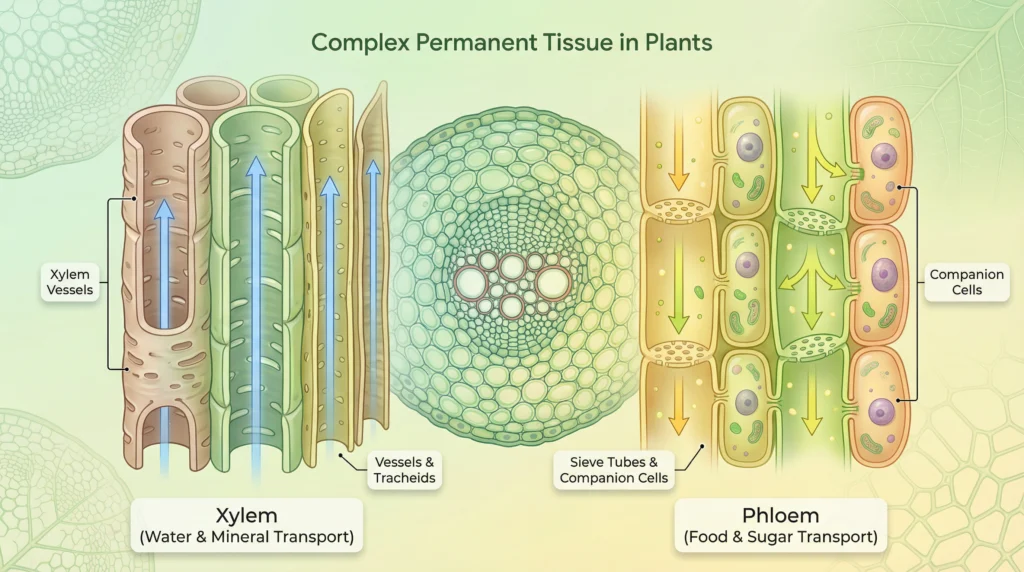
Xylem
Xylem is responsible for transporting water and minerals from roots to other parts of the plant. It also helps provide structural support to the plant body.
Components of xylem: Tracheids, vessels, xylem fibers, and xylem parenchyma.
Function: Upward transport of water.
Example: Water movement from roots to leaves.
Phloem
Phloem is a specialized plant structure that carries nutrients and organic substances produced in the leaves to different parts of the plant. It plays an important role in distributing food required for growth and energy. Phloem transports food produced during Photosynthesis.
Components: Sieve tubes, companion cells, phloem fibers, and phloem parenchyma.
Function: Transport of sugars throughout the plant.
Animal Tissues
In animals, groups of similar cells are organized to perform specific functions necessary for survival and proper body functioning. These specialized cell groups help in activities such as protection, movement, coordination, and transport of substances throughout the body. Their organization allows different parts of the body to work together efficiently and maintain internal balance.
Based on their functions and structure, they are mainly classified into four types:
- Epithelial tissue
- Connective tissue
- Muscle tissue
- Nervous tissue

Epithelial Tissue
Epithelial tissue is a group of closely packed cells that forms the outer covering of the body and lines internal organs and cavities. These cells protect body parts, help in absorption, and also take part in secretion and filtration. Because the cells are tightly arranged, they create a protective barrier for the body.
Examples: Skin, lining of stomach, and blood vessels.
Characteristics
- Cells tightly packed
- Very little intercellular space
- Rest on a basement membrane
Functions
- Protection
- Absorption
- Secretion
- Filtration
Types of Epithelial Tissue
- Squamous epithelium
- Cuboidal epithelium
- Columnar epithelium
- Ciliated epithelium
- Glandular epithelium
Example: Intestinal lining absorbs nutrients.
Connective Tissue
Connective tissue is a type of animal tissue that supports, connects, and protects different parts of the body. It helps maintain the structure of organs and plays an important role in transporting substances such as nutrients and oxygen. The cells in this type are not tightly packed and are embedded in a supporting material called the matrix.
Characteristics: Cells loosely spaced and a large amount of extracellular matrix.
Examples: Bone, blood, cartilage, tendons, and ligaments.
Functions
- Support body structure
- Transport substances
- Protection of organs
Example: Blood transports oxygen and nutrients.
Muscle Tissue
Muscle tissue is responsible for producing movement in the body. It works by contracting and relaxing, which allows different parts of the body to move and perform various activities. This type of body structure is found in areas such as the arms, legs, heart, and internal organs.
Characteristics: Cells can contract and relax, and they contain long and elastic fibers that enable movement and flexibility in the body.
Types of Muscle Tissue
1. Skeletal Muscle
Skeletal muscle helps the body move by working together with the bones. It allows a person to perform actions such as walking, running, lifting objects, and other physical movements. These muscles are under our conscious control, meaning we can move them whenever we want.
- Attached to bones
- Voluntary control
Example: Movement of arms and legs.
2. Smooth Muscle
Smooth muscle helps the body perform movements inside internal organs automatically without conscious effort. It works slowly and continuously to move substances through different parts of the body, helping organs function properly.
- Found in internal organs
- Involuntary control
Example: Movement of food in the intestine.
3. Cardiac Muscle
Cardiac muscle is a special type of muscle found in the heart that helps pump blood throughout the body. It works automatically and continuously to maintain blood circulation, which is essential for supplying oxygen and nutrients to all body parts.
- Found only in the heart
- Involuntary but rhythmic contraction
Example: Pumping of blood.
Nervous Tissue
Nervous tissue helps the body control and coordinate different activities by sending messages from one part of the body to another. Nervous tissues are responsible for transmitting electrical signals in the body. These signals help the brain, spinal cord, and nerves communicate with muscles and organs so that the body can respond quickly to different situations.
Main components: Neurons and neuroglial cells.
Functions: Receive stimuli, process information, and transmit impulses.
Example: Signals from brain to muscles.
Diagram Explanation of Tissues
In a typical diagram of tissues, students may see:
- A cluster of similar cells forming a tissue layer
- In plant tissue diagrams, xylem and phloem arranged in vascular bundles
- In animal tissues, epithelial cells arranged in layers
Understanding diagrams requires identifying:
- Cell shape
- Cell arrangement
- Presence of cell walls or fibers.
Real-Life Applications of Tissues
The study of tissues has many practical applications.
1. Medical Diagnosis
Doctors examine tissue samples using histology to detect diseases.
Example: Biopsy for cancer detection.
2. Tissue Engineering
Scientists grow tissues artificially for medical treatments.
Example: Artificial skin for burn victims.
3. Agriculture
Understanding plant tissues helps improve crop growth.
Example: Better water transport in plants.
4. Biotechnology
Plant tissue culture allows rapid plant multiplication.
Example: Banana tissue culture farming.
Common Mistakes Students Make
While studying tissues, students often make these errors:
- Confusing plant tissues with animal tissues.
- Mixing up xylem and phloem functions.
- Forgetting the four types of animal tissues.
- Not understanding the difference between meristematic and permanent tissues.
Correct understanding of classification helps avoid these mistakes.
Exam-Oriented Tips
Students preparing for biology exams should remember these key points:
- Memorize the classification of tissues.
- Understand functions rather than rote learning.
- Practice drawing diagrams of plant tissues.
- Learn differences between types of tissues.
Example important comparison:
| Feature | Xylem | Phloem |
|---|---|---|
| Function | Transport water | Transport food |
| Direction | Upward | Both directions |
| Cell type | Mostly dead | Mostly living |
Practice Questions
Question 1
What are tissues?
Answer:
Groups of similar cells that work together to perform a specific function.
Question 2
Name the two main types of plant tissues.
Answer:
Meristematic tissue and permanent tissue.
Question 3
Which tissue transports water in plants?
Answer:
Xylem.
Question 4
Name the four types of animal tissues.
Answer:
- Epithelial tissue
- Connective tissue
- Muscle tissue
- Nervous tissue
Question 5
Which tissue is responsible for movement?
Answer:
Muscle tissue.
Important Concepts Recap
Tissues are groups of similar cells that perform specific functions in multicellular organisms.
Key points to remember:
- Cells combine to form tissues.
- Plant tissues include meristematic and permanent tissues.
- Permanent tissues include parenchyma, collenchyma, sclerenchyma, xylem, and phloem.
- Animal tissues include epithelial, connective, muscle, and nervous tissues.
- The study of tissues helps understand body organization, growth, and disease.
Understanding tissues is fundamental for biology students because it explains how cells cooperate to build organs and maintain life processes.
You may also visit the Biology section.
Frequently Asked Questions
What are tissues in biology?
Tissues are groups of similar cells that work together to perform a particular function in plants or animals.
Who discovered tissues?
The concept of tissues was developed by the French scientist Xavier Bichat, who classified tissues in the human body.
What are the four types of animal tissues?
The four main animal tissues are epithelial, connective, muscle, and nervous tissues.
What is meristematic tissue?
Meristematic tissue is plant tissue made of actively dividing cells responsible for plant growth.
What is the function of xylem?
Xylem transports water and minerals from the roots to other parts of the plant.
What is tissue culture?
Tissue culture is a technique used to grow plant cells or tissues in laboratory conditions for plant propagation.
🌐 Connect With Us
👉 Informosio Tech – Science & Technology news, AI trends, gadgets, and innovations