
Understanding The Fundamental Unit of Life
All living organisms, from tiny bacteria to large animals and plants, are made up of microscopic units called cells. These tiny structures carry out all the processes necessary for life such as metabolism, growth, and reproduction. Because every living organism is composed of cells, scientists refer to the cell as The Fundamental Unit of Life.
The concept of the cell is central to biology and chemistry because it explains how life functions at the microscopic level. Cells contain specialized structures that perform specific tasks, allowing organisms to survive and reproduce.
The study of cells is known as cytology, and modern understanding of cells began after the invention of the microscope. According to the cell theory, all living organisms are composed of cells, cells are the basic structural and functional units of life, and new cells arise from pre-existing cells.
Understanding the cell helps students learn how tissues, organs, and entire organisms function. It also forms the foundation for advanced topics such as genetics, molecular biology, and biotechnology.
What is The Fundamental Unit of Life?
The fundamental unit of life refers to the smallest structural and functional component of a living organism. All living beings, whether simple microorganisms or complex organisms like plants and animals, are made up of cells. These cells carry out essential life processes such as metabolism, growth, respiration, and reproduction.
The cell is known as cellular structure because it is the smallest unit capable of performing all life processes. Each cell contains important structures such as the cell membrane, cytoplasm, nucleus, and various organelles that help it function properly. In multicellular organisms, millions or trillions of cells work together to form tissues, organs, and organ systems, allowing the organism to survive and grow.
Definition
The Fundamental Unit of Life refers to the basic building block of all living organisms. Every living organism is made up of one or more cells that perform essential biological functions necessary for survival.
A cell is the smallest structural and functional unit of a living organism capable of carrying out life processes. Cells perform vital activities such as metabolism, growth, respiration, and reproduction, which allow organisms to live and function properly.
Key Characteristics of Cells
Cells share several basic features:
- Surrounded by a cell membrane
- Contain cytoplasm
- Possess genetic material (DNA)
- Carry out metabolic reactions
- Capable of growth and division
Cells may exist as single independent organisms or as parts of complex multicellular organisms.
Examples:
- Amoeba – single-celled organism
- Bacteria – unicellular prokaryote
- Humans – multicellular organisms made of trillions of cells
Thus, the concept of The Fundamental Unit of Life explains the basic organization of all living beings.
Discovery of Cells
The discovery of Cell is one of the most important milestones in biology. The understanding of The Fundamental Unit of Life developed gradually through scientific discoveries made by several scientists over many years. Improvements in microscope technology allowed scientists to observe microscopic structures and understand that all living organisms are made of cells.
In 1665, the English scientist Robert Hooke examined a thin slice of cork under a microscope. He observed many small, box-like compartments and named them cells because they resembled the small rooms of a monastery.

Later, Anton van Leeuwenhoek improved the microscope and became the first scientist to observe living cells, including microorganisms such as bacteria and protozoa. His discoveries proved that living organisms could exist at a microscopic level.
In the nineteenth century, scientists Matthias Schleiden and Theodor Schwann proposed the Cell Theory. They concluded that all plants and animals are composed of cells and that the cell is the basic unit of life.
Another scientist, Rudolf Virchow, later expanded this theory by stating that all cells arise from pre-existing cells. This idea explained how new cells are formed through cell division.
Together, these discoveries established the modern understanding that the cell is the fundamental unit of life and the basic building block of all living organisms.
Cell Theory
Cell Theory is a fundamental concept in biology that explains the basic principles of how living organisms are structured and how they function. The cell theory explains the role of cells in living organisms. It states that cells are the basic building blocks that make up all forms of life.
The theory was developed in the nineteenth century by scientists Matthias Schleiden and Theodor Schwann, and later expanded by Rudolf Virchow. According to the cell theory, all living organisms are made up of one or more cells, and the cell is the basic structural and functional unit responsible for carrying out essential life processes.
Another important principle of this theory states that new cells arise only from pre-existing cells through cell division. This explains how organisms grow, develop, and repair damaged tissues.
Thus, the cell theory provides the scientific foundation for understanding that the cell is the fundamental unit of life, forming the basis of structure, function, growth, and reproduction in all living organisms.
Main Principles
- All living organisms are made of cells.
- The cell is the basic structural and functional unit of life.
- All cells arise from pre-existing cells.
These principles confirm that the cell is The Fundamental Unit of Life.
Types of Cells
Cells can be broadly classified into two major categories.
Prokaryotic Cells
Prokaryotic cells are simple and primitive types of cells that lack a true nucleus and membrane-bound organelles. They are considered the earliest forms of life on Earth and are usually very small in size compared to other cells.
In prokaryotic cells, the genetic material (DNA) is not enclosed within a nuclear membrane. Instead, it is located in a region of the cytoplasm called the nucleoid. These cells also contain basic structures such as a cell membrane, cytoplasm, ribosomes, and sometimes a cell wall that provides protection and shape.
Prokaryotic organisms are typically unicellular, meaning they consist of a single cell that performs all the functions necessary for life. Examples of organisms with prokaryotic cells include bacteria and cyanobacteria.
Although prokaryotic cells are structurally simple, they can carry out essential life processes such as metabolism, growth, and reproduction. Their simplicity helps scientists understand the early evolution of life and the basic organization of cells.

Examples:
- Bacteria
- Cyanobacteria
Characteristics
- No true nucleus
- Genetic material present in nucleoid region
- Lack membrane-bound organelles
- Usually very small (1–10 µm)
Structure includes:
- Cell membrane
- Cytoplasm
- Ribosomes
- DNA
Eukaryotic Cells
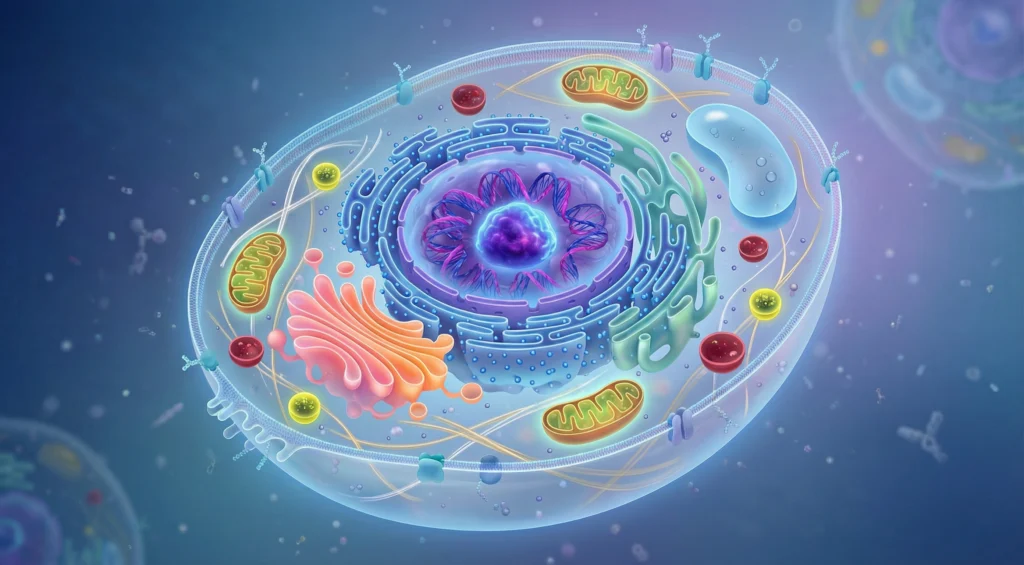
Eukaryotic cells are complex cells that contain a true nucleus enclosed by a nuclear membrane and several membrane-bound organelles. These cells are larger and more organized than simpler cells and are capable of performing various life processes efficiently.
The nucleus is the most important part of a eukaryotic cell because it controls cellular activities and stores genetic material in the form of DNA. The cytoplasm contains several organelles such as mitochondria, endoplasmic reticulum, Golgi apparatus, and ribosomes, each performing specific functions necessary for the survival of the cell.
Eukaryotic cells have a well-developed internal structure that allows the cell to carry out processes like energy production, protein synthesis, and transport of materials within the cell. The presence of membrane-bound organelles helps maintain organization and efficiency in cellular functions.
These cells are generally larger in size and more structurally complex, which enables them to perform specialized functions and support the growth and development of living organisms.
Examples:
- Animal cells
- Plant cells
- Fungi
- Protists
Characteristics
- True nucleus
- Membrane-bound organelles
- Larger size (10–100 µm)
The complexity of eukaryotic cells further demonstrates how the cell acts as The Fundamental Unit of Life.
Structure of the Cell
Cells contain several components that perform specialized functions.
Cell Membrane (Plasma Membrane)
The cell membrane, also called the plasma membrane, is the thin outer boundary that surrounds the cell and separates the cell’s internal contents from the external environment. It protects the cell and helps maintain its shape.
The plasma membrane is made mainly of lipids and proteins arranged in a lipid bilayer structure. One of its important properties is that it is selectively permeable, which means it allows some substances to pass through while restricting others.
It regulates the movement of materials such as nutrients, gases, water, and waste products into and out of the cell, helping the cell maintain a stable internal environment.

Functions
- Protects the cell
- Controls entry and exit of substances
- Maintains internal environment
Selectively Permeable Nature
The selectively permeable nature is an important property of the cell membrane that allows certain substances to pass through it while restricting others. This property helps the cell control the movement of materials between the inside of the cell and the external environment.
Small molecules such as oxygen, carbon dioxide, and water can pass through the membrane easily, while larger or harmful substances are prevented from entering. Because of this selective control, the cell can obtain essential nutrients and remove waste products.
Thus, the selectively permeable nature of the cell membrane helps maintain a stable internal environment, which is necessary for the proper functioning and survival of the cell.
Diffusion
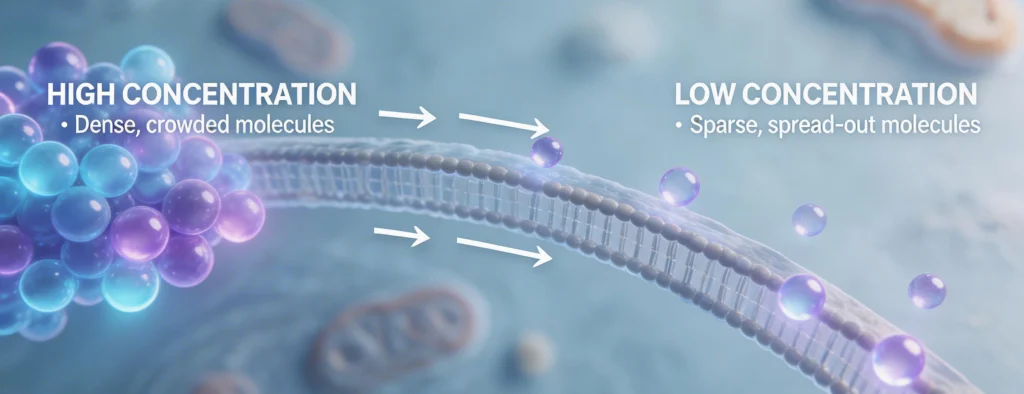
Diffusion is the process by which particles move from a region of higher concentration to a region of lower concentration until they are evenly distributed. This movement occurs naturally without the use of energy.
In cells, diffusion allows substances such as oxygen and carbon dioxide to move across the cell membrane. It helps in the exchange of gases and other small molecules between the cell and its surroundings.
Thus, diffusion is an important process that helps maintain balance within the cell by allowing the movement of necessary substances.
Example:
Oxygen entering cells.
Osmosis
Osmosis is the process by which water molecules move from a region of higher water concentration to a region of lower water concentration through a semi-permeable membrane.
In cells, osmosis occurs through the cell membrane, allowing water to move into or out of the cell depending on the surrounding conditions. This movement helps maintain the proper balance of water inside the cell.
Osmosis is important for maintaining cell shape, turgor pressure in plant cells, and overall cellular balance.
Example:
Water movement in plant cells.

Cell Wall
The cell wall is a rigid outer covering present outside the cell membrane in certain cells. It provides strength, protection, and structural support to the cell. The cell wall forms the outermost boundary and helps maintain the shape of the cell.
The cell wall is mainly composed of cellulose, a strong and complex carbohydrate that gives the wall its rigidity. Because of its tough nature, the cell wall protects the cell from mechanical damage and prevents the cell from bursting when excess water enters.
Another important function of the cell wall is that it helps maintain turgor pressure, which keeps the cell firm and properly shaped. It also allows water, gases, and certain dissolved substances to pass through it easily because it is freely permeable.
In addition, the cell wall provides protection against environmental stress and supports the overall structure of tissues. Thus, the cell wall plays an essential role in maintaining the stability and protection of the cell.

Characteristics
- Made of cellulose
- Provides structural support
- Protects the cell
It helps plants maintain shape and resist pressure.
Cytoplasm
The cytoplasm is the semi-fluid, jelly-like substance present between the cell membrane and the nucleus inside the cell. It forms a major part of the cell and provides a medium in which various cellular components are suspended.
The cytoplasm mainly consists of water, salts, enzymes, and organic molecules. It contains several important cell organelles such as mitochondria, endoplasmic reticulum, Golgi apparatus, ribosomes, and lysosomes. These organelles carry out different functions necessary for the survival of the cell.
One of the main functions of the cytoplasm is to serve as the site for many metabolic reactions that occur inside the cell. It helps in processes such as the synthesis of molecules, energy production, and transport of materials within the cell.
The cytoplasm also helps maintain the shape and internal organization of the cell. By holding the organelles in place and providing a suitable environment for chemical reactions, it supports the normal functioning of the cell.

Functions
- Site of metabolic reactions
- Contains organelles
- Supports internal cell structures
Cell Organelles
Cell organelles are specialized structures present inside the cytoplasm of a cell that perform specific functions necessary for the cell’s survival. Each organelle has a particular role, such as energy production, protein synthesis, and transport of materials, helping the cell carry out its life processes efficiently.

Nucleus
The nucleus is a large, membrane-bound organelle present inside the cell that functions as the control center of the cell. It regulates important cellular activities such as growth, metabolism, and reproduction by controlling the expression of genetic information.
The nucleus is surrounded by a double-layered nuclear membrane (nuclear envelope) that separates it from the cytoplasm. This membrane contains nuclear pores that allow the exchange of materials such as RNA and proteins between the nucleus and the cytoplasm.
Inside the nucleus is a semi-fluid substance called nucleoplasm, which contains thread-like structures known as chromosomes. Chromosomes are composed of DNA and proteins and carry the genetic information responsible for heredity and the transmission of traits.
The nucleus also contains a dense structure called the nucleolus, which is involved in the formation of ribosomes. Ribosomes are essential for protein synthesis, which is necessary for cell growth and repair.
Thus, the nucleus plays a vital role in controlling cell activities, storing genetic information, and regulating cell division.
Structure
- Nuclear membrane
- Nucleoplasm
- Chromosomes
Function
- Stores genetic information
- Controls cell division
Because it controls cell activities, the nucleus is often called the control center of The Fundamental Unit of Life.
Mitochondria
Mitochondria are important membrane-bound organelles found in the cytoplasm of the cell. They are commonly known as the powerhouse of the cell because they produce the energy required for various cellular activities.
Mitochondria generate energy in the form of ATP (Adenosine Triphosphate) through the process of cellular respiration. This energy is essential for carrying out functions such as growth, movement, and metabolism within the cell.
Structurally, mitochondria are double-membraned organelles. The outer membrane is smooth, while the inner membrane forms folds called cristae, which increase the surface area for energy production.
Inside the mitochondria is a fluid called the matrix, which contains enzymes necessary for energy production. Thus, mitochondria play a vital role in supplying energy and maintaining the normal functioning of the cell.
Function
They produce energy in the form of ATP (Adenosine Triphosphate).
Chemical Equation (Cellular Respiration)
Glucose + Oxygen → Carbon dioxide + Water + Energy (ATP)
This energy powers cellular activities.
Endoplasmic Reticulum (ER)
The Endoplasmic Reticulum (ER) is a network of membrane-bound tubes and flattened sacs present in the cytoplasm of the cell. It is connected to the nuclear membrane and plays an important role in the synthesis and transport of materials within the cell.
There are two main types of endoplasmic reticulum: Rough Endoplasmic Reticulum (RER) and Smooth Endoplasmic Reticulum (SER). The rough ER has ribosomes attached to its surface and is mainly involved in protein synthesis. The smooth ER does not contain ribosomes and is responsible for lipid synthesis and detoxification of harmful substances.
The ER also helps in the transport of proteins and lipids to different parts of the cell. Because of this transport system, it plays an important role in maintaining proper cellular organization and functioning.
Types
Rough ER
- Contains ribosomes
- Protein synthesis
Smooth ER
- Lipid synthesis
- Detoxification
Golgi Apparatus
The Golgi apparatus is a membrane-bound organelle present in the cytoplasm of the cell. It consists of a series of flattened, stacked sacs called cisternae and plays an important role in the processing and transport of cellular materials.
The main function of the Golgi apparatus is to modify, package, and transport proteins and lipids that are synthesized in the endoplasmic reticulum. These substances are packed into small vesicles and sent to different parts of the cell or outside the cell.
The Golgi apparatus also helps in the secretion of substances and the formation of certain cellular structures such as lysosomes.
Thus, the Golgi apparatus acts as a packaging and distribution center of the cell, ensuring that proteins and other molecules reach their correct destinations.
Function
- Protein processing
- Secretion of substances
- Transport within the cell
Lysosomes
Lysosomes are small membrane-bound organelles present in the cytoplasm of the cell. They contain powerful digestive enzymes that help break down various substances inside the cell.
The main function of lysosomes is to digest waste materials, worn-out cell parts, and foreign substances such as bacteria. These enzymes break complex materials into simpler substances that can be reused by the cell.
Lysosomes also help in cleaning the cell by destroying damaged organelles and removing unnecessary materials. Because of this function, they play an important role in maintaining cellular health.
Sometimes lysosomes may burst and release their enzymes, which can digest the entire cell. Due to this property, lysosomes are often called the “suicide bags of the cell.”
Functions
- Destroy waste materials
- Break down cellular debris
- Digest foreign particles
They are sometimes called suicide bags of the cell.
Ribosomes
Ribosomes are small, non-membrane-bound structures present in the cytoplasm of the cell. They are mainly responsible for the synthesis of proteins, which are essential for the growth, repair, and functioning of the cell.
Ribosomes are made of ribosomal RNA (rRNA) and proteins. They can be found either freely floating in the cytoplasm or attached to the surface of the rough endoplasmic reticulum.
Free ribosomes usually produce proteins that are used inside the cell, while ribosomes attached to the rough endoplasmic reticulum synthesize proteins that are transported to other parts of the cell.
Thus, ribosomes play a vital role in the production of proteins, which are necessary for many cellular activities and biological processes.
They may be:
- Free in cytoplasm
- Attached to rough ER
Vacuoles
Vacuoles are membrane-bound sac-like structures present in the cytoplasm of the cell. They are mainly responsible for the storage of water, nutrients, and waste materials.
In plant cells, the vacuole is usually large and centrally located, occupying a major part of the cell. It contains a fluid called cell sap, which helps maintain turgor pressure and keeps the cell firm and properly shaped.
Vacuoles also help in the storage of useful substances such as salts, sugars, and pigments, as well as the removal of waste products from the cell.
Thus, vacuoles play an important role in storage, maintaining cell structure, and regulating the internal environment of the cell.
In Plant Cells
In plant cells, the vacuole is usually large and centrally located, occupying a significant portion of the cell. It is filled with a fluid called cell sap, which contains water, salts, sugars, and other substances.
The large vacuole helps maintain turgor pressure, which keeps the plant cell firm and supports the structure of plant tissues.
It also plays an important role in the storage of nutrients and waste materials, helping maintain the internal balance of the cell.
- Large central vacuole
- Maintains turgor pressure
In Animal Cells
In animal cells, vacuoles are usually small and temporary compared to those in plant cells. They are present in the cytoplasm and help in the storage and transport of substances.
Animal cell vacuoles store materials such as water, nutrients, and waste products for a short period of time.
They also assist in maintaining the balance of substances within the cell and help in removing waste materials.
Plastids
Plastids are membrane-bound organelles present in the cytoplasm of plant cells. They play an important role in the manufacture and storage of food in the cell.
Plastids contain pigments and are mainly involved in processes such as photosynthesis and storage of nutrients. Based on their functions and pigments, plastids are classified into three main types: chloroplasts, chromoplasts, and leucoplasts.
Chloroplasts contain chlorophyll and are responsible for carrying out photosynthesis. Chromoplasts contain pigments that give color to plant parts, while leucoplasts are mainly involved in the storage of food substances such as starch, oils, and proteins.
Thus, plastids play an essential role in food production, storage, and pigmentation in plant cells.
Types
Chloroplast
Chloroplast is a type of plastid present in plant cells that contains the green pigment chlorophyll. It is mainly responsible for the process of photosynthesis, through which plants prepare their own food. Chloroplasts capture sunlight and use it to convert carbon dioxide and water into glucose and oxygen. This process provides energy for the plant and releases oxygen into the environment. Thus, chloroplasts play a vital role in food production and energy supply in plant cells.
- Contains chlorophyll
- Site of photosynthesis
Photosynthesis equation:
Carbon dioxide + Water → Glucose + Oxygen
Chromoplast
Chromoplasts are a type of plastid present in plant cells that contain colored pigments other than chlorophyll. These pigments may be yellow, orange, or red. The main function of chromoplasts is to synthesize and store pigments that give color to different parts of plants. These pigments help in attracting organisms for pollination and seed dispersal. Thus, chromoplasts play an important role in providing color and supporting reproductive processes in plants.
- Pigment storage
Leucoplast
Leucoplasts are colorless plastids present in plant cells that are mainly involved in the storage of food materials. They store substances such as starch, oils, and proteins inside the cell. Leucoplasts are usually found in plant parts that do not perform photosynthesis. Thus, leucoplasts play an important role in the storage and accumulation of nutrients in plant cells.
- Storage of starch, oils, proteins
Plant Cells vs Animal Cells
| Feature | Plant Cell | Animal Cell |
|---|---|---|
| Cell wall | Present | Absent |
| Vacuole | Large | Small |
| Plastids | Present | Absent |
| Shape | Regular | Irregular |
Both types still follow the principle that the cell is The Fundamental Unit of Life.
Transport Across Cell Membrane
Transport across the cell membrane refers to the movement of substances into and out of the cell through the plasma membrane. This process is essential for maintaining the internal balance of the cell. Substances move across the membrane through processes such as diffusion, osmosis, and active transport. These processes allow the cell to take in necessary materials like nutrients and oxygen and remove waste products. Thus, transport across the cell membrane helps regulate the exchange of materials between the cell and its surrounding environment.
Diffusion
Diffusion is the process by which particles move from a region of higher concentration to a region of lower concentration until they are evenly distributed. This process occurs naturally without the use of cellular energy. In living cells, diffusion helps in the movement of small molecules such as oxygen and carbon dioxide across the cell membrane. It plays an important role in maintaining the balance of substances inside the cell.
Osmosis
Osmosis is the process by which water molecules move from a region of higher water concentration to a region of lower water concentration through a semi-permeable membrane. This process occurs naturally without the use of energy. In cells, osmosis helps maintain the proper balance of water and supports the normal functioning of the cell.
Active Transport
Osmosis is the process by which water molecules move from a region of higher water concentration to a region of lower water concentration through a semi-permeable membrane. This process occurs naturally without the use of energy. In cells, osmosis helps maintain the proper balance of water and supports the normal functioning of the cell.
Example:
Ion pumps in nerve cells.
Real-Life Applications of The Fundamental Unit of Life
The concept of The Fundamental Unit of Life is important in many real-life fields such as medicine, biotechnology, and agriculture. Understanding cells helps scientists study diseases, develop medicines, and improve medical treatments. It also helps in techniques like tissue culture and genetic research, which are used to improve crops and produce useful biological products.
Medicine
- Understanding diseases
- Cancer research
- Development of medicines
Biotechnology
- Genetic engineering
- Vaccine production
- Tissue culture
Agriculture
- Crop improvement
- Disease-resistant plants
Common Mistakes Students Make
Students often misunderstand several concepts related to The Fundamental Unit of Life.
Common errors include:
- Confusing cell wall and cell membrane
- Thinking mitochondria exist only in animals
- Forgetting plant cells also have mitochondria
- Misunderstanding diffusion vs osmosis
- Mixing functions of ER and Golgi apparatus
Avoiding these mistakes improves exam performance.
Exam-Oriented Tips
Students should remember the following for exams:
- Memorize functions of organelles
- Practice cell diagrams
- Understand differences between plant and animal cells
- Revise transport processes
- Write definitions clearly
Exam questions often focus on:
- Structure of cell
- Functions of organelles
- Differences between cell types
Practice Questions
Question 1
What is meant by The Fundamental Unit of Life?
Answer:
The cell is the smallest structural and functional unit capable of performing life processes.
Question 2
Who discovered cells?
Answer:
Robert Hooke discovered cells in 1665.
Question 3
Which organelle is called the powerhouse of the cell?
Answer:
Mitochondria.
Question 4
What is osmosis?
Answer:
Movement of water across a semi-permeable membrane from high concentration to low concentration.
Question 5
Which organelle controls cell activities?
Answer:
The nucleus.
Short Recap of The Fundamental Unit of Life
The cell is known as The Fundamental Unit of Life because it forms the basic structure of all living organisms. Every organism, whether simple or complex, is composed of cells that perform essential life processes.
Cells contain specialized structures called organelles, each responsible for specific functions such as energy production, protein synthesis, and waste removal. The nucleus controls cellular activities, while mitochondria provide energy for metabolic processes.
Understanding The Fundamental Unit of Life is crucial for learning advanced topics in biology, medicine, and biotechnology. By studying cell structure and function, students gain insight into how living organisms grow, reproduce, and survive.
For more details, visit Biology.
Frequently Asked Questions (FAQs)
What is meant by The Fundamental Unit of Life?
The cell is called The Fundamental Unit of Life because it is the smallest unit capable of carrying out all life processes.
Why are cells important?
Cells perform all biological activities including metabolism, energy production, and reproduction.
What is cytology?
Cytology is the branch of biology that studies cells.
What is the difference between prokaryotic and eukaryotic cells?
Prokaryotic cells lack a nucleus while eukaryotic cells contain a well-defined nucleus.
Why is mitochondria called the powerhouse of the cell?
Because it produces ATP, the main energy source used by cells.
Do all cells have a nucleus?
No. Prokaryotic cells do not have a true nucleus
🌐 Connect With Us
👉 Informosio Tech – Science & Technology news, AI trends, gadgets, and innovations