

Square Roots and Surds in Quantitative Aptitude is an important chapter for competitive exams such as SSC, Banking, Railway, Defence, and State-level government exams. Questions from this topic test your understanding of number properties, simplification techniques, and algebraic concepts. Many students initially find surds confusing because they involve irrational numbers, but once the fundamentals are clear, this chapter becomes logical and scoring.
At Informosio, we focus on building strong mathematical foundations through clear explanations and structured learning. In this complete guide, you will learn Square Roots and Surds in Quantitative Aptitude step by step with examples, formulas, shortcut techniques, and exam-focused strategies.
What is a Square Root?
The square root of a number is a value that, when multiplied by itself, gives the original number.
For example:
√25 = 5
Because 5 × 5 = 25
√64 = 8
Because 8 × 8 = 64
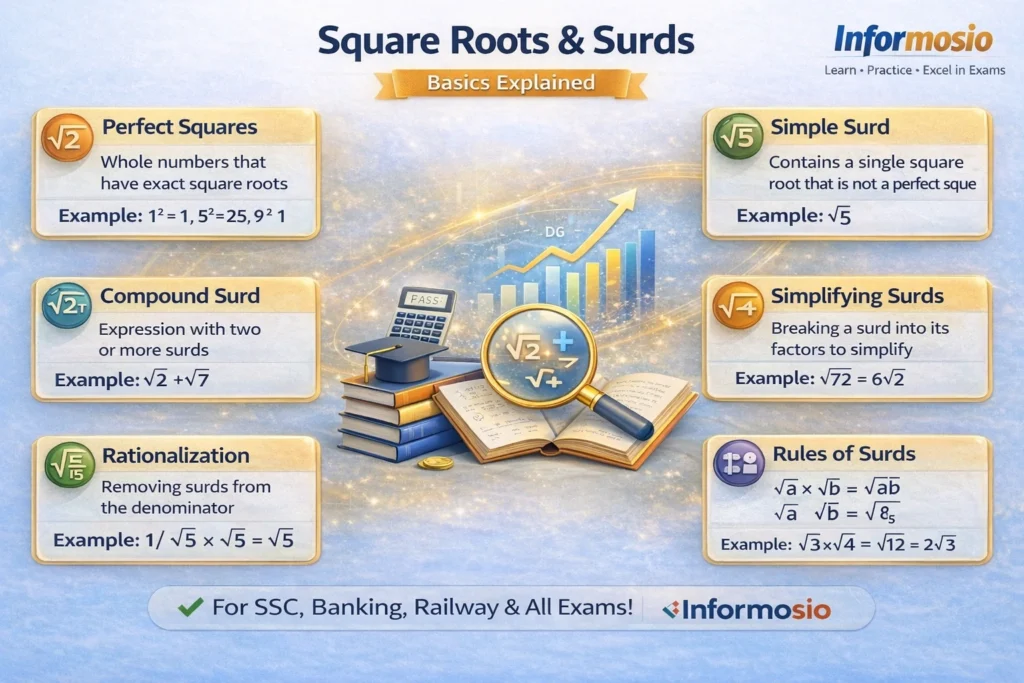
If a number has a whole number as its square root, it is called a perfect square.
Important Perfect Squares (Must Memorize)
Memorizing square values helps solve questions quickly in exams.
1² = 1
2² = 4
3² = 9
4² = 16
5² = 25
6² = 36
7² = 49
8² = 64
9² = 81
10² = 100
11² = 121
12² = 144
13² = 169
14² = 196
15² = 225
16² = 256
17² = 289
18² = 324
19² = 361
20² = 400
21² = 441
22² = 484
23² = 529
24² = 576
25² = 625
26² = 676
27² = 729
28² = 784
29² = 841
30² = 900
Knowing these values reduces calculation time significantly.
What is a Surd?
A surd is a square root that cannot be simplified into a whole number. In simple terms, if the number inside the root is not a perfect square, it becomes a surd.
Examples:
√2
√3
√5
√7
These are irrational numbers because they cannot be written exactly in fraction form.
Types of Surds
Understanding types of surds makes problem-solving easier.
1. Simple Surd
Contains only one square root.
Example: √5
2. Compound Surd
Contains two or more surds.
Example: √2 + √3
3. Pure Surd
No rational number outside the root.
Example: √7
4. Mixed Surd
A number outside the root.
Example: 4√3
Simplifying Square Roots
To simplify a square root, break the number into factors and separate perfect squares.
Example 1:
Simplify √72
72 = 36 × 2
√72 = √36 × √2
= 6√2
Example 2:
Simplify √98
98 = 49 × 2
√98 = √49 × √2
= 7√2
Example 3:
Simplify √200
200 = 100 × 2
√200 = √100 × √2
= 10√2
This method is commonly used in competitive exams.
Rules of Surds
Multiplication Rule
√a × √b = √(ab)
Example:
√3 × √12
= √36
= 6
Division Rule
√a ÷ √b = √(a/b)
Example:
√18 ÷ √2
= √9
= 3
Addition and Subtraction
You can only add or subtract like surds.
Example:
5√7 + 2√7 = 7√7
But:
√2 + √3 cannot be simplified further.
Rationalization of Surds
Rationalization means removing the root from the denominator.
Case 1: Single Surd
1 / √5
Multiply numerator and denominator by √5:
= √5 / 5
Case 2: Binomial Surd
1 / (3 + √2)
Multiply by conjugate (3 − √2):
= (3 − √2) / (9 − 2)
= (3 − √2) / 7
This concept is frequently tested in exams.
Important Identities Used
(a + b)² = a² + b² + 2ab
(a − b)² = a² + b² − 2ab
(a + b)(a − b) = a² − b²
These identities are especially helpful in rationalization.
Comparison of Surds
To compare two surds, square both sides.
Example:
Compare √8 and √10
Since 10 > 8
√10 > √8
Approximate Values of Common Surds
Some commonly used approximations:
√2 ≈ 1.414
√3 ≈ 1.732
√5 ≈ 2.236
These are helpful in estimation questions.
Common Mistakes Students Make in Square Roots and Surds
- Adding unlike surds
- Forgetting to separate perfect square factors
- Making mistakes in rationalization
- Not memorizing square values
- Ignoring algebraic identities
Regular practice reduces these mistakes.
Preparation Strategy
To master Square Roots and Surds in Quantitative Aptitude:
- Memorize squares up to 30
- Practice simplification daily
- Solve rationalization questions separately
- Attempt previous year questions
- Revise identities weekly
Consistency improves speed and accuracy.
Why This Topic Is Important
Square Roots and Surds in Quantitative Aptitude is connected to:
- Simplification
- Algebra
- Quadratic Equations
- Number System
- Data Interpretation
A strong understanding of this chapter strengthens your overall maths foundation.
Final Conclusion
Square Roots and Surds in Quantitative Aptitude may appear complex initially, but with clear understanding and regular practice, it becomes manageable and scoring. Focus on perfect squares, simplification techniques, and rationalization methods to solve questions efficiently.
Explore more Quantitative Aptitude topics on Informosio and continue strengthening your fundamentals step by step. With dedication and consistent effort, you can turn this chapter into one of your strongest scoring areas.
🌐Connect With Us
Informosio Official – General updates, current affairs, and informative content