

The Number System in Quantitative Aptitude is one of the most fundamental chapters for competitive exams such as SSC, Banking, Railway, Defence, and State government tests. Many other maths topics like Simplification, HCF–LCM, Algebra, and Percentages are directly connected to this chapter. Most students feel nervous when they see Number System questions. However, the reality is simple: this chapter is based on basic concepts and logical rules. Once you understand the types of numbers, divisibility rules, and HCF–LCM, this topic becomes easy and highly scoring.
At Informosio, we focus on building strong fundamentals. In this guide, you will learn the Number System in Quantitative Aptitude step by step with clear explanations, formulas, and easy examples.
What Is Number System?
In Quantitative Aptitude, the number system deals with different types of numbers, their properties, and rules of operations.
Questions from this chapter usually come from:
- Types of numbers
- Divisibility
- HCF and LCM
- Remainders
- Unit digit
- Factors
A strong understanding of these concepts helps you solve many exam questions quickly.
Types of Numbers
Understanding number types is the first step in mastering the Number System in Quantitative Aptitude.
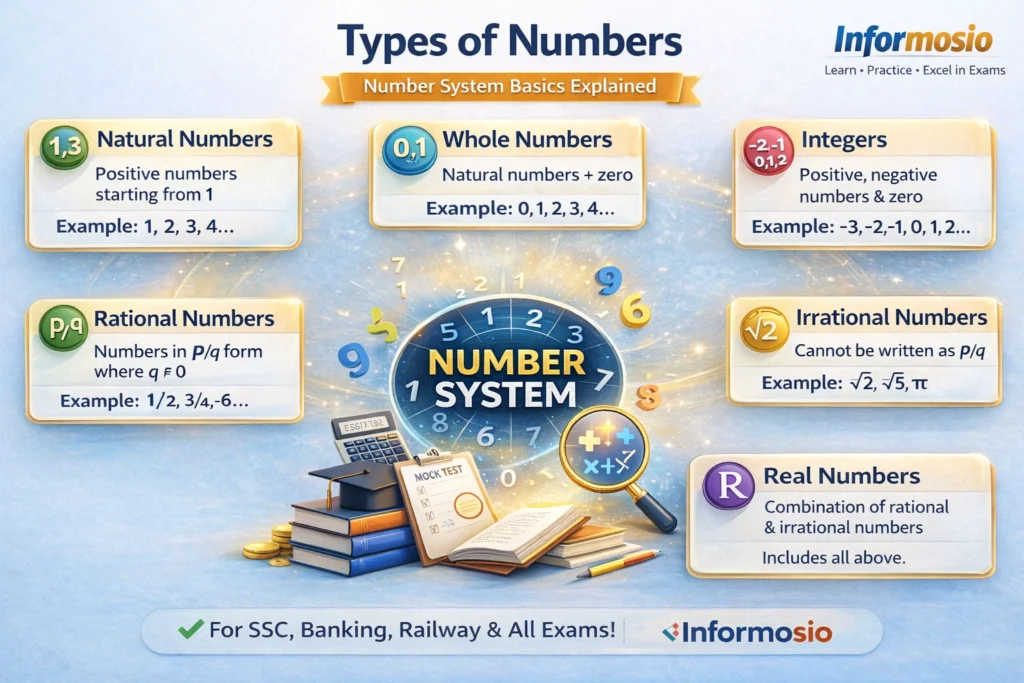
Natural Numbers
Positive numbers starting from 1.
Example: 1, 2, 3, 4…
Whole Numbers
Natural numbers including zero.
Example: 0, 1, 2, 3…
Integers
Positive numbers, negative numbers, and zero.
Example: –3, –2, –1, 0, 1, 2, 3
Even Numbers
Numbers divisible by 2.
Example: 2, 4, 6, 8
General form: 2n
Odd Numbers
Numbers not divisible by 2.
Example: 1, 3, 5, 7
General form: 2n + 1
Prime Numbers
Numbers having exactly two factors: 1 and itself.
Example: 2, 3, 5, 7
Important: 2 is the only even prime number.
Composite Numbers
Numbers having more than two factors.
Example: 4, 6, 8, 9
Note: 1 is neither prime nor composite.
Co-Prime Numbers
Two numbers having only 1 as a common factor.
Example: 14 and 25
Rational Numbers
Numbers that can be written in p/q form.
Example: 1/2, 3/4, –6
Irrational Numbers
Numbers that cannot be written in fraction form.
Example: √2, √5, π
Real Numbers
All rational and irrational numbers together.
Divisibility Rules
These rules help you solve questions faster without long calculations.
- Divisible by 2 → Last digit even
Example: 158 - Divisible by 3 → Sum of digits divisible by 3
Example: 123 → 1+2+3 = 6 - Divisible by 4 → Last two digits divisible by 4
Example: 1224 → 24 ÷ 4 = 6 - Divisible by 5 → Last digit 0 or 5
Example: 1520 - Divisible by 9 → Sum of digits divisible by 9
Example: 585 → 5+8+5 = 18 - Divisible by 11 → Difference of odd-even position digits is multiple of 11
Example: 1661 → (1+6) – (6+1) = 0
Learning these rules saves a lot of time in competitive exams.
HCF and LCM
HCF (Highest Common Factor)
It is the greatest number that divides both numbers.
Example:
12 = 2² × 3
18 = 2 × 3²
Common factors = 2 × 3 = 6
HCF = 6
LCM (Least Common Multiple)
It is the smallest number divisible by both numbers.
LCM = 2² × 3² = 36
Important Formula
HCF × LCM = Product of two numbers
Check:
6 × 36 = 12 × 18 = 216
This formula is frequently used in exams.
Basic Algebraic Formulas Used in Number System
- (a + b)² = a² + b² + 2ab
- (a − b)² = a² + b² − 2ab
- a² − b² = (a + b)(a − b)
- (a + b)³ = a³ + b³ + 3ab(a + b)
These formulas help in simplification problems.
How to Prepare Number System Effectively
Follow this simple study plan:
- Understand number types clearly
- Memorize divisibility rules
- Practice HCF–LCM daily
- Solve 15–20 questions every day
- Analyze mistakes
- Revise formulas weekly
Divide the Number System in Quantitative Aptitude into small parts and complete one section at a time.
⭐ Practice Strategy
To master this chapter, include:
✅ Topic-wise MCQs
✅ Previous Year Questions
✅ Daily practice sets
✅ Mock tests
Regular practice improves both speed and accuracy.
🧠 Smart Tips for Students
- Learn shortcuts and patterns
- Revise formulas regularly
- Practice unit digit problems
- Maintain a small formula notebook
- Stay consistent
Small daily efforts bring big results.
Final Preparation Strategy
The Number System in Quantitative Aptitude may look difficult initially, but with clear concepts and regular practice, it becomes one of the easiest scoring chapters.
Explore more preparation guides on Informosio, including Quantitative Aptitude, Reasoning Ability, English Language, and General Knowledge.
Bookmark this page and use it as your complete Number System in Quantitative Aptitude reference on Informosio. Study topic-wise, practice smartly, and stay consistent — success will follow.
🌐Connect With Us
Informosio Official – General updates, current affairs, and informative content