
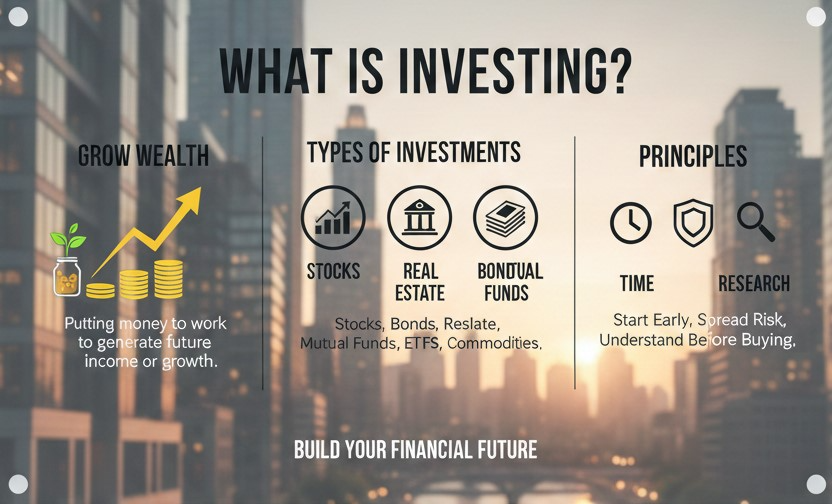
Investing is the process of allocating money into assets with the expectation of generating income or profit over time. Instead of simply saving money in a bank account, investing allows your money to grow by putting it to work in financial instruments such as stocks, bonds, mutual funds, real estate, or businesses.
To understand What is Investing, think of it as planting a seed today so it can grow into a tree tomorrow. The goal is long-term financial growth rather than immediate consumption.
Why Financial growth Is Important?
Inflation reduces the purchasing power of money over time. If you keep all your savings in cash, its value may decline in real terms. Investing helps your money grow at a rate that ideally outpaces inflation.
Here are key reasons why investing matters:
- Wealth creation over the long term
- Financial security for retirement
- Achieving life goals like buying a home or funding education
- Generating passive income
Without investing, it becomes difficult to build significant wealth, especially in a rapidly changing economic environment.
How Financial growth Works?
When you invest, you purchase assets that have the potential to increase in value or generate income. Returns generally come from two sources:
- Capital appreciation (increase in asset value)
- Income (dividends, interest, rent, etc.)
For example, if you buy shares of a company and its stock price rises, you benefit from capital appreciation. If the company pays dividends, you earn additional income.
Understanding What is Investing also requires understanding risk. Higher potential returns often come with higher risk. Markets fluctuate, and asset prices can rise or fall depending on economic conditions, company performance, and investor sentiment.
Types of Investments
There are several major categories of investments:
1. Stocks
Stocks represent ownership in a company. Investors earn returns through price appreciation and dividends. Stocks are known for higher growth potential but also greater volatility.
2. Bonds
Bonds are fixed-income instruments where investors lend money to governments or corporations in exchange for regular interest payments. They are generally considered lower risk than stocks.
3. Mutual Funds and ETFs
These are pooled investment vehicles managed by professionals. They allow diversification by investing in multiple securities at once.
4. Real Estate
Property investments can generate rental income and long-term appreciation.
5. Commodities
Gold, silver, oil, and agricultural products fall under this category. These are often used for diversification and inflation protection.
Each type carries different levels of risk, return potential, and liquidity.
Risk and Return Relationship
A fundamental principle of wealth building is the risk-return tradeoff. Assets with higher return potential typically involve higher uncertainty. Conservative investors may prefer bonds and fixed-income instruments, while aggressive investors may focus on equities.
Diversification is a strategy used to reduce risk. By spreading investments across different asset classes, sectors, or geographies, investors minimize the impact of poor performance from any single investment.
When learning What is Investing, recognizing your risk tolerance is essential. Factors such as age, income stability, financial goals, and time horizon influence your investment decisions.
Short-Term vs Long-Term Investing
Investing strategies vary based on time horizon:
- Short-term investing focuses on quick gains through market timing or price fluctuations.
- Long-term investing emphasizes steady growth over years or decades.
Historically, long-term investing has proven more reliable because markets tend to grow over extended periods despite short-term volatility.
Patience and discipline are critical components of successful investing. Frequent buying and selling based on emotions can lead to losses.
The Power of Compounding
One of the most powerful concepts in financial growth is compounding. It refers to earning returns on both your initial investment and the accumulated returns over time.
This formula represents compound growth, where:
A = Final amount
P = Principal investment
r = Annual interest rate
n = Number of times interest compounds per year
t = Time in years
The longer you stay invested, the more powerful compounding becomes. Even small, consistent investments can grow significantly over decades.
Common Financial growth Strategies
There are multiple approaches investors use:
Value Investing
Buying undervalued stocks and holding them until the market recognizes their true worth.
Growth Investing
Investing in companies expected to grow faster than the overall market.
Income Investing
Focusing on assets that provide regular income, such as dividend stocks or bonds.
Index Investing
Tracking a market index rather than trying to outperform it. This strategy is popular due to lower costs and consistent long-term returns.
Choosing the right strategy depends on financial goals, knowledge, and risk appetite.
Mistakes to Avoid
Beginners often make avoidable errors:
- Investing without research
- Following market hype
- Lack of diversification
- Emotional decision-making
- Ignoring long-term goals
Understanding What is Financial growth includes recognizing that markets move in cycles. Staying disciplined during downturns is crucial.
How to Start Wealth building?
Starting does not require large capital. Many platforms allow small investments. Here are basic steps:
- Define financial goals
- Build an emergency fund
- Assess risk tolerance
- Choose suitable investment instruments
- Invest consistently
Systematic wealth building, such as monthly contributions, helps build wealth steadily over time.
Explore the Latest Insights in Finance.
Final Thoughts
What is Investing? It is the disciplined process of putting money into assets that generate growth and income over time. It is not gambling, nor is it a shortcut to instant riches. Instead, Wealth building requires patience, knowledge, and strategic planning.
Whether you aim to achieve financial independence, secure retirement, or build generational wealth, wealth building plays a central role. The earlier you begin and the longer you stay invested, the greater the benefits you can experience.
By understanding the fundamentals, managing risk wisely, and maintaining consistency, anyone can participate in the wealth-building process.
🌐Engage With Us
Informosio Official – General updates, current affairs, and informative content