Acceleration in physics explains how velocity changes due to speed or direction. This guide introduces formulas, motion graphs, and real-life examples to help students understand how objects speed up, slow down, or change direction.
What is Acceleration in Physics?
Acceleration in physics describes how quickly an object’s velocity changes over time. This change can occur due to an increase in speed, a decrease in speed, or a change in direction. Because acceleration involves velocity, it is considered a vector quantity.
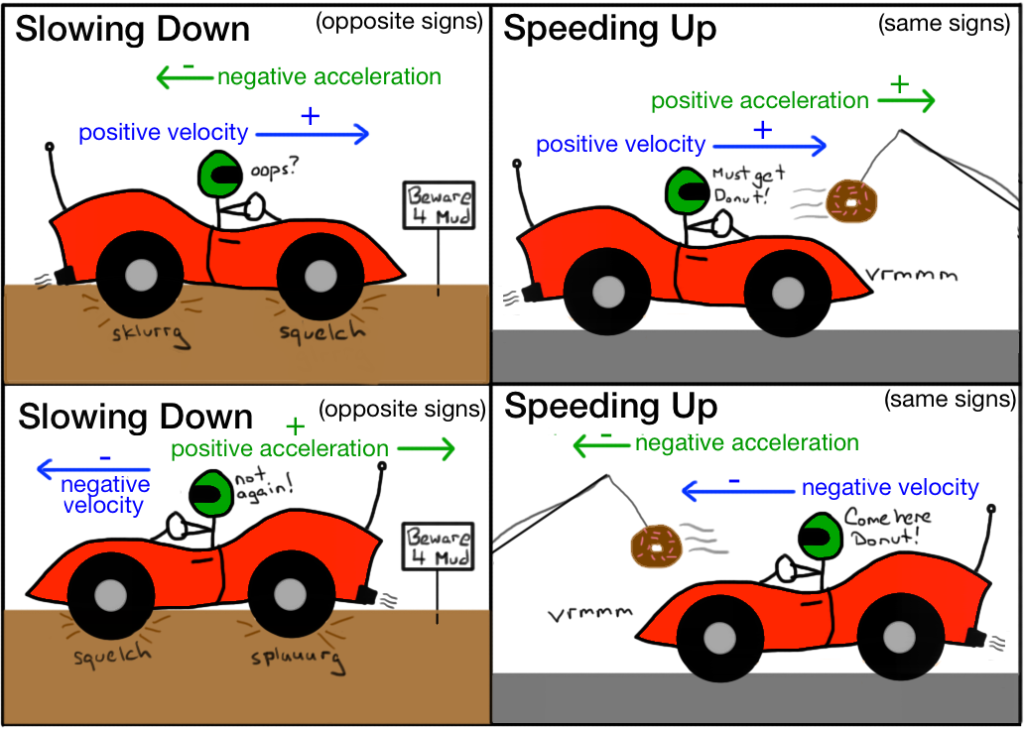
For example, when a car speeds up from a traffic signal, slows down near a turn, or changes direction while moving, acceleration occurs. Understanding acceleration in physics helps students analyse motion more deeply and recognise how forces influence movement.
👉 Back to: Complete Guide to Motion in Physics.
Formula for Acceleration
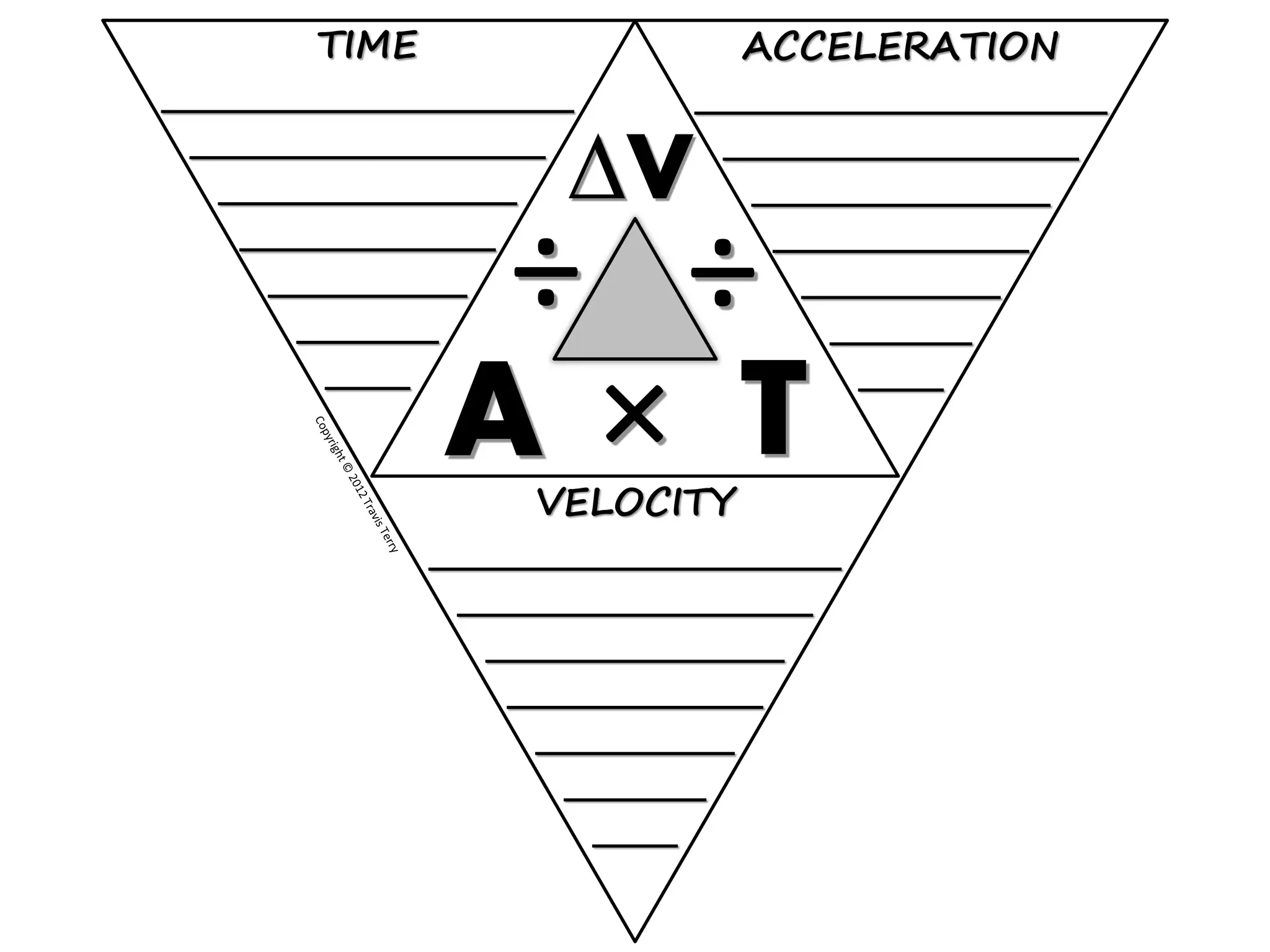
The basic formula used to calculate acceleration is:
Acceleration = Change in Velocity ÷ Time
This formula shows how quickly velocity changes during motion. If velocity increases rapidly, the acceleration is high. If velocity changes slowly, the acceleration is smaller.
For instance, if a bicycle increases its velocity from 2 m/s to 10 m/s in 4 seconds, the acceleration equals 2 m/s².
Learning this formula helps students solve numerical problems and understand real-world motion more effectively.
Types of Acceleration
Acceleration can appear in different forms depending on how velocity changes:
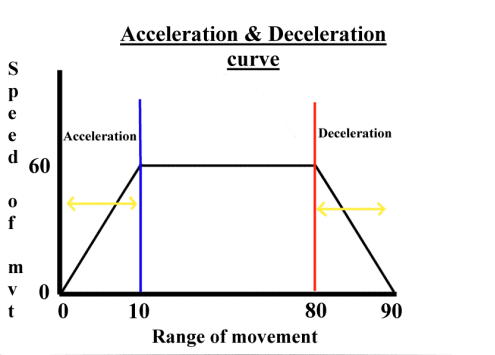
Positive Acceleration
Positive acceleration occurs when an object speeds up over time. A rocket launching into space is a strong example.
Negative Acceleration (Deceleration)
Negative acceleration happens when an object slows down. For example, a car braking near a signal shows deceleration.
Uniform Acceleration
Uniform acceleration occurs when velocity changes at a constant rate. Objects falling freely under gravity often demonstrate uniform acceleration.
Understanding these types helps students connect theory with everyday experiences.
SI Unit of Acceleration
The SI unit of acceleration is meter per second squared (m/s²). This unit shows how much velocity changes every second. Including units is essential for accurate physics calculations and clear communication of results.
Acceleration vs Velocity
Many learners confuse acceleration with velocity, but they describe different aspects of motion:
- Velocity tells how fast and in which direction an object moves.
- Acceleration tells how quickly velocity changes.
An object can have velocity without acceleration if it moves at constant speed in a straight line. However, whenever velocity changes, acceleration is present.
👉 You can explore velocity in physics for deeper understanding (add internal link later).
Graphical Representation of Acceleration
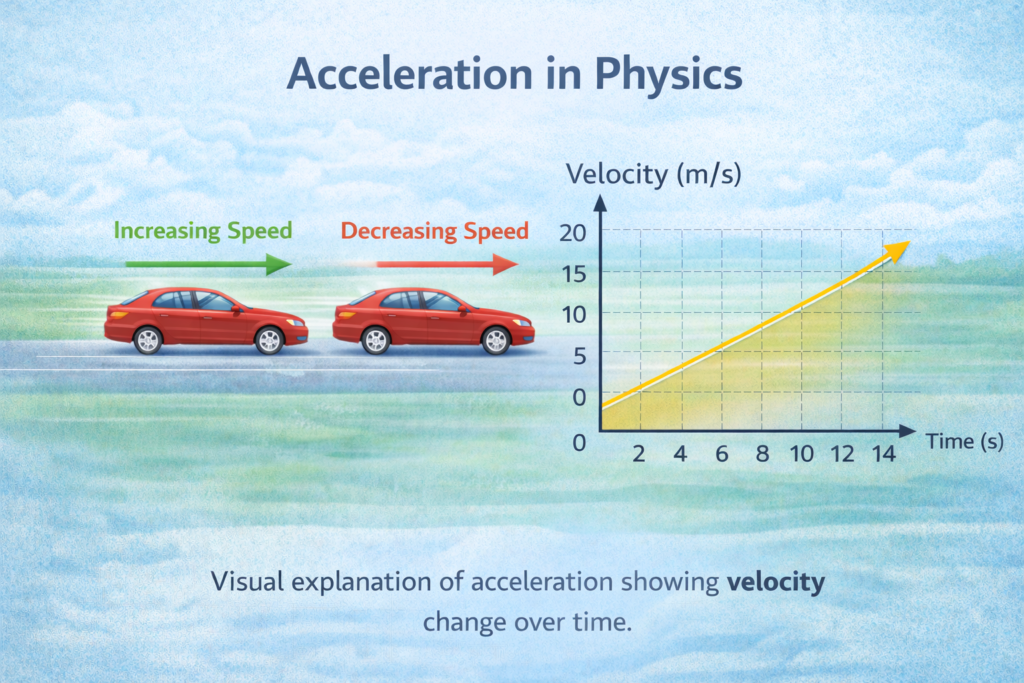
Acceleration is often represented using velocity-time graphs. In these graphs:
- A straight horizontal line indicates zero acceleration.
- A sloped line represents constant acceleration.
- A curved line shows changing acceleration.
Graphs allow students to visualise motion easily and interpret changes without complex calculations.
Real-Life Examples of Acceleration
Acceleration appears in many daily situations:
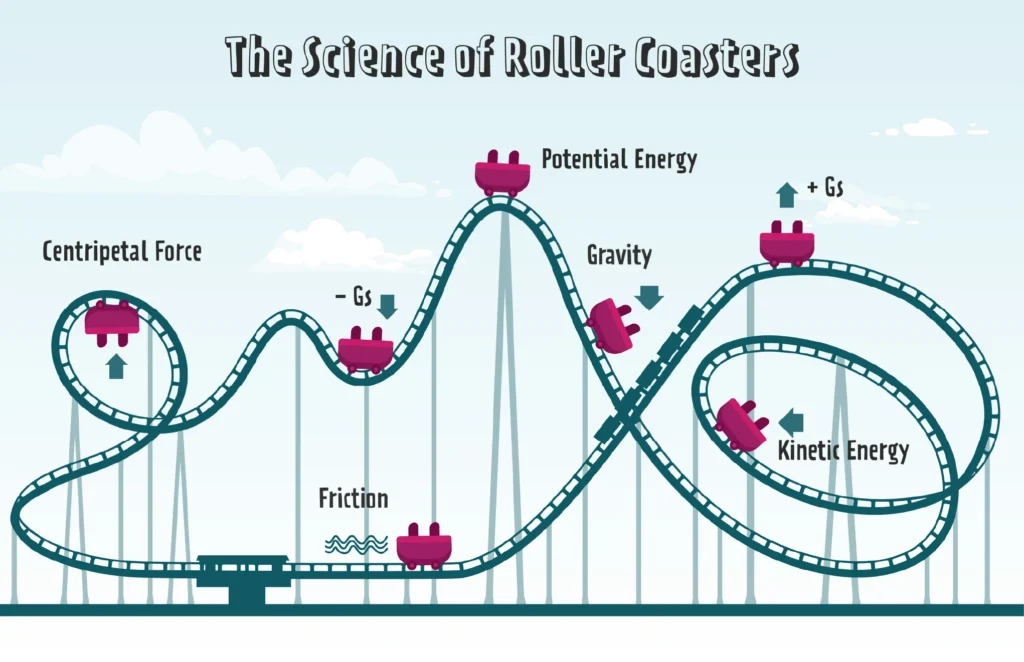
- A car increasing speed on a highway
- A roller coaster changing direction rapidly
- A ball falling toward the ground
These examples help students understand how acceleration affects movement in real life.
Common Mistakes Students Make
While learning acceleration, beginners often:
- Confuse acceleration with speed
- Forget to include direction
- Ignore units in calculations
Avoiding these mistakes improves problem-solving skills and strengthens understanding of physics concepts.
Understanding acceleration in physics also helps students interpret real-world situations like braking vehicles, falling objects, and changing directions during sports. Observing these examples improves conceptual clarity and makes learning motion more practical and engaging.
Conclusion
Acceleration in physics explains how velocity changes over time due to speed or direction changes. By understanding formulas, units, and graphical representations, students build a strong foundation for advanced motion topics. Mastering acceleration helps learners analyse real-world movement more accurately.
FAQs About Acceleration in Physics
1. What is acceleration in physics?
Acceleration describes how quickly velocity changes over time.
2. What is the SI unit of acceleration?
The SI unit of acceleration is meter per second squared (m/s²).
3. Can acceleration be negative?
Yes, negative acceleration occurs when an object slows down.
4. Why is acceleration important in motion?
It helps explain changes in speed and direction during movement.
🌐 Connect With Us
👉 Informosio Official – General updates, current affairs, and informative content