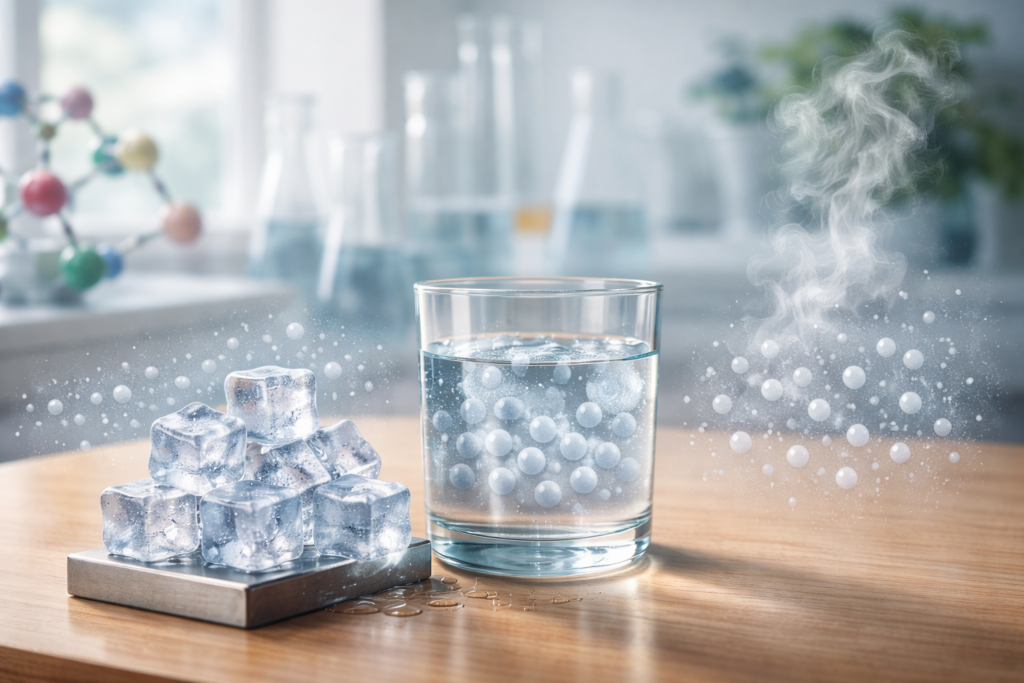
What Is Matter in Our Surroundings?
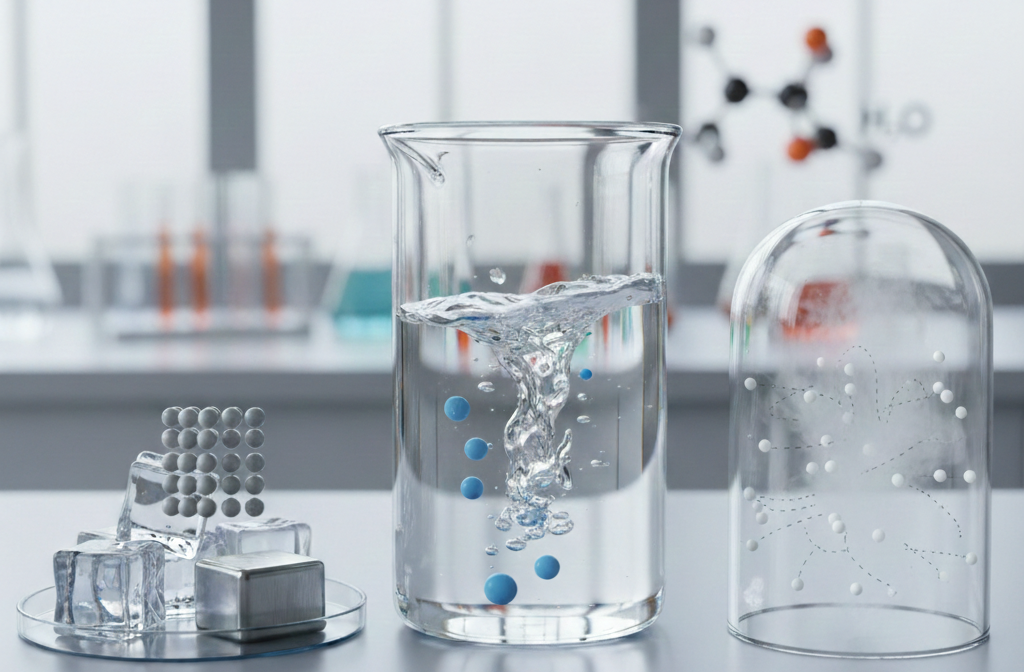
Everything around us that occupies space and has mass is called matter. The air we breathe, the water we drink, the food we eat, and even the desk you sit on are all forms of matter. In Matter in Our Surroundings, we study what matter is made of, how its particles behave, the different states of matter, and processes like evaporation that explain everyday phenomena.
This chapter is the foundation of Chemistry for Class 9 students and helps build scientific thinking. Understanding Matter in Our Surroundings is essential not only for exams but also for explaining daily-life experiences such as drying of clothes, melting of ice, and cooling caused by evaporation.
At first glance, substances around us may appear continuous and uniform, but in reality, they are made up of extremely small particles. These particles are constantly moving, have spaces between them, and attract one another. Studying these basic ideas helps students understand why solids are rigid, liquids can flow, and gases spread rapidly to fill available space. It also explains how changes in temperature and pressure can alter the physical state of a substance.
By learning these concepts, students develop a strong base for further studies in Chemistry and related sciences. The ideas discussed here connect textbook knowledge with real-life observations, making the subject easier to understand, remember, and apply. This chapter encourages students to observe their surroundings scientifically and think logically about the physical world around them.
What Is Matter? (Basic Definition)
Matter is anything that has mass and occupies space. This definition includes all physical substances found around us, whether they are visible or invisible. Objects such as books, water, air, metals, and even tiny particles of dust are all forms of matter because they have weight and take up space.
Matter exists in different physical forms, commonly as solids, liquids, and gases. These forms differ in shape, volume, and the way their particles are arranged and move. For example, solids have a fixed shape, liquids can flow, and gases spread out to fill any container. Despite these differences, all forms share the same basic property of having mass and volume.
At a microscopic level, matter is made up of extremely small particles that are constantly in motion and attract one another. The behavior of these particles explains many everyday observations, such as why ice melts into water, why liquids evaporate, and why gases can be compressed. Understanding what matter is provides a strong foundation for studying physical and chemical changes in science.
Examples
- Air in a balloon
- Water in a glass
- Sugar dissolved in tea
Even gases are matter because they have mass and occupy space.
Characteristics of Particles of Matter
All matter is made up of very tiny particles. These particles have certain characteristics that explain the behavior of matter.
1. Particles of Matter Are Very Small
Particles of matter are so small that they cannot be seen with the naked eye.
Explanation
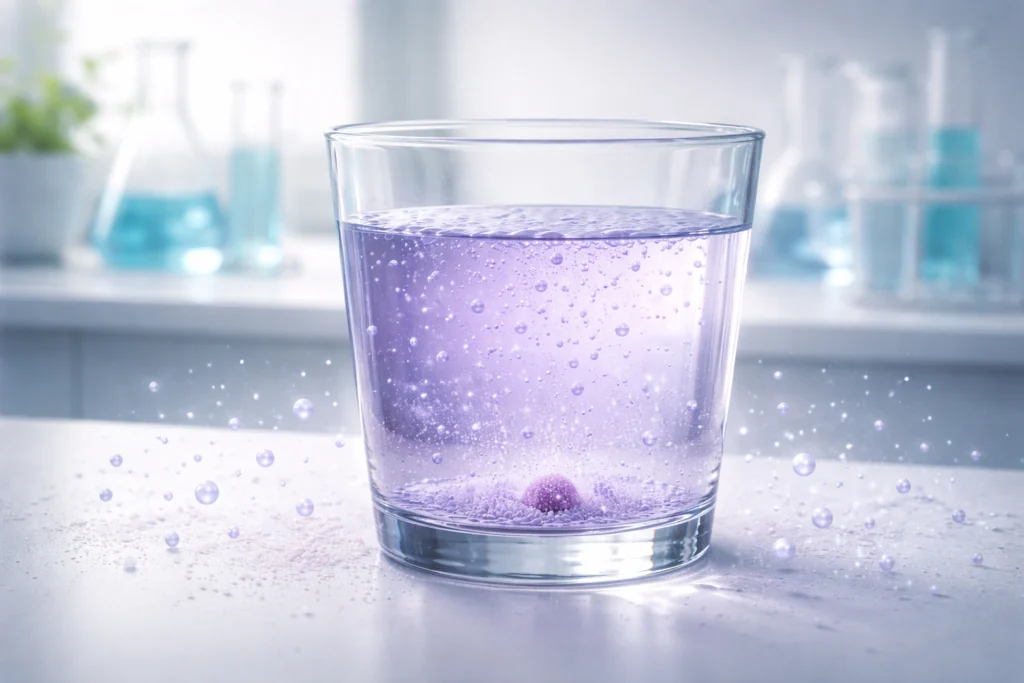
If you dissolve a small crystal of potassium permanganate in water, the color spreads throughout the water. Even after repeated dilution, the color is still visible. This shows that particles are extremely small.
Conclusion
A tiny amount of matter contains millions of particles.
2. Particles of Matter Have Space Between Them
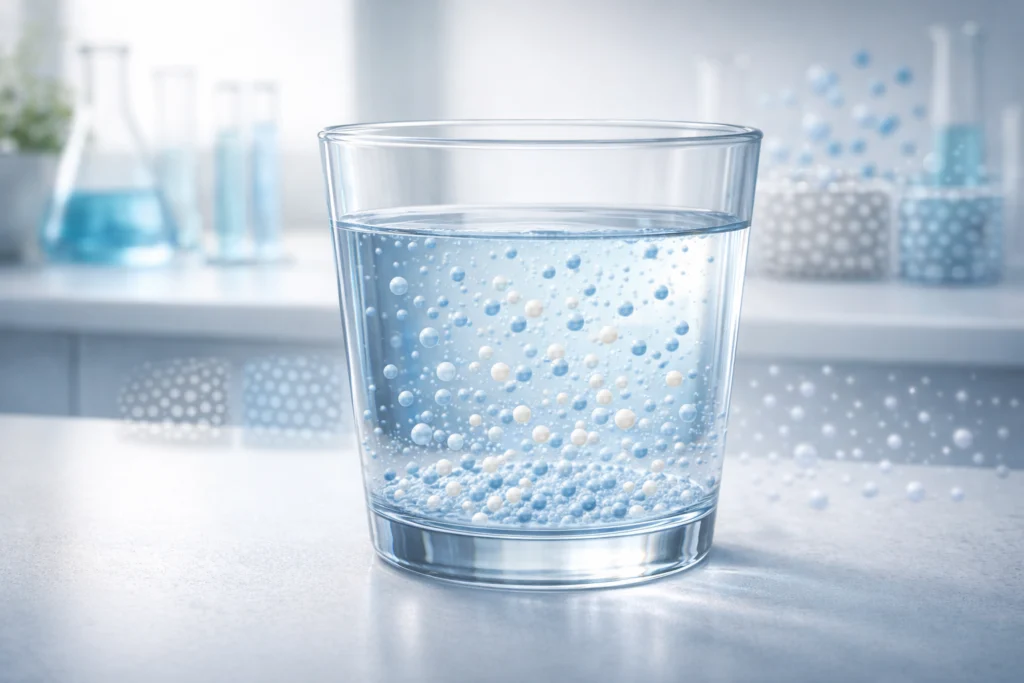
There is space between particles of matter.
Example
When sugar is dissolved in water, the sugar particles occupy the spaces between water particles. The water level does not rise significantly.
Key Point
The amount of space varies in solids, liquids, and gases.
3. Particles of Matter Are in Constant Motion
Particles of matter are always moving.
Explanation
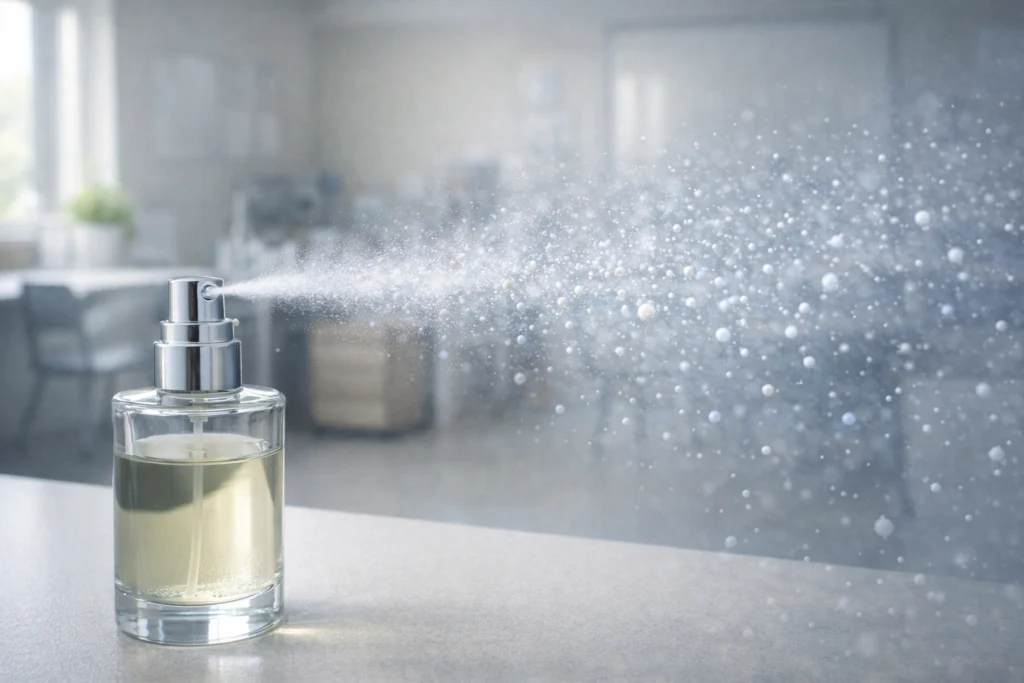
The spreading of perfume in a room occurs because gas particles move randomly in all directions.
Scientific Term
This continuous movement of particles is called diffusion.
4. Particles of Matter Attract Each Other
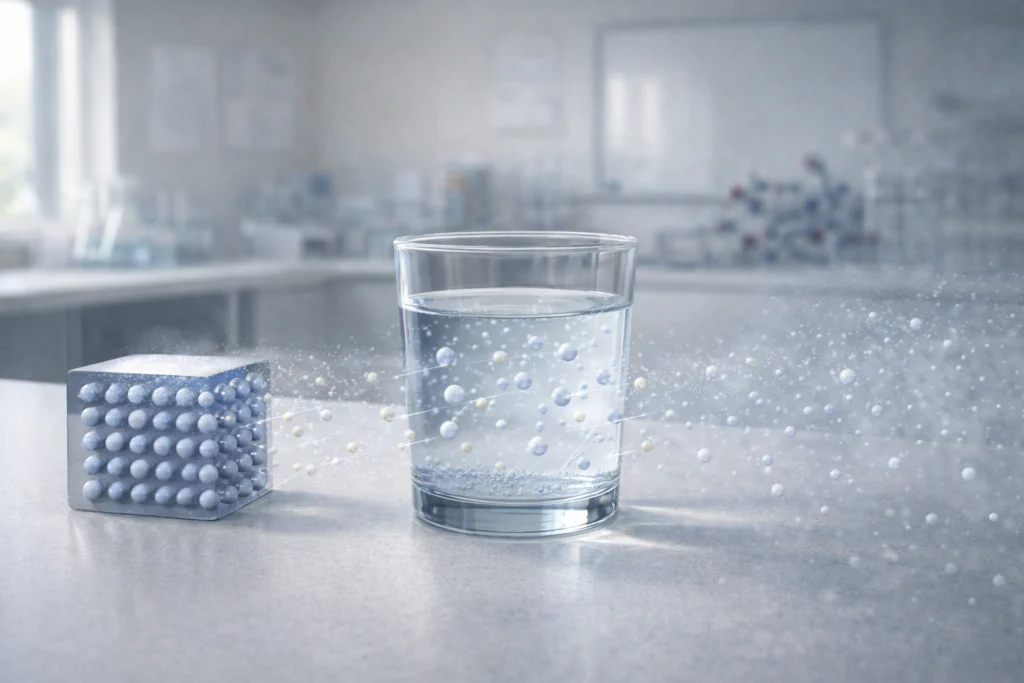
Particles of matter have a force of attraction between them.
Order of Attraction
- Solids: Very strong attraction
- Liquids: Moderate attraction
- Gases: Very weak attraction
This attraction keeps particles together.
States of Matter
Based on physical properties, matter exists in different states. In this chapter, we mainly study three states of matter.
Solid State
Properties of Solids
- Fixed shape
- Fixed volume
- Strong intermolecular force
- Negligible compressibility
Examples
- Ice
- Iron
- Wood
Why Solids Are Rigid
Particles are closely packed and vibrate at fixed positions.
Liquid State
Properties of Liquids
- Fixed volume
- No fixed shape
- Can flow
- Slightly compressible
Examples
- Water
- Milk
- Oil
Why Liquids Flow
Particles are loosely packed and can slide over each other.
Gaseous State
Properties of Gases
- No fixed shape
- No fixed volume
- Highly compressible
- Very weak intermolecular force
Examples
- Oxygen
- Carbon dioxide
- Air
Why Gases Fill Containers
Gases fill containers because their particles have very weak attraction and move freely in all directions. Particles move freely and randomly at high speed. As a result, gas particles spread out and occupy all the available space in a container.
Comparison of Three States of Matter
| Property | Solid | Liquid | Gas |
|---|---|---|---|
| Shape | Fixed | Not fixed | Not fixed |
| Volume | Fixed | Fixed | Not fixed |
| Compressibility | Very low | Low | High |
| Particle Movement | Very less | Moderate | Very high |
Interconversion of States of Matter
Interconversion of states of matter explains how substances change between solid, liquid, and gaseous forms. Matter can change from one state to another by changing temperature or pressure. In Matter in Our Surroundings, this concept helps us understand melting, freezing, boiling, condensation, and sublimation. By studying Matter in Our Surroundings, students learn how heating increases particle motion and cooling reduces it, leading to changes in state. Similarly, Matter in Our Surroundings shows that applying or reducing pressure can convert gases into liquids or solids. Overall, Matter in Our Surroundings connects everyday observations—like ice melting or steam condensing—to clear scientific principles.
Effect of Temperature
Melting (Fusion)
Solid → Liquid
Example: Ice melts into water at 0°C.
Boiling (Vaporisation)
Liquid → Gas
Example: Water boils at 100°C (at atmospheric pressure).
Effect of Pressure
Increasing pressure can convert gases into liquids.
Example
Liquefied Petroleum Gas (LPG) is stored in cylinders by applying high pressure.
Latent Heat
Latent heat is the heat energy required to change the state of matter without changing its temperature. In Matter in Our Surroundings, this concept explains why temperature stays constant during melting or boiling, as the energy is used to overcome forces between particles rather than increasing temperature.
Types of Latent Heat
- Latent heat of fusion
- Latent heat of vaporisation
Evaporation
Evaporation is a surface phenomenon in which a liquid changes into vapour at temperatures below its boiling point. In Matter in Our Surroundings, evaporation occurs because some particles at the surface gain enough energy to escape into the air. This process causes cooling, as higher-energy particles leave the liquid, reducing the average kinetic energy of the remaining particles.
Factors Affecting Evaporation
1. Surface Area
Greater surface area → Faster evaporation
Example: Wet clothes dry faster when spread out.
2. Temperature
Higher temperature → Faster evaporation
3. Humidity
Lower humidity → Faster evaporation
4. Wind Speed
Higher wind speed → Faster evaporation
Cooling Effect of Evaporation
During evaporation, high-energy particles escape, leaving behind lower-energy particles. This lowers the temperature of the liquid. As a result, the average kinetic energy of the remaining particles decreases, producing a cooling effect. This explains everyday experiences such as sweating cooling our body and water becoming cool in an earthen pot.
Examples
- Sweating cools our body
- Water in an earthen pot becomes cool
- Alcohol feels cool on skin
Why Should We Wear Cotton Clothes in Summer?
Cotton clothes are preferred in summer because they absorb sweat from the body. Cotton absorbs sweat and spreads it over a large surface area, increasing evaporation and cooling the body. Faster evaporation removes heat from the skin, helping us feel cool and comfortable in hot weather.
Real-Life Applications of Matter in Our Surroundings
- Refrigerators use evaporation for cooling
- LPG cylinders store gas under pressure
- Drying of clothes
- Use of perfumes and deodorants
Common Mistakes Students Make
- Confusing evaporation with boiling
- Thinking gases have no mass
- Forgetting factors affecting evaporation
- Writing incomplete definitions
Exam-Oriented Tips
- Always write definitions clearly
- Use proper scientific terms
- Draw neat labeled diagrams when required
- Practice numerical and reasoning questions
Practice Questions (With Answers)
Q1. Define matter.
Answer: Matter is anything that has mass and occupies space.
Q2. Name three characteristics of particles of matter.
Answer:
- They are very small
- They have spaces between them
- They are in constant motion
Q3. Why does evaporation cause cooling?
Answer: Because high-energy particles escape, reducing the average kinetic energy.
Q4. Which state of matter is most compressible?
Answer: Gaseous state.
Reference Sources
Khan Academy (NCERT Class 9 Science)
NCERT Class 9 Science Textbook
LearnCBSE Notes
Allen CBSE Notes
Vedantu Important Questions
Askiitians Revision Notes
Revision Summary: Matter in Our Surroundings
In Matter in Our Surroundings, we learned that matter is made up of tiny particles that have space, motion, and attraction. Matter exists mainly as solids, liquids, and gases, each with unique properties. Changes in temperature and pressure cause interconversion of states. Evaporation is a surface phenomenon that leads to cooling and explains many everyday experiences. Mastering this chapter builds a strong foundation for Chemistry and helps in scoring well in exams.
You can visit also Chemistry & Materials
Frequently Asked Questions (FAQs)
1. What is Matter in Our Surroundings?
It is the study of matter, its particles, states, and changes in state.
2. Is air considered matter?
Yes, air has mass and occupies space.
3. What is diffusion?
The movement of particles from high concentration to low concentration.
4. Why are solids incompressible?
Because particles are tightly packed.
5. What is evaporation?
The change of liquid into vapour at any temperature.
6. Why does sweating cool our body?
Due to cooling effect of evaporation.