Ecology & Environment form the foundation of life on Earth. They explain how living organisms interact with one another and with the physical world, shaping biodiversity, climate stability, and the availability of natural resources. From microscopic organisms in soil to vast forests and oceans, every component is interconnected through energy flow, nutrient cycles, and population dynamics.
In today’s rapidly changing world, understanding Ecology & Environment is no longer limited to academic study. It is essential for sustainable development, environmental conservation, public health, and informed policymaking. This long-form guide provides an in-depth, professional, and structured explanation of core ecological concepts—designed for students, educators, researchers, and competitive exam aspirants.
Ecosystem – Basic Concept of Ecology and Environment
An ecosystem is a natural system where living organisms such as plants, animals, and microorganisms live together and interact with non-living components like air, water, soil, sunlight, and temperature. All these components are closely connected and depend on one another for survival.
In an ecosystem, plants prepare food using sunlight, animals obtain energy by eating plants or other animals, and microorganisms decompose dead organisms, returning nutrients to the soil. This continuous interaction allows energy to flow and nutrients to recycle, maintaining balance in nature. An ecosystem can be small like a pond or large like a forest, but in every case, each component plays an important role in keeping the system stable and functional.
Components of an Ecosystem
Biotic Components
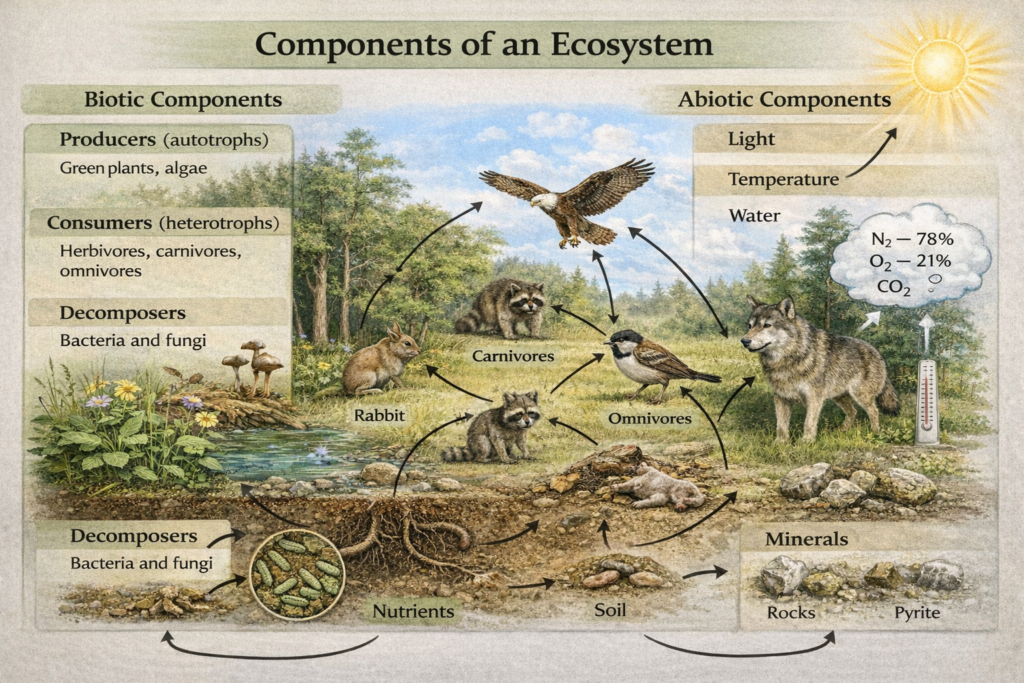
- Producers (autotrophs): Green plants, algae
- Consumers (heterotrophs): Herbivores, carnivores, omnivores
- Decomposers: Bacteria and fungi
Abiotic Components
- Light
- Temperature
- Water
- Soil
- Minerals
- Atmospheric gases
These components work together to maintain ecological balance.
Types of Ecosystems
| Ecosystem Type | Examples | Key Features |
|---|---|---|
| Terrestrial | Forests, grasslands, deserts | Climate-driven structure |
| Aquatic | Freshwater, marine | Salinity and depth variations |
| Artificial | Croplands, urban systems | Human-managed |
Each ecosystem plays a vital role in global Ecology & Environment, supporting life and regulating Earth’s systems.
Food Chain and Food Web
Energy transfer is central to Ecology & Environment, and it occurs primarily through food chains and food webs.
Food Chain
A food chain is a simple sequence that shows how energy and nutrients pass from one organism to another in a natural system. It explains who eats whom and how living organisms depend on each other for food.
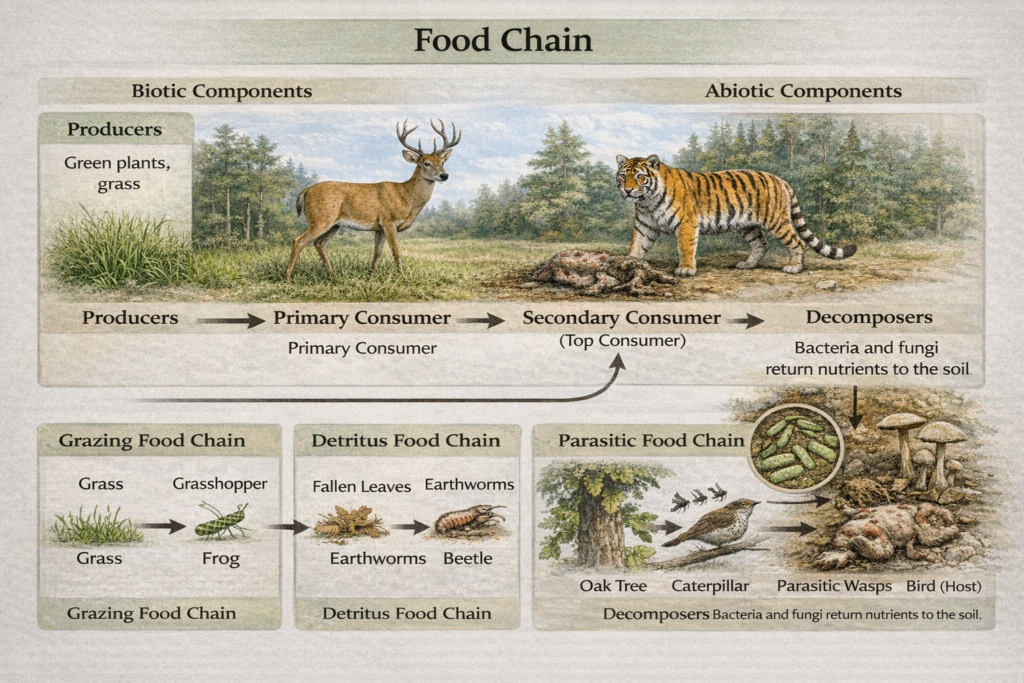
A food chain usually begins with plants, which make their own food using sunlight. These plants are eaten by herbivores, which are then eaten by carnivores. At the end of the chain, decomposers such as bacteria and fungi break down dead plants and animals, returning nutrients to the soil.
Each step in a food chain represents a trophic level, and as energy moves from one level to the next, some energy is lost. Because of this energy loss, food chains are usually short. Food chains help us understand energy transfer, feeding relationships, and balance in nature.
Example:
Grass → Deer → Tiger
Types of Food Chains
- Grazing food chain
- Detritus food chain
- Parasitic food chain
Food Web
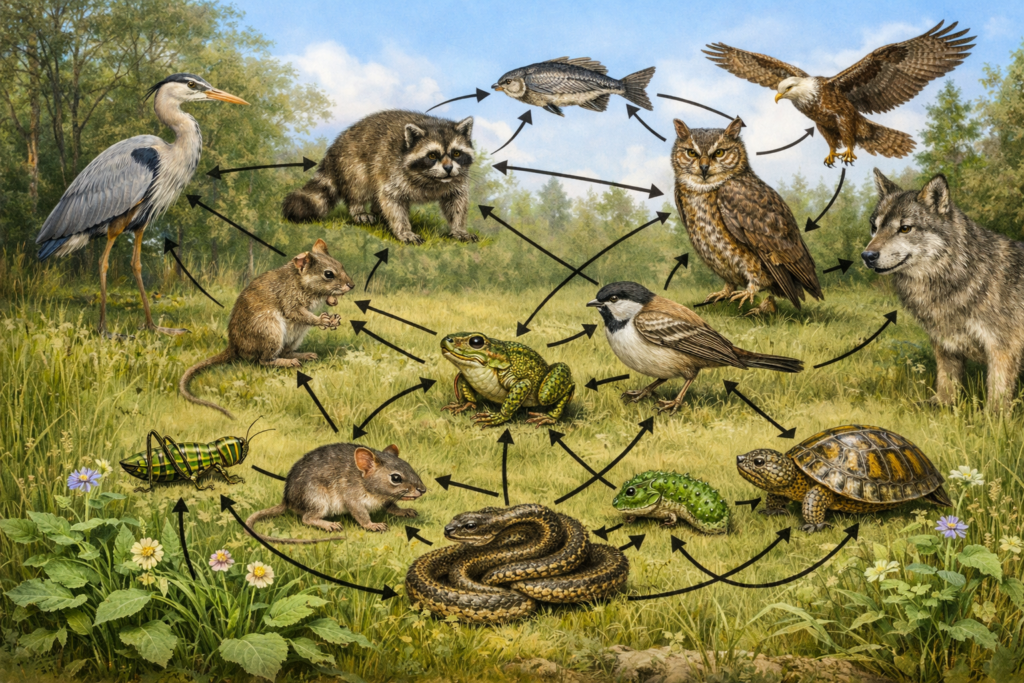
A food web is a network of interconnected food chains that shows the multiple feeding relationships among organisms in a natural system. Unlike a single food chain, which follows one straight path of energy flow, a food web illustrates how plants and animals are linked through several feeding pathways.
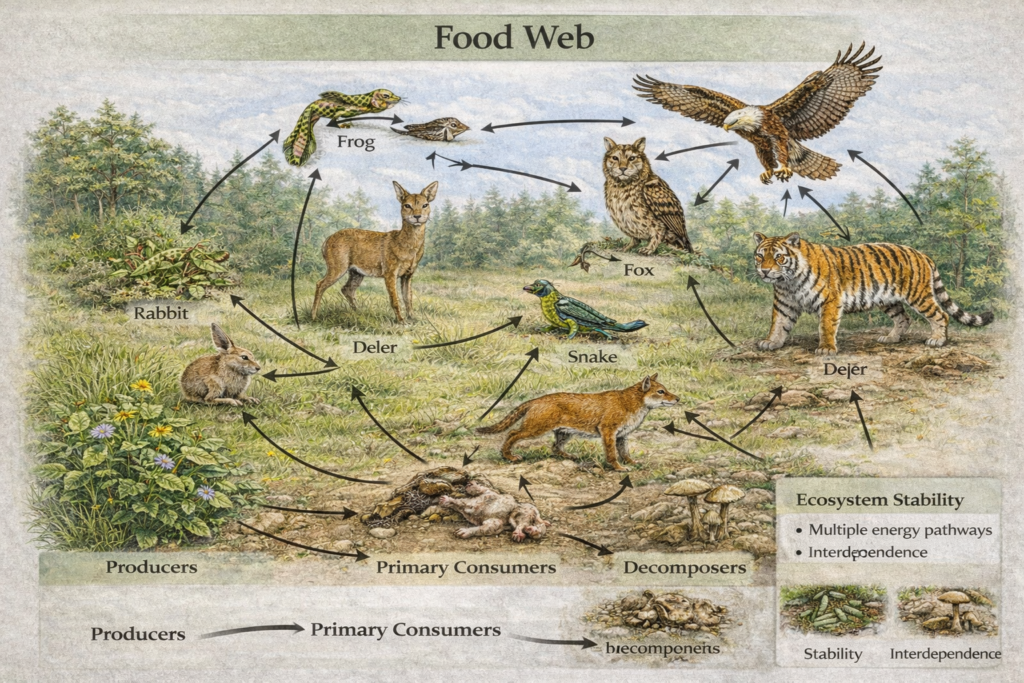
In a food web, one organism may have more than one source of food and may also be eaten by different predators. For example, a grass-eating insect may be eaten by birds, frogs, or reptiles, and these animals may, in turn, be eaten by larger predators. This interconnected structure makes natural systems more stable.
Food webs help maintain balance by providing alternative food sources when one organism becomes scarce. They give a more realistic picture of how energy and nutrients move through living communities and show the interdependence of organisms in nature.. It provides:
- Greater stability
- Multiple energy pathways
- Resilience against species loss
Food webs are more realistic representations of Ecology & Environment compared to simple food chains.
Energy Flow in Ecology & Environment
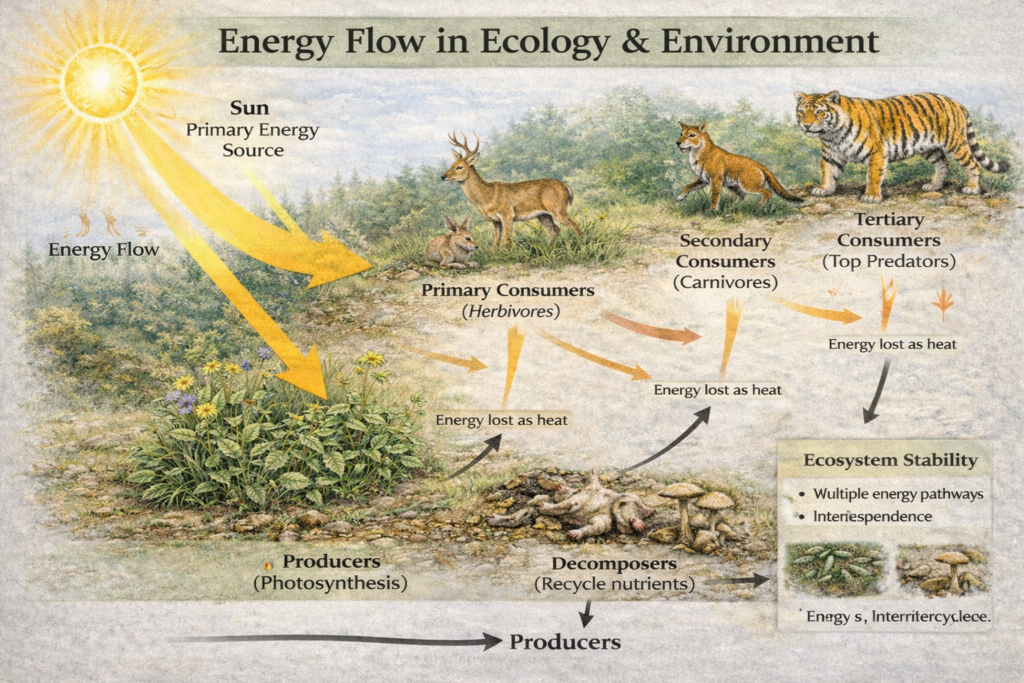
Energy flow in ecosystems refers to the movement of energy from one organism to another through different trophic levels. In Ecology & Environment, energy flow always begins with the sun, which is the primary source of energy for almost all life on Earth.
Green plants, known as producers, capture solar energy through the process of photosynthesis and convert it into chemical energy stored in food. This energy is then transferred to primary consumers (herbivores) when they eat plants. Secondary and tertiary consumers obtain energy by feeding on other animals.
As energy moves from one trophic level to the next, a large portion of it is lost as heat during metabolic activities such as respiration and movement. Because of this energy loss, only a small fraction—about 10% of the energy—is passed on to the next level. This explains why food chains are short and why top predators are fewer in number.
Energy flow in an ecosystem is unidirectional, meaning it cannot be recycled back to the sun. Once energy is used and lost as heat, it cannot be reused. This one-way flow of energy is essential for maintaining the structure, productivity, and stability of ecosystems.
Laws Governing Energy Flow
- Energy cannot be recycled
- Energy transfer follows the second law of thermodynamics
- Only about 10% of energy passes to the next trophic level
Ecological Pyramids
Types of Ecological Pyramids
- Pyramid of energy
- Pyramid of biomass
- Pyramid of numbers
Among these, the pyramid of energy is always upright, highlighting energy loss at each trophic level—an essential principle of Ecology & Environment.
Biogeochemical Cycles
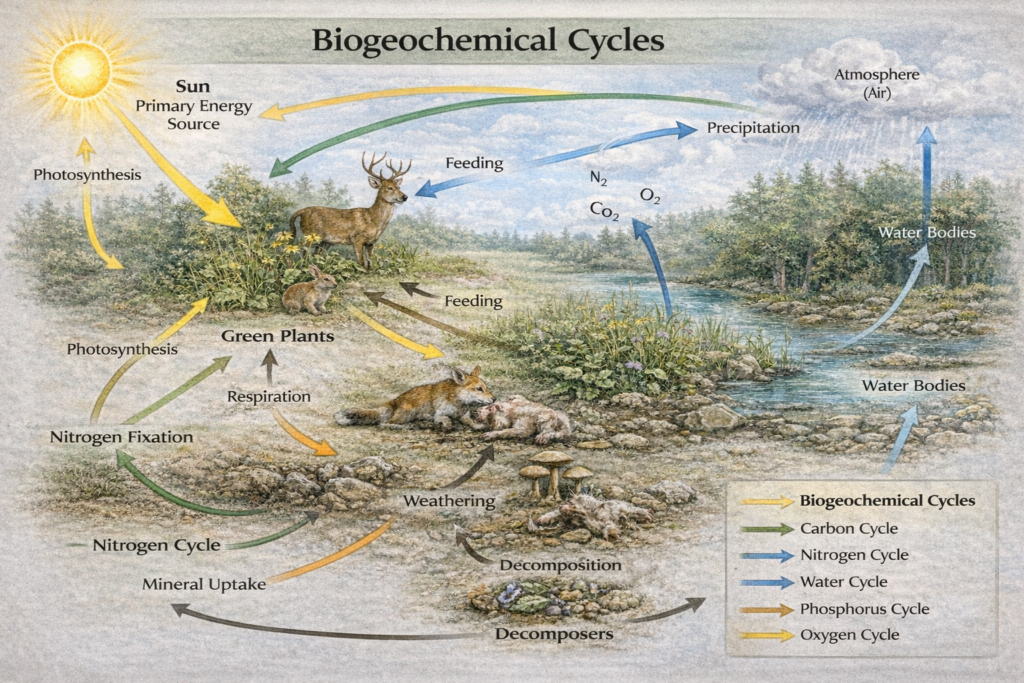
Biogeochemical cycles are natural processes that describe how essential elements move continuously between living organisms (biotic components) and the non-living environment (abiotic components) such as air, water, and soil in Ecology & Environment.
These cycles ensure that important elements like carbon, nitrogen, water, phosphorus, and oxygen are reused again and again rather than being lost from the Earth’s system. For example, plants absorb nutrients from soil and air, animals obtain these elements by feeding on plants or other animals, and decomposers return them to the environment by breaking down dead organisms and waste materials.
Biogeochemical cycles help maintain ecological balance by regulating nutrient availability, supporting growth and metabolism of organisms, and stabilizing climate and environmental conditions. Any disturbance in these cycles—such as pollution or excessive resource use—can disrupt ecosystems and negatively affect the overall Ecology & Environment.
Major Biogeochemical Cycles
Carbon Cycle
- Maintains atmospheric CO₂ balance
- Supports photosynthesis and respiration
Nitrogen Cycle
- Converts inert nitrogen into usable forms
- Involves nitrogen fixation, nitrification, and denitrification
Water Cycle
- Includes evaporation, condensation, precipitation
- Regulates climate and water availability
Phosphorus Cycle
- No gaseous phase
- Essential for DNA, ATP, and cell membranes
Disruption of these cycles directly impacts Ecology & Environment, leading to climate change and ecosystem degradation.
Population Ecology
Population ecology studies population size, density, distribution, and growth within Ecology & Environment.
Population Characteristics
- Density
- Natality
- Mortality
- Age structure
- Sex ratio
Population Growth Models
Exponential Growth
- Occurs under unlimited resources
Logistic Growth
- Limited by carrying capacity (K)
Factors Affecting Population Size
- Environmental resistance
- Predation
- Disease
- Resource availability
Understanding population ecology helps manage wildlife, human populations, and natural resources responsibly.
Biodiversity Explained: A Key Pillar of Ecology and the Environment
Biodiversity refers to the wide variety of living organisms present on Earth, including plants, animals, and microorganisms, within Ecology & Environment. It includes differences not only between species but also within species and among ecosystems.
Biodiversity exists at three main levels: genetic diversity, which refers to variations within a species; species diversity, which is the number and variety of species in a given area; and ecosystem diversity, which includes different habitats such as forests, grasslands, deserts, and aquatic systems. Each level plays a vital role in maintaining ecological balance.
High biodiversity increases the stability and productivity of ecosystems by enabling them to withstand environmental changes and disturbances. It provides essential resources such as food, medicines, raw materials, and ecosystem services like pollination, soil fertility, and climate regulation. Therefore, biodiversity is considered a fundamental pillar of Ecology & Environment, supporting life and ensuring the sustainable functioning of natural systems.
Levels of Biodiversity
- Genetic diversity
- Species diversity
- Ecosystem diversity
Importance of Biodiversity
- Ecological stability
- Economic resources
- Medicinal value
- Cultural significance
Biodiversity Hotspots
Regions with high species richness and endemism, but under severe threat. Conservation of these areas is critical for maintaining global Ecology & Environment balance.
Conservation of Environment
Conservation of Environment refers to the protection, preservation, and responsible management of natural resources, ecosystems, and living organisms within the natural environment. Its main goal is to maintain ecological balance and ensure that resources remain available for present and future generations.
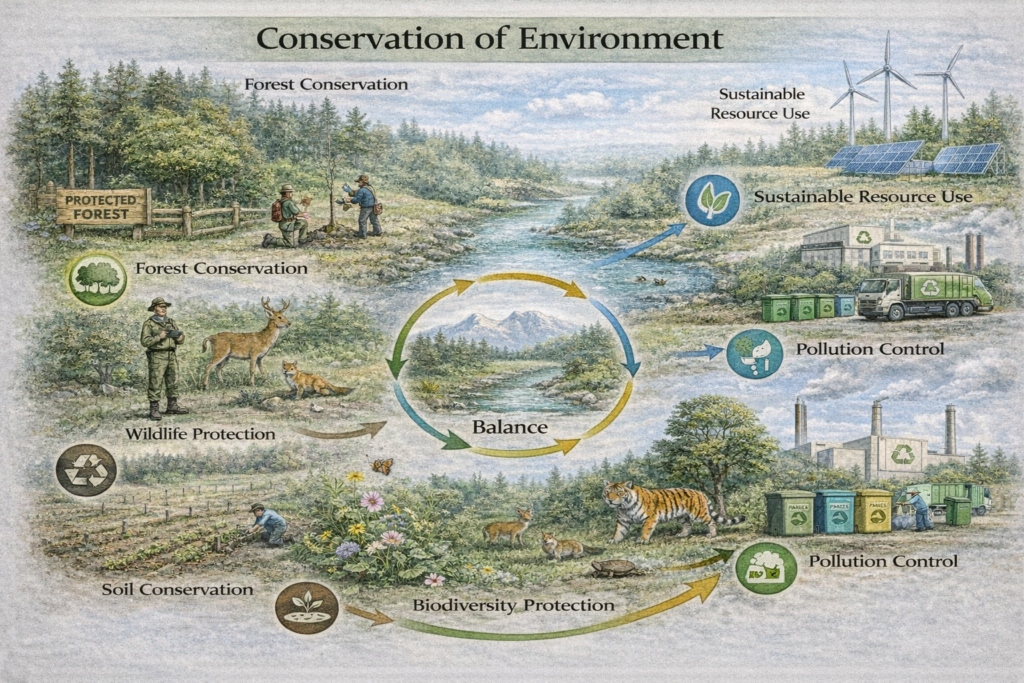
Environmental conservation focuses on safeguarding forests, wildlife, water bodies, soil, and biodiversity from overuse, pollution, and degradation. It includes practices such as sustainable resource use, habitat conservation, restoration of damaged ecosystems, and control of environmental pollution. These efforts encourage human activities that reduce harm to nature.
By conserving the environment, we help sustain biodiversity, regulate climate, support essential life-support systems, and enhance human well-being. Effective conservation is essential for protecting the natural world and achieving long-term environmental sustainability.
In-situ Conservation
- National parks
- Wildlife sanctuaries
- Biosphere reserves
Ex-situ Conservation
- Zoos
- Botanical gardens
- Seed banks
Sustainable Development
Sustainable development refers to a model of growth that fulfills the needs of the present generation without reducing the ability of future generations to meet their own needs. It emphasizes a balanced approach to progress that considers economic growth, social well-being, and protection of the natural system.
This concept encourages the efficient and responsible use of natural resources so that ecosystems remain healthy and productive over time. Sustainable development promotes practices such as renewable energy use, conservation of resources, pollution control, and environmentally responsible planning. It ensures that development activities do not cause long-term damage to land, water, air, or biodiversity.
By following the principles of sustainable development, societies can achieve progress while maintaining harmony with the natural environment, ensuring long-term stability, resource availability, and improved quality of life for both present and future generations.
Environmental Pollution
Environmental pollution refers to the introduction of harmful substances or energy into air, water, soil, or surroundings that cause damage to living organisms and natural systems. It is one of the most serious global problems affecting human health, biodiversity, and the balance of nature.
Pollution can take many forms, including air pollution from industrial emissions and vehicles, water pollution from sewage and chemicals, soil pollution due to pesticides and waste disposal, and noise pollution caused by urbanization. These pollutants degrade natural resources, disrupt food chains, and reduce the quality of life for both humans and wildlife.
If left uncontrolled, environmental pollution can lead to climate change, loss of biodiversity, health disorders, and long-term damage to natural resources. Preventing pollution through sustainable practices, proper waste management, cleaner technologies, and public awareness is essential for protecting the natural environment and ensuring a healthy future.
Types of Pollution
| Pollution Type | Sources | Effects |
|---|---|---|
| Air | Industries, vehicles | Respiratory diseases |
| Water | Sewage, chemicals | Aquatic life loss |
| Soil | Pesticides, waste | Reduced fertility |
| Noise | Urbanization | Stress, hearing loss |
| Thermal | Power plants | Ecosystem imbalance |
Control Measures
- Cleaner technologies
- Waste management
- Environmental laws
- Public awareness
Effective pollution control is essential for protecting Ecology & Environment and human health.
Human Impact on Ecology & Environment
Human impact on the natural environment refers to the changes caused by human activities that disturb natural systems and ecological balance. Rapid population growth, industrialization, urban development, and excessive use of natural resources have greatly modified landscapes and biological systems.
Activities such as deforestation, mining, large-scale agriculture, and construction lead to habitat destruction and loss of biodiversity. The burning of fossil fuels releases greenhouse gases, contributing to climate change, global warming, and altered weather patterns. Industrial waste, plastic pollution, and chemical runoff contaminate air, water, and soil, harming both wildlife and human health.
These human-induced changes reduce the ability of natural systems to function effectively and recover from disturbances. Reducing negative human impact through sustainable practices, conservation efforts, and responsible resource management is essential to protect the natural environment and maintain long-term ecological stability.
Major Impacts
- Deforestation
- Climate change
- Urbanization
- Industrialization
Climate Change and Ecology
- Rising temperatures
- Melting glaciers
- Sea-level rise
- Altered species distribution
Addressing these challenges requires integrated ecological understanding and global cooperation.
Role of Ecology & Environment in Daily Life
- Clean air and water
- Food security
- Climate regulation
- Disease control
Healthy Ecology & Environment systems directly influence quality of life and economic stability.
Applications of Ecology & Environment
- Environmental Impact Assessment
- Wildlife management
- Agriculture sustainability
- Urban planning
- Climate policy
Ecological principles guide evidence-based decisions across multiple sectors.
Conclusion
Ecology & Environment provide a scientific framework for understanding life-support systems on Earth. From ecosystems and energy flow to biodiversity and conservation, every concept highlights the delicate balance that sustains our planet. Human activities have placed unprecedented pressure on natural systems, making ecological awareness and environmental responsibility more important than ever.
By applying principles of Ecology & Environment, societies can move toward sustainable development, protect biodiversity, and ensure a healthier future for generations to come. A deep understanding of these concepts is not just academic—it is essential for survival in a rapidly changing world.
Frequently Asked Questions (FAQs)
1. What is the scope of Ecology & Environment?
It covers ecosystems, biodiversity, conservation, pollution, and sustainability across natural and human systems.
2. Why is Ecology & Environment important for competitive exams?
It forms a core part of biology, environmental science, and general studies sections.
3. How does energy flow differ from nutrient cycling?
Energy flows one-way, while nutrients are recycled in Ecology & Environment.
4. What causes biodiversity loss?
Habitat destruction, pollution, invasive species, and climate change.
5. What is the role of humans in conservation?
Humans can protect ecosystems through sustainable practices and policies.
6. How does pollution affect ecosystems?
It disrupts food chains, reduces biodiversity, and alters biogeochemical cycles.
7. What is sustainable development?
Development that balances economic growth with ecological protection.