Asexual reproduction is one of the most important topics in biology, especially for school and competitive examinations. It explains how new organisms are formed from a single parent without the involvement of gametes or fertilization.
In nature, many living organisms such as bacteria, plants, fungi, and some animals reproduce asexually. This mode of reproduction allows organisms to increase their population rapidly and survive in stable environments.
This article explains asexual reproduction in a clear, step-by-step, student-friendly manner, covering definitions, processes, types, examples, diagrams in text form, common misconceptions, exam notes, practice questions, and FAQs.
What is Asexual Reproduction?
Definition of Asexual Reproduction
Asexual reproduction is a type of reproduction in which a single parent organism produces offspring, and the offspring are genetically identical to the parent.
Key Points of the Definition
- Only one parent is involved
- No fusion of gametes occurs
- No fertilization takes place
- Offspring are called clones
- Genetic variation is very limited
Characteristics of Asexual Reproduction
Asexual reproduction has some distinct features that separate it from sexual reproduction.
Main Characteristics
- Involves mitotic cell division
- Fast and energy-efficient
- Produces large numbers of offspring
- Offspring resemble the parent exactly
- Occurs mainly in simple organisms
Biological Basis of Asexual Reproduction
Role of Mitosis
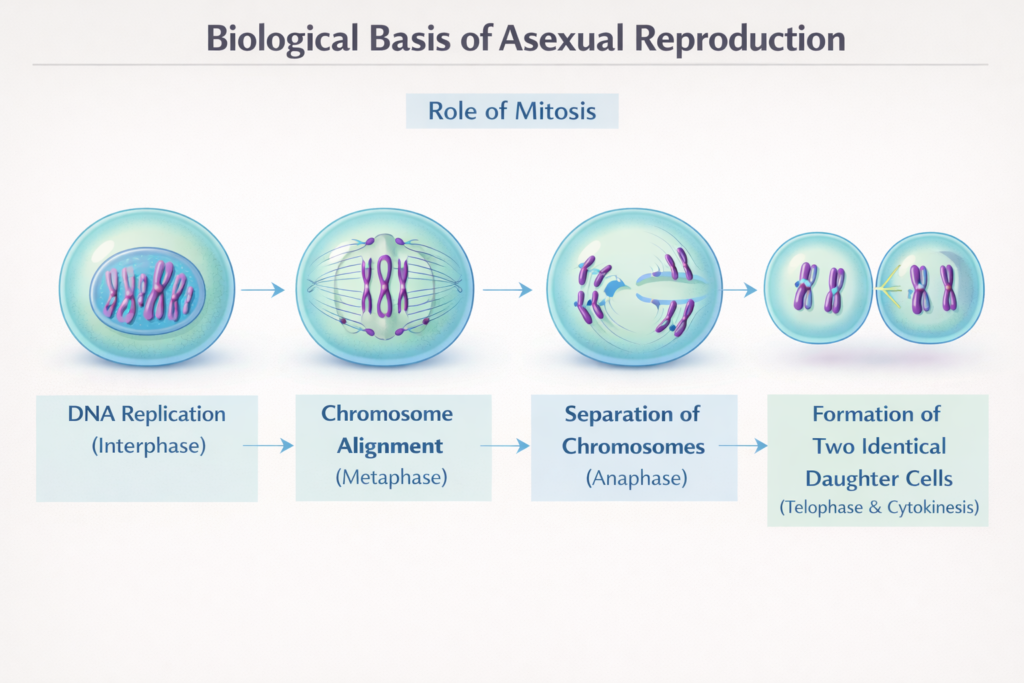
The basic biological process behind asexual reproduction is mitosis.
Steps of Mitosis in Asexual Reproduction
- DNA replication
- Chromosome alignment
- Separation of chromosomes
- Formation of two identical cells
Because mitosis produces identical cells, the offspring formed through asexual reproduction are genetically the same as the parent.
Types of Asexual Reproduction
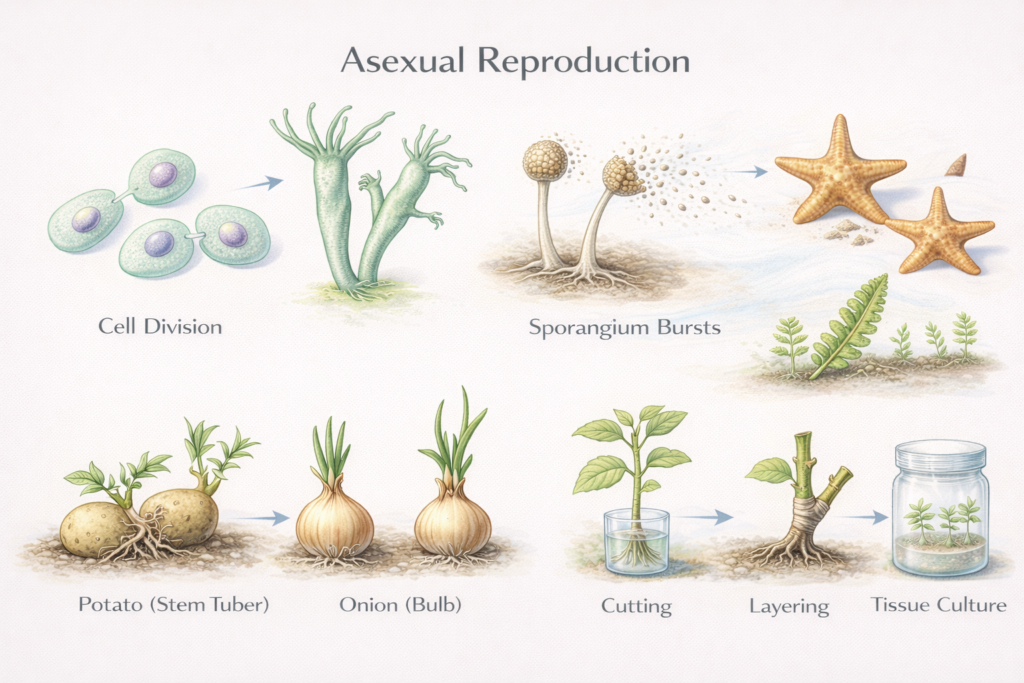
There are seven major types of asexual reproduction found in living organisms.
1. Binary Fission
Definition
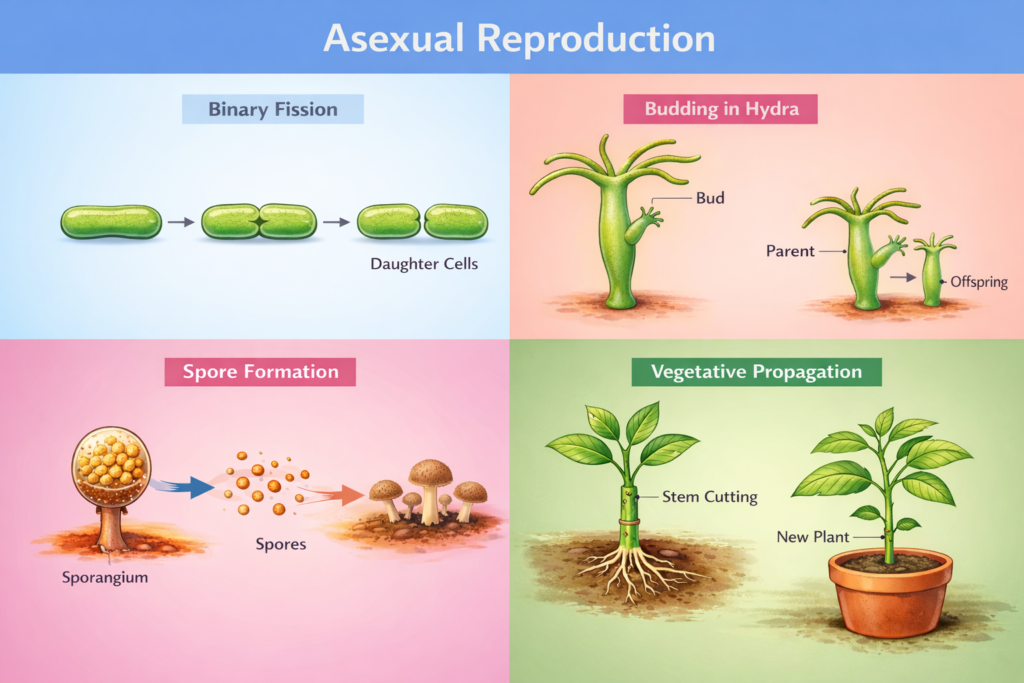
Binary fission is a process where one unicellular organism divides into two identical daughter cells.
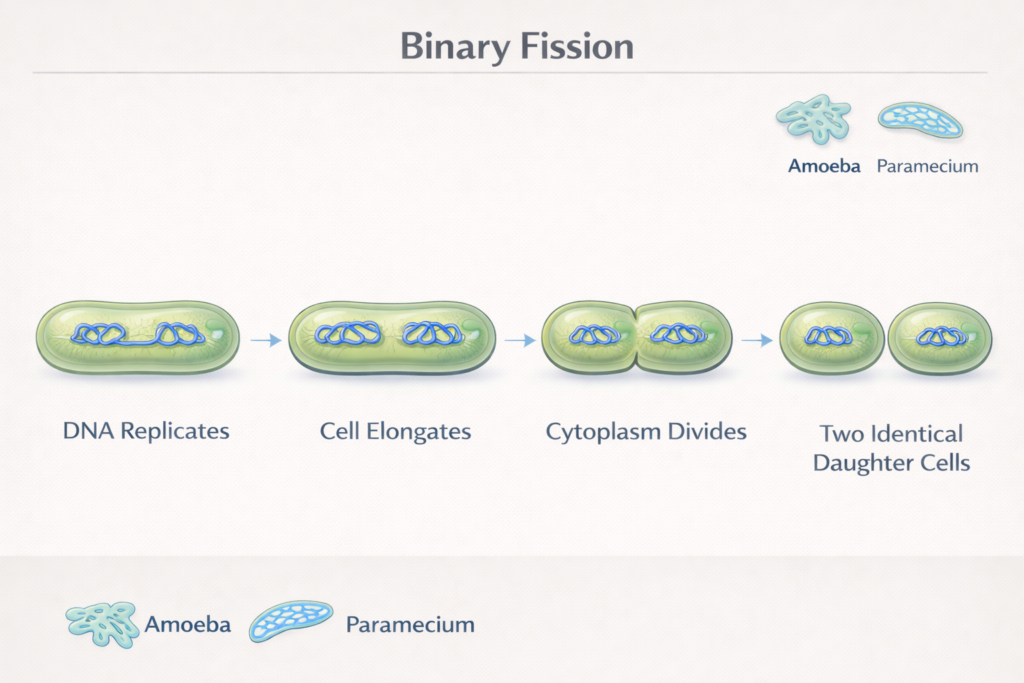
Organisms Showing Binary Fission
- Bacteria
- Amoeba
- Paramecium
Step-by-Step Process
- DNA replicates
- Cell elongates
- Cytoplasm divides
- Two identical cells are formed
Diagram Explained in Text
Imagine a single bacterial cell splitting in the middle, forming two equal halves, each becoming a new organism.
Importance
- Very rapid reproduction
- Helps bacteria multiply quickly
2. Multiple Fission
Definition
Multiple fission is a type of asexual reproduction where one parent cell divides into many daughter cells at once.
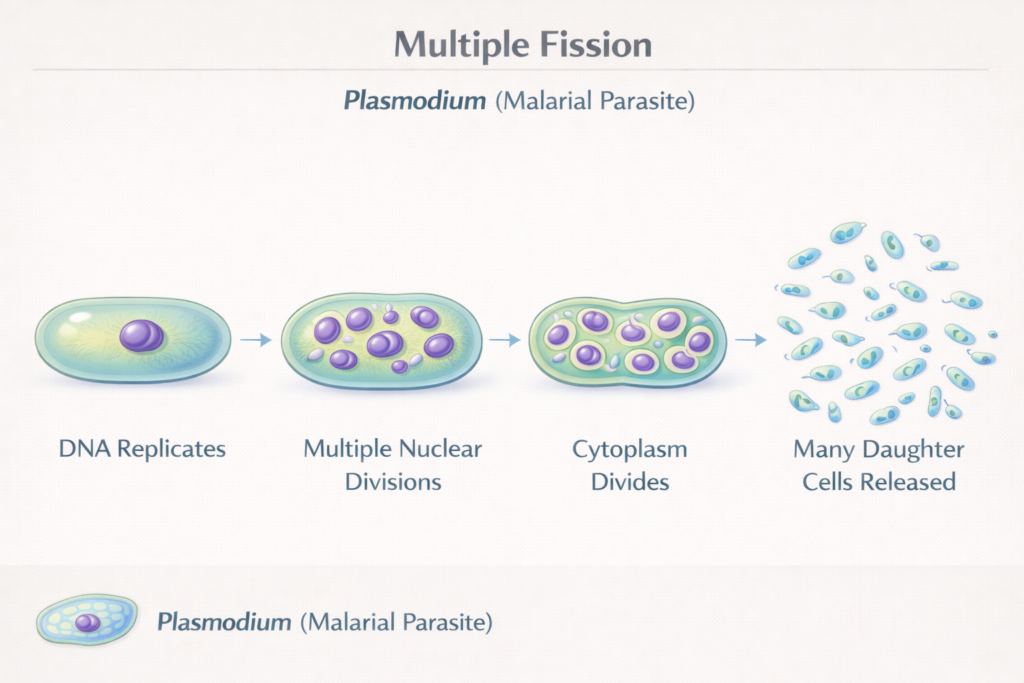
Example
- Plasmodium (malarial parasite)
Steps
- Nucleus divides multiple times
- Cytoplasm divides around each nucleus
- Many offspring are released
Biological Significance
- Helps parasites survive inside hosts
- Causes rapid spread of diseases like malaria
3. Budding
Definition
Budding is a process in which a small outgrowth (bud) forms on the parent body and later separates.
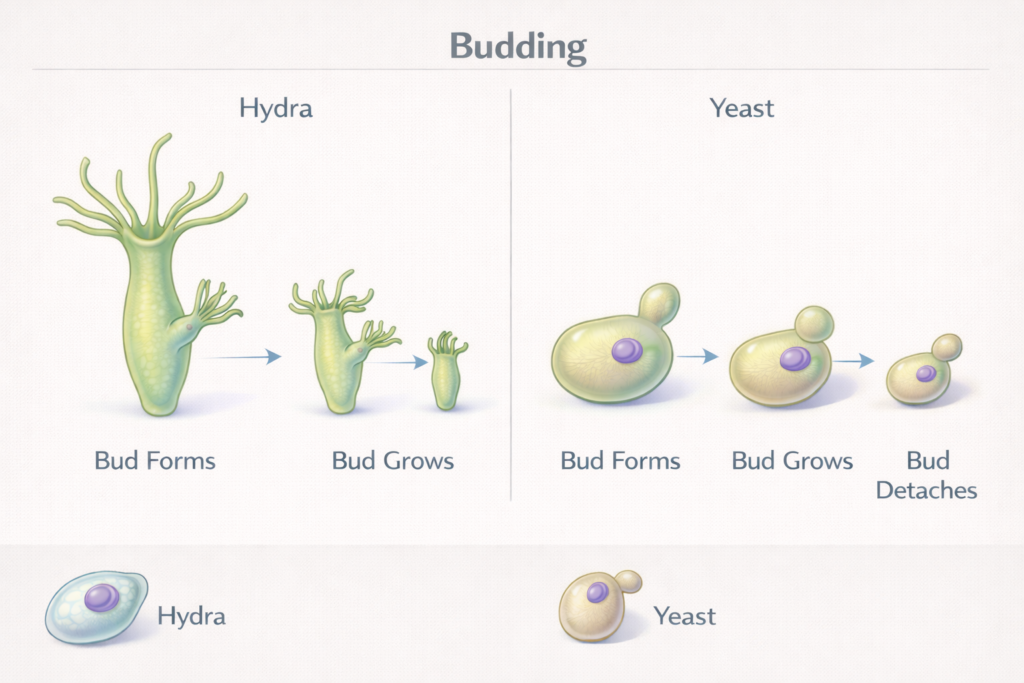
Examples
- Hydra
- Yeast
Step-by-Step Explanation
- Cell division occurs at one point
- Bud grows while attached to parent
- Bud detaches and becomes independent
Diagram Explained
Think of a small branch growing from a tree trunk, which later falls and grows into a new tree.
4. Fragmentation
Definition
Fragmentation is a form of asexual reproduction where the parent body breaks into fragments, and each fragment develops into a new organism.
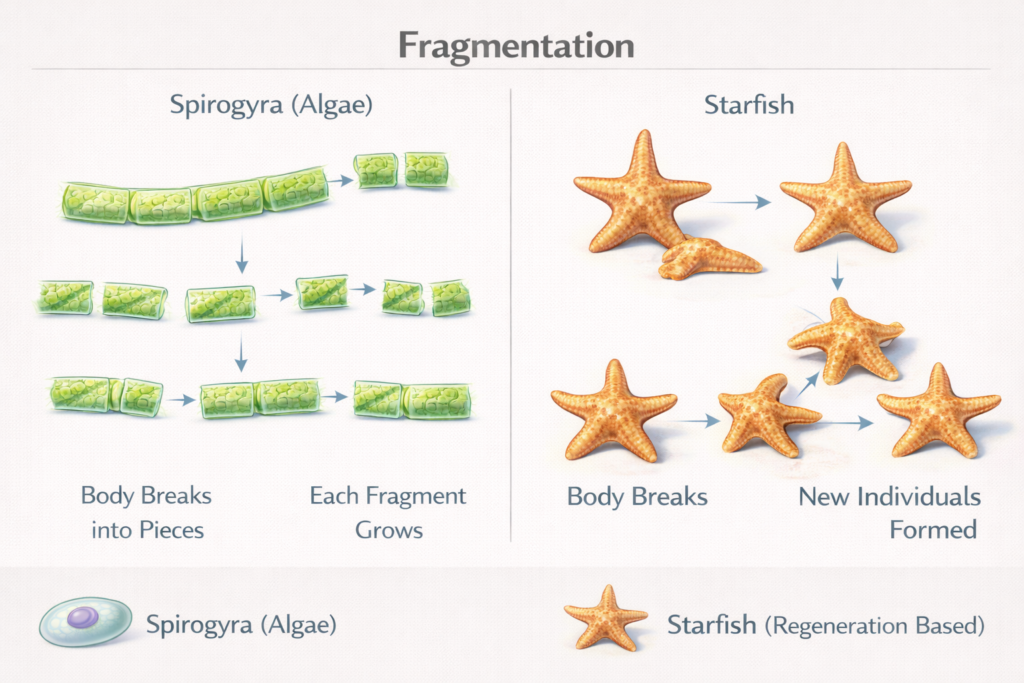
Examples
- Spirogyra (algae)
- Starfish (regeneration based)
Steps
- Body breaks into pieces
- Each fragment grows by mitosis
- New individual is formed
5. Regeneration
Definition
Regeneration is the ability of an organism to regrow lost body parts, and sometimes form a whole new organism.
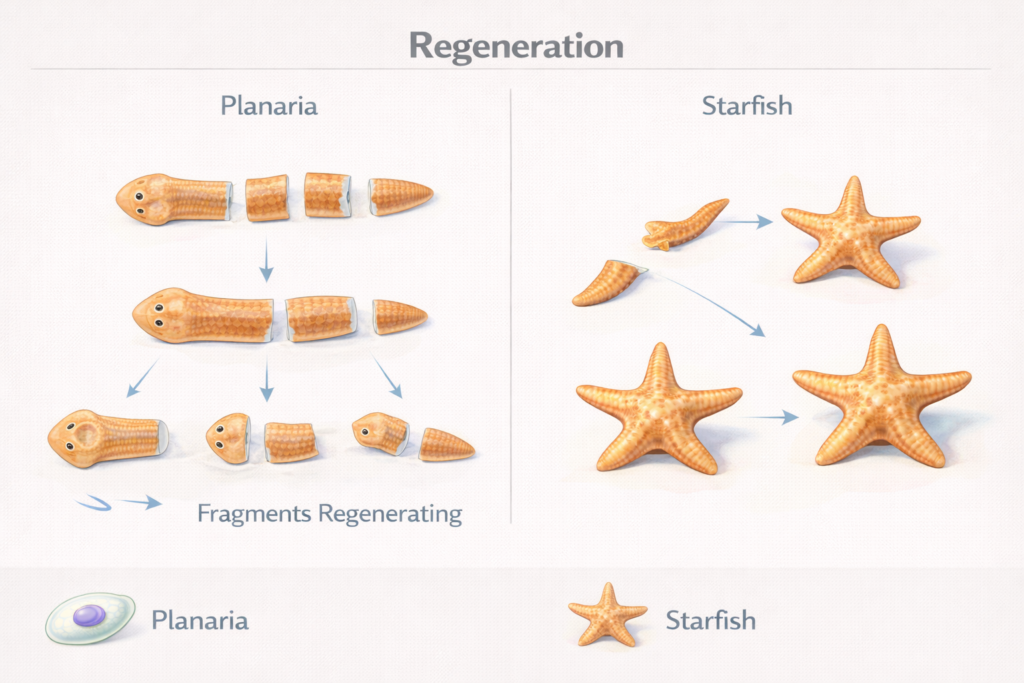
Examples
- Planaria
- Starfish
Biological Importance
- Helps organisms recover from injury
- Used in medical research
6. Spore Formation
Definition
Spore formation involves the production of spores, which are tiny, thick-walled reproductive units.
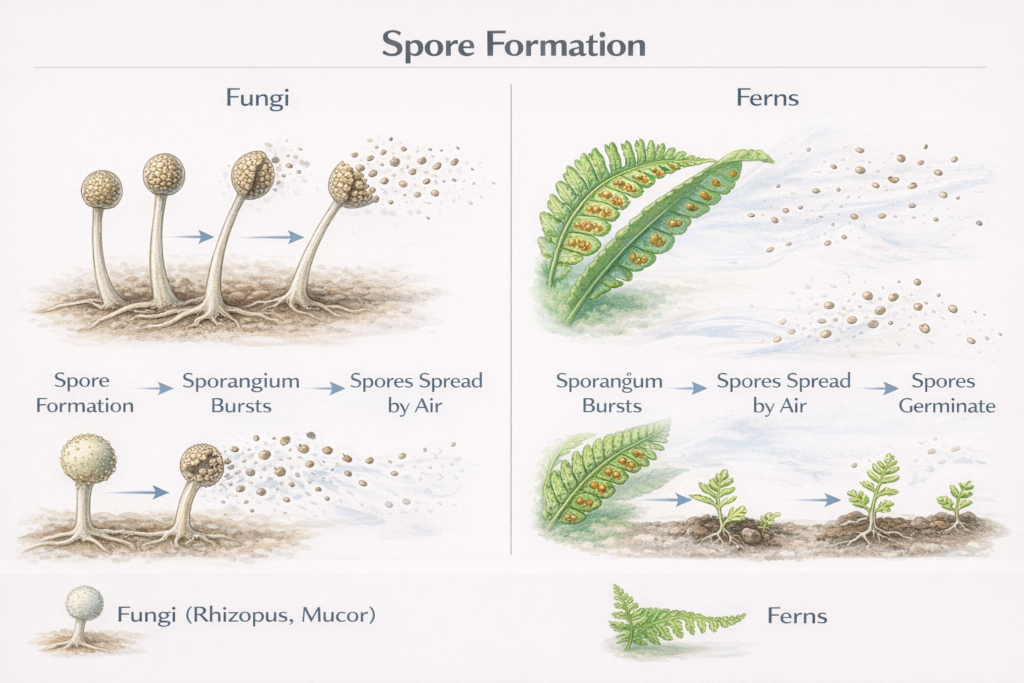
Examples
- Fungi (Rhizopus, Mucor)
- Ferns
Steps
- Spores form inside sporangia
- Sporangia burst
- Spores spread by air
- Spores germinate in favorable conditions
Importance
- Survival in harsh conditions
- Wide dispersal
7. Vegetative Propagation (in Plants)
Definition
Vegetative propagation is a type of asexual reproduction in plants where new plants grow from vegetative parts like roots, stems, or leaves.
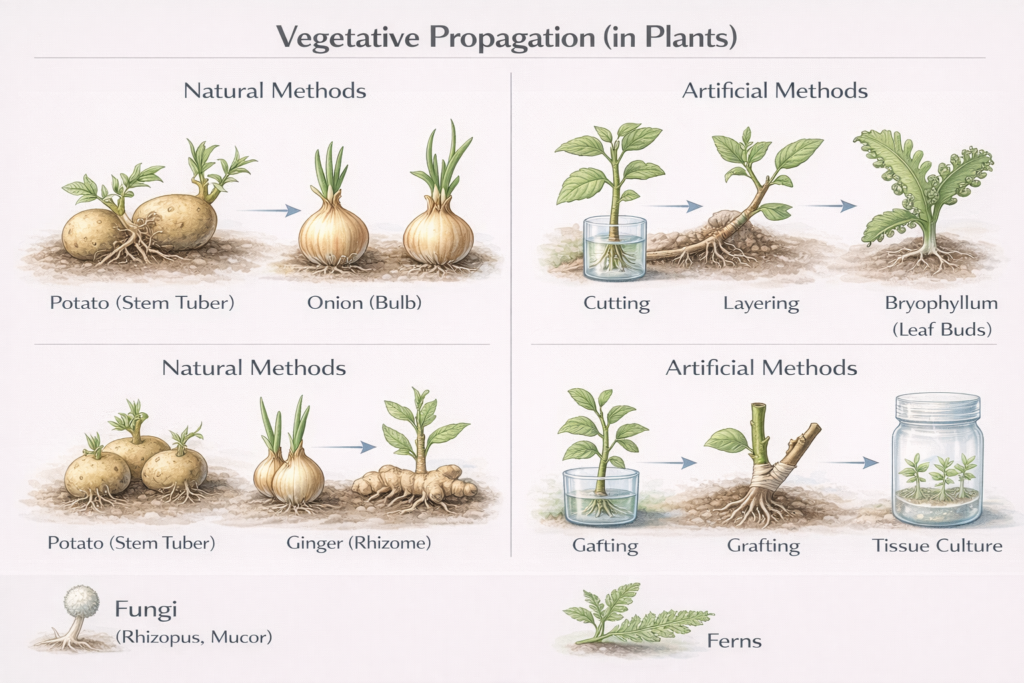
Natural Methods
- Potato (stem tuber)
- Onion (bulb)
- Ginger (rhizome)
- Bryophyllum (leaf buds)
Artificial Methods
- Cutting
- Layering
- Grafting
- Tissue culture
Importance in Agriculture
- Faster crop production
- Maintains desirable traits
Importance of Asexual Reproduction
Asexual reproduction plays a major role in survival and evolution.
Advantages
- Rapid population growth
- No need for a mate
- Energy-efficient
- Useful in stable environments
Limitations
- No genetic variation
- Vulnerable to diseases
- Poor adaptability to changing environments
Asexual vs Sexual Reproduction (Brief Comparison)
| Feature | Asexual Reproduction | Sexual Reproduction |
|---|---|---|
| Parents | One | Two |
| Gametes | Absent | Present |
| Variation | Very low | High |
| Speed | Fast | Slow |
Common Mistakes and Misconceptions
- Asexual reproduction does NOT involve fertilization
- Regeneration is not always reproduction
- Binary fission and mitosis are not the same
- All offspring are clones, not siblings
- Plants also show asexual reproduction
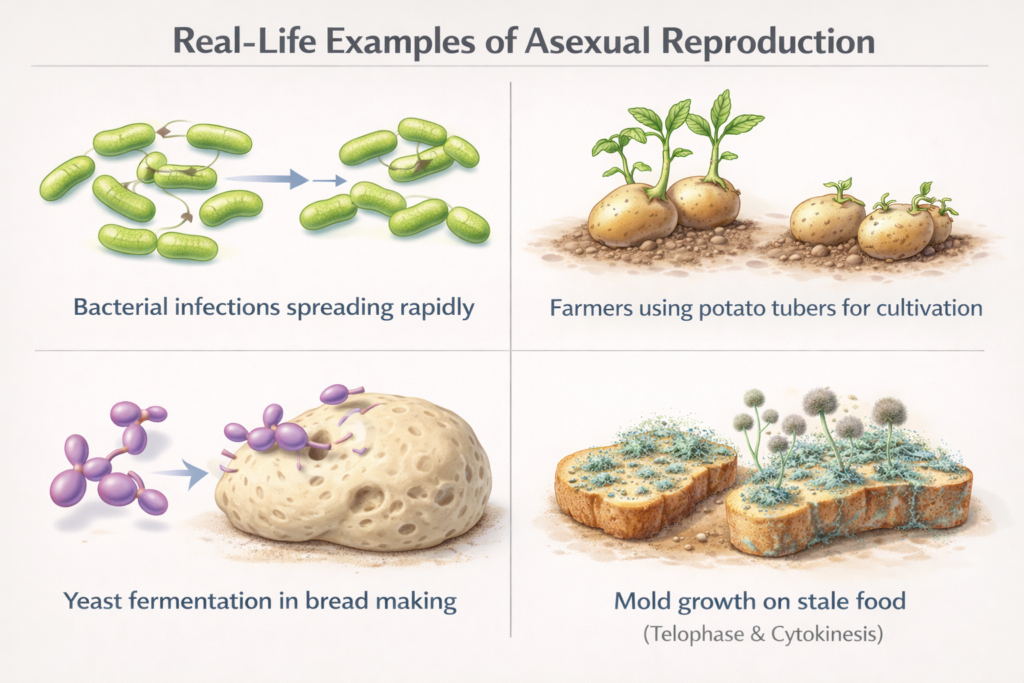
Real-Life Examples of Asexual Reproduction
- Bacterial infections spreading rapidly
- Farmers using potato tubers for cultivation
- Yeast fermentation in bread making
- Mold growth on stale food
Exam-Oriented Notes
- Definition questions are frequently asked
- Diagrams of binary fission and budding are important
- Examples must be specific
- Difference questions are common in exams
- Vegetative propagation has high weightage
Practice Questions (With Answers)
Q1. Define asexual reproduction.
Answer: Asexual reproduction is the formation of offspring from a single parent without fertilization.
Q2. Name two organisms showing budding.
Answer: Hydra and yeast
Q3. Which type of reproduction occurs in Plasmodium?
Answer: Multiple fission
Q4. What is vegetative propagation?
Answer: Formation of new plants from vegetative parts like roots, stems, or leaves.
Q5. Name one advantage of asexual reproduction.
Answer: Rapid reproduction
Summary for Quick Revision
- Asexual reproduction involves one parent
- No gametes or fertilization
- Produces genetically identical offspring
- Seven main types exist
- Important in plants, microbes, and simple animals
- Fast but lacks variation
Conclusion
Asexual reproduction is a fundamental biological process that allows organisms to survive, multiply rapidly, and maintain stability in favorable environments. Understanding its mechanisms, types, and significance is essential for mastering biology concepts and scoring well in examinations.
Frequently Asked Questions (FAQs)
1. Is asexual reproduction found in humans?
No, humans reproduce only sexually.
2. Why is genetic variation absent in asexual reproduction?
Because there is no fusion of gametes.
3. Which organisms mostly use asexual reproduction?
Bacteria, fungi, plants, and simple animals.
4. Can plants reproduce both ways?
Yes, plants can reproduce sexually and asexually.
5. Which is faster: sexual or asexual reproduction?
Asexual reproduction is faster.
6. Are clones harmful?
No, but they are less adaptable.